The Ministry of Science presented its year-end report, which contains some advances in astronomy and, at the same time, in an international report the country ranks 31st among the 40 nations with the best scientific development.
On December 20, the Minister of Science, Technology and Productive Innovation, Dr. Lino Barañao, presented the 2012 management report at the Scientific Technological Pole.
In his presentation, Barañao highlighted: the start-up of the Pole; the increase in the budget, which reached $4,117,200,000 for 2013; the number of researchers at the National Scientific and Technical Research Council (CONICET), which in 2012 reached 7,485 and whose salaries averaged $17,047.19; and the number of fellows, 9,076, whose stipend averaged $6,828.49. Furthermore, the number of repatriated scientists rose to 946.
On the website of the ministry, there is a list of the most outstanding events, according to the ministry itself, but the full report (pdf) is also available as well as an interactive summary (flash format).
From the full report, I think it's worth highlighting, for astronomy:
Within the framework of the Secretariat of Scientific and Technological Articulation:
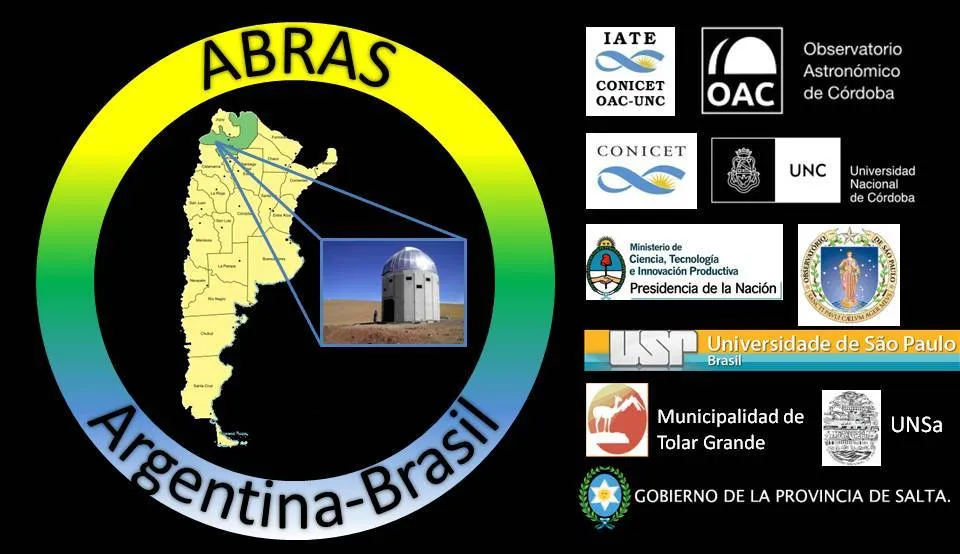
Execution of the Argentine Brazilian Astronomical Center Project (ABRAS) within the Advisory Commission for Large Projects in Astronomy and Space Sciences.
Through Resolution No. 619/12, $150,000 were transferred to the Institute of Theoretical and Experimental Astronomy for the execution of the ABRAS project. (1)
¬ Linked to the CICyT, the Secretariat held monthly meetings, in one of which it signed the Deep Space 3 (DS3) Agreement between the National Commission for Space Activities (CONAE), the National Atomic Energy Commission (CNEA) and CONICET for the use time of the radio astronomy antenna. It also presented the portal of the Large Instruments and Databases Program and signed the commitment agreements recommended by the Advisory Council of the Electronic Library of Science and Technology for a better use of that facility. Along the same lines, it processed the request for the incorporation of the Scientific Technological Council of Defense (COCITDEF) of the Ministry of Defense as a member of CICyT (resolution pending) and signed the "Document I of the Advisory Commission on Evaluation of Scientific and Technological Personnel"
Regarding the GEMINI Project, the National Time Committee held 2 meetings to evaluate the observation proposals submitted for the Gemini telescopes for semesters 2012A and 2012B. Likewise, it signed the Agreement with the National University of San Juan (UNaSJ) for the use of the bHROS instrument to be installed at the Institute of Astronomical, Earth and Space Sciences (ICATE).
National Scientific and Technical Research Council (CONICET):
Regarding cooperation and exchange, 56 agreements were signed with national and international institutions; 103 main meetings were funded and 23 binding meetings approved under the call for Scientific and Technological Meetings 2012. 117 main meetings and 30 binding meetings are under evaluation. 11 international cooperation agreements were signed with different institutions and 102 projects developed with 11 countries, for $2,847,000. In addition, CONICET funded scientific visits of Argentine researchers to counterpart institutions for $170,300 and issued calls with 14 research institutions from 12 countries for research projects and scientific visits with 2013-14 execution. It supported the National Networks for the Study and Control of Desertification and for the Study of the Upper Atmosphere; the Networks for the Conservation of Patagonian Fluvial Ecosystems and Mariculture; the New Astronomical Virtual Observatory; the Interactive Platform for Social Science Research; the Research Program in the Argentine Sea.
Jorge Sahade passed away
It was on December 18. At the age of 97, Dr. Sahade was a reference in Argentine astronomy. He graduated from the University of La Plata. There he was the first dean of the Faculty of Exact Sciences and a professor at the Faculty of Astronomical and Geophysical Sciences at the same university.
He was also the first director of the Institute of Astronomy and Space Physics IAFE (UBA-CONICET), first president of the National Commission for Space Activities (CONAE), president of the Executive Committee of the International Astronomical Union (IAU) and the Argentine Astronomical Association.
Among other recognitions, he had received the 1983 Konex Award, in the Physics and Astronomy category, and the first telescope of the El Leoncito Astronomical Complex is named after him in honor of his career.
At the beginning of the year, Dr. Gloria Dubner, current president of IAFE, interviewed the prestigious astronomer requested journalist Cecilia Draghi to conduct an interview with Dr. Sahade. The interview, both written and audio, can be seen on the IAFE website.
The latest issue of the IAR Bulletin includes Sahade's CV.
He was, of course, a Senior Researcher at CONICET. At that institution they also mourned the loss of the astronomer.
Argentine Science and the world
The magazine Scientific American, from the Nature group, published the report "State of the World's Science" in its December 7 issue. In Nature, published in October, there is a special titled The New Map of Science.
The report contains a set of articles.
One of them is an interactive with a ranking of the 40 countries with the best scientific development. The article indicates that it is not easy to measure what makes one country better than another in science. But it points out that measuring the number of published papers is a good way, although it doesn't say much about whether a nation is taking advantage of those published ideas. Therefore, other metrics play their role. Patents give a clue as to how well a country is exploiting its ideas... for commercial purposes. What a nation spends on Research and Development (R&D) captures what universities, states and industry do. The number of students in science and technology is a key metric, but little data is available.
The ranking in that interactive, it is indicated, is based on preliminary data from Digital Science, a company of the Nature Group, on a database of papers published in the most important journals in the world, organized by country of origin.
In summary: everything is important, but the score, that is, the ranking score is based, exclusively, on the number of publications in specialized journals.
The other data, if available for each country, should also be taken into account, but they do not add to or subtract from the rating in this ranking (they are shown, if available).
In this framework, first place goes to...the United States. Followed by Germany, China, Japan, England, France, Canada, Italy, Spain, and Korea.
The first Latin American country to appear is Brazil, in 24th place. Argentina is second, in 31st place.
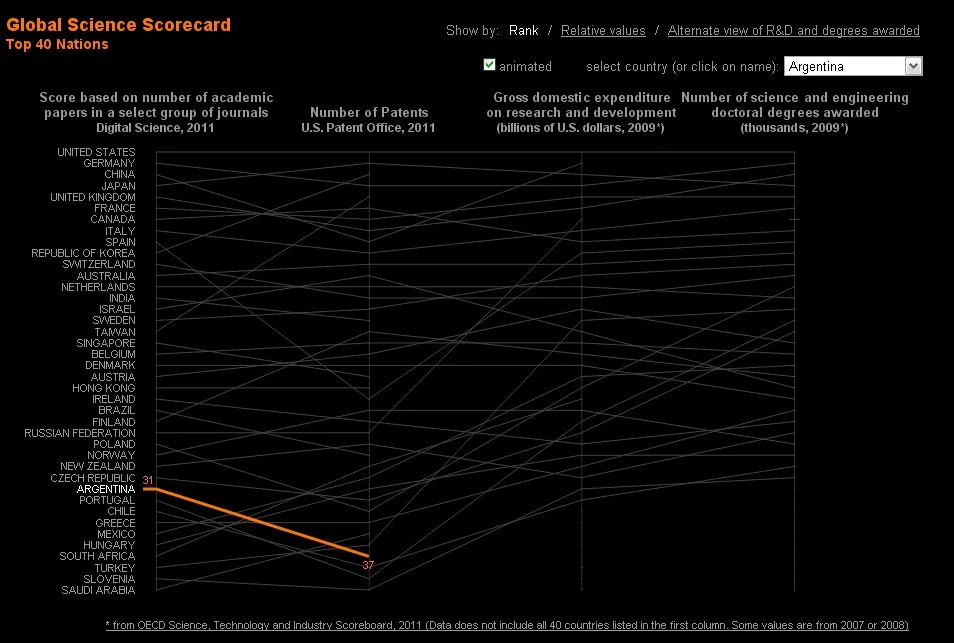
In the interactive chart, then, the score based on the number of papers published in journals selected by Digital Science in 2011 is shown. Then the number of patents, according to the U.S. Office 2011. Gross domestic expenditure on R&D, billions of dollars, 2009. And finally the number of doctorates in science and engineering in thousands, 2009.
And yet, scientists move
Another of the articles addresses scientific mobility to account for how many scientists from one country work elsewhere.
That data comes from the GlobSci survey.
With an interactive map, which has two parts, it shows that in Spain 93% of scientists in that country are local and 7% are foreign. And that 13% of foreign scientists are Argentine. The majority of Spanish researchers (92%) work in their country and only the rest emigrate, mainly to the United States.
In Brazil, the data are similar to Spain, but among foreigners Argentines are 16%.
Argentina does not appear on that map.
These mobility percentages are better visualized in the following chart:
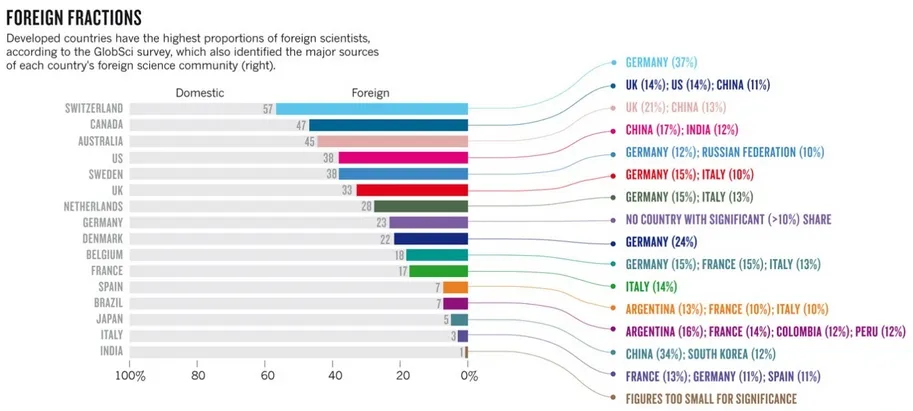
Here we can see that 57% of researchers in Switzerland are foreign, of which 37% are German.
In the United States, 38% of scientists come from other countries, the majority (17%) from China.
In the article there are other interesting data on mobility.
Other articles address the issue of globalization through scientific collaboration, which appears as an essential topic. For example, the VLA radio telescope built in 1980 produced data used by more than 2,500 scientists worldwide for more than 13,000 projects.
Other examples are also astronomical (from the scientific point of view, as well as the huge numbers): The ALMA Correlator, the Large Synoptic Survey Telescope. Of course CERN.
The economics of science
In another article of the report it is indicated that salary inequality allows for better science, by showing the salary gap in faculty positions in various areas, using the Gini coefficient. A value of zero implies there is no inequality, while a value of 1 indicates maximum inequality. The chart shows this gap taking the years 1973, 1985, 1995, and 2006 for biological sciences, mathematics and computing, engineering, and physics.
Furthermore, it distinguishes, to account for such a gap, between assistant professor, associate professor, and full professor.
The article summarizes that:
The United States leads the world in science in almost all measurements. The resources dedicated to university research have much to do with that success.
But the ability to reward high productivity with high salaries is key to the success of research centers and in retaining the best talent.
Europe, in contrast, treats its professors as public servants, with salaries based on years of experience, instead of productivity.
In Saudi Arabia they are trying to improve their reputation by lavishing high salaries on visiting scientists, with relative inequality.
But, as one of the article's commentators points out, the "winner takes all" logic by which productivity is rewarded, largely as indicated at the beginning, based on papers, is probably not the appropriate one. The commentator mentions the book "The Spirit Level," by Richard Wilkinson and Kate Pickett. In Spanish it has been published as Desigualdad: Un análisis de la (in)felicidad colectiva. (2)
To conclude, the report also includes the opinion of scientists from eight countries on how to boost research in their nations in the next decade. Among the eight, there is a Spaniard and a Brazilian.
Conclusion
Recently I received the DVD Europe to the stars, made by ESO on the occasion of its 50th anniversary. The audiovisual work accounts for the European effort to take a position in the Southern Hemisphere, in Chile, to do astronomy at different wavelengths, with the most advanced instruments in the world. Honestly, it is impossible not to be left with your mouth open.
From that perspective, accounting for projects like LLAMA, ABRAS, NOVA, in our country, is like comparing Phobos to the Sun in size.
That view, if it were exclusive or excluding, would also be stupid. Without losing sight of the fact that we are light-years away from the so-called First World in multiple aspects, and without also getting on an epic, disproportionate triumphalism, I believe our country has advanced a lot in the last decade, in relation to where we were in 2001.
Undoubtedly, criticisms can be made about the current state of science in our country. Science goes hand in hand with politics and often there is cronyism, personal convenience, and various types of bias. I don't think we should be content with the fact that in the past the same thing happened and resign ourselves to the future being the same. It is true that if those biases exist it is difficult to find someone who points them out.
But having said that, we must also weigh the advances in infrastructure, human resources, budget, criteria for economic distribution, etc.
That in our country there are astronomical projects like those mentioned, which involve collaboration with Brazil, detection of different wavelengths (which expands scientific possibilities) and availability of better equipment is not little.
Just as it is annoying to compare ESO's infrastructure in Chile with astronomical instrumentation in Argentina, due to its great difference, it is also so when drawing differences in matters of public communication of astronomy.
ESO, NASA, ESA produce a quantity of press releases, give conferences, produce digital, audiovisual, and printed materials with an impressive deployment. In our country we are parsecs away, although CONAE, CONICET, and MinCyt have improved a lot. Recently, for example, I was able to attend two talks by ESA scientists given at UCA (Puerto Madero), one day before the inauguration of DSA 3, thanks to an invitation from CONAE.
Improvement in communication is not achieved solely with economic resources. There are a series of scruples to overcome, prejudices about the popularization of astronomy and the intrusion of "strangers".
The forecasts for Argentine science and in particular for astronomy are very good. Continuity will be necessary, I don't mean of people, but of policies, that is, ideas, projects, models of the country in scientific matters. But about that, it seems, no one speaks. Nor asks.
Sources and related links
- The Ministry of Science presented its year-end report
- (1) Argentina will have its fourth optical research astronomical observatory
- (2)BARTOLL, Xavier and MALMUSI, Davide. Desigualdad: Un análisis de la (in)felicidad colectiva. Gac Sanit [online]. 2011, vol.25, n.4 [cited 2012-12-28], pp. 348-348 . Available at: http://scielo.isciii.es/scielo.php?script=sci_arttext&pid=S0213-91112011000400019&lng=es&nrm=iso. ISSN 0213-9111.
- Global mobility: Science on the move, Nature 490, 326–329 (18 October 2012) DOI:10.1038/490326a
About the images
- Image Ranking of "The World's Best Countries in Science", by Jan Willem Tulp in Scientific American.
- Graphic Foreing Fractions, from Nature 490, 326–329 (18 October 2012).