A collection of links to music, images and videos relating art and science. Today: Images of Baade's Window; A Sun Pillar; NGC 1097, the dancer; The solitude of ALMA. Music: Fondella: Unknown Cove. Video: Björk: Biophilia in Argentina.

Images of the decade
Baade's "Window"
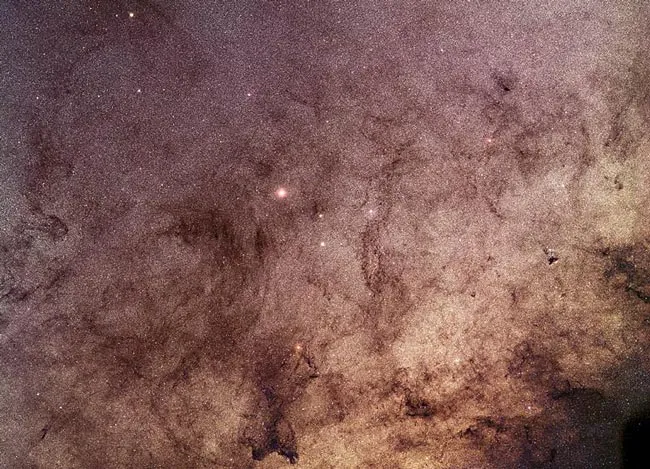
Billions of stars light the path that leads to the center of our galaxy. But the galactic center is obscured by dust clouds at visible wavelengths. In the late 1940s, astronomer Walter Baade, working at the Mount Wilson Observatory in California, identified a relatively clear region, without much dust, about four degrees from the galactic center. It was there, in that "window" of about 30 arcminutes around the globular cluster NGC 6522, that he was able to determine the first reliable distance to the center of the Milky Way. Modern measurements calculate that it lies about 25,000 light-years away, a bit more than calculated by Baade, which was published in 1946.
Credits & Copyright: David Malin (AAO),ROE,UKS Telescope
It was the Astronomy Picture of the Day (APOD) on December 23, 2002.
And at Observatorio.
On the Australian Astronomical Observatory AAO page you can see another record of the cluster and the "window".
There are also more images of the area, with annotations, on David Malin's page.
A Sun Pillar
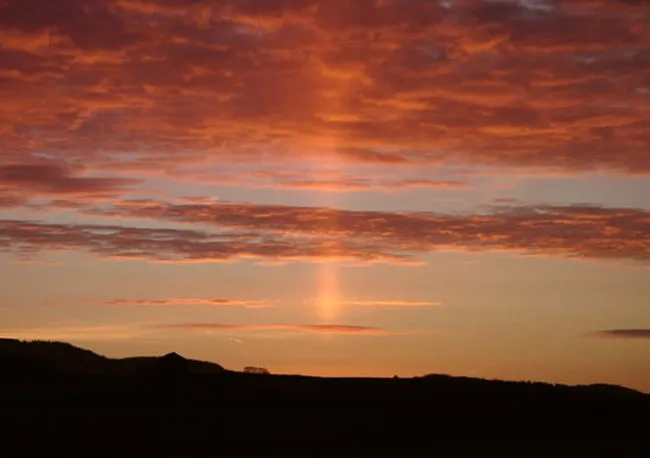
Have you ever seen a Sun pillar? When the air is cold and the Sun is rising or setting, ice crystals in the atmosphere reflect sunlight and create an unusual column of light. These hexagonal crystals form in high clouds and can reflect not only direct sunlight, but also light from our star reflected by the Moon. It even happens with light from the Earth's surface, giving the sensation of auroras near the ground, very peculiar.
There are some images of Sun pillars that are worthy of admiration and are used as wallpapers.
Credits & Copyright: Dave Liquorice
It was the Astronomy Picture of the Day (APOD) on December 30, 2002.
And at Observatorio.
Images of the week
NGC 1097, the dancer
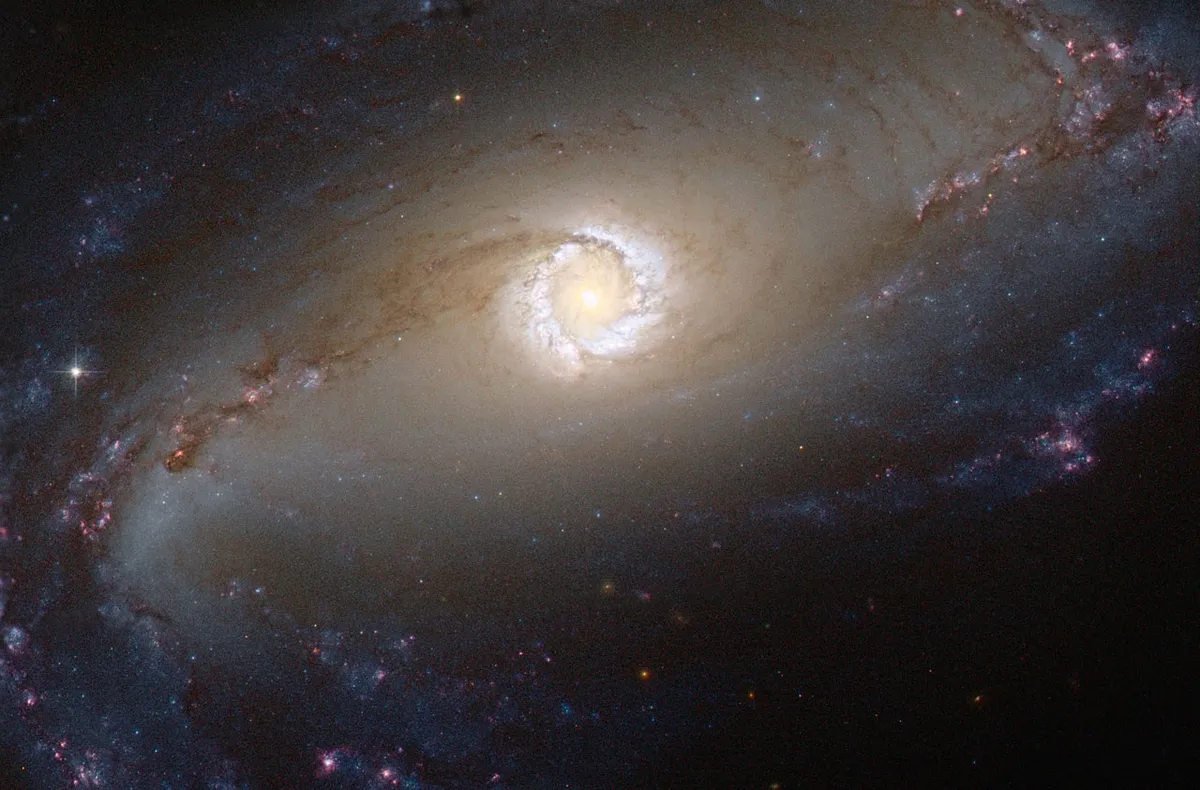
With the Hubble telescope, astronomers have captured this spectacular image of the barred spiral galaxy NGC 1097. The galaxy, which lies 45 million light-years away in Fornax, is a Seyfert type, meaning it has an active nucleus with a supermassive black hole. On its journey through the cosmos, it is accompanied by two small companions: NGC 1097A, an elliptical orbiting 42,000 light-years from the center of the first; and NGC 1097B, a small dwarf. The companions are not seen in this photograph, but astronomers think the first and the second have had interactions in the past, that is, they have danced the dance of the stars and the dance of space, paraphrasing the poem The Dancer, by Kahlil Gibran.
It was the Hubble Space Telescope Picture of the Week.
Credits: ESA/Hubble & NASA// Acknowledgement: E. Sturdivant
The solitude of ALMA
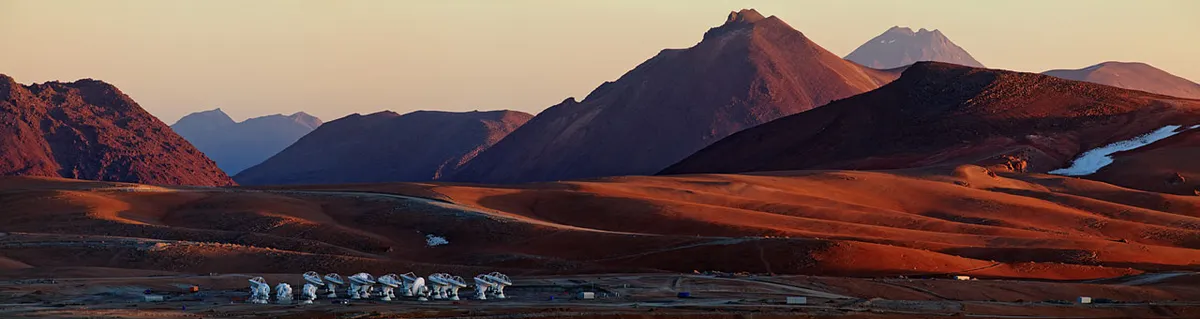
This panoramic view of the Chajnantor Plateau shows the location of the ALMA array (the Atacama Large Millimeter/submillimeter Array), taken near the peak of Cerro Chico. Babak Tafreshi, an ESO Photo Ambassador, has managed to capture the feeling of solitude experienced at this site, 5,000 meters above sea level in the Chilean Andes. The lights and shadows paint the landscape, emphasizing the aspect of this terrain, almost otherworldly. In the background of the image, the cluster of ALMA antennas looks like a strange crowd of robotic visitors on the plain. When the telescope is completed in 2013, the array will consist of a total of 66 antennas operating together.
More, in the ESO Picture of the Week.
Credit: ESO/B. Tafreshi (twanight.org)
Space Music
Fondella: Unknown Cove
This English artist, from Hastings, has an album titled "Unknown Cove" which includes a track called Sun Pillar. Also, it contains the song Alpheratz and another whose translation is "Feldepasto".
Animated Science
Björk: Biophilia, between art and science
"Biophilia" –which means love for life– the latest multimedia production by artist Björk, unfolds the close relationship between science, music and new technologies across different media and platforms. It is an expanded narrative on a vinyl record, a CD, a series of music videos, a set of applications for iPad and iPhone, new instruments specially designed to create unique sounds, live presentations and an Educational Program for children called Biophilia Residency. One of the Biophilia workshops for kids was held in Buenos Aires in April 2012, when Björk visited Argentina.
More info on the Educ.ar site
To access previous editions of this section, consult the Multimedia Selection Series. The series attempts to show that the immensity of the universe can be perceived in different ways. I choose some images from a decade ago -so they don't fall into oblivion- and from the current week that ends, as well as sounds/music and videos that are artistic forms of expression with content related to astronomy and related sciences. I am also collecting these materials on the Pinterest account