Last year, two alleged cases of plagiarism were considered within the Argentine Association of Astronomy. Here is the first one.
The following note has an introduction to the topic, especially written for those who have no idea what plagiarism is, the similarities and differences with what happens in art or journalism, and the "gray areas". See Astronomical déjà vu.
On March 27, 2011, the newspaper La Capital of Rosario reported the news [1] and later other media redistributed the alleged facts: the Argentine astronomer, Dr. Roberto Aquilano, would have been reported for plagiarism by an editor of the English journal Astroparticle Physics.
At that time, considering that Dr. Aquilano is a recognized astronomer and that he is also a public official -Undersecretary of Scientific and Technological Promotion of the province of Santa Fe- and given the primary elections that were not far off, one could think of some partisan campaign or incomplete or out-of-context information.
However, what was reported in those media was that the astronomer would have sent a paper to the aforementioned journal in January 2009 as the lead author, followed by other colleagues from Rosario and La Plata. The work would be titled "Self -gravitating objects and Einstein Equation...". Coincidence or not, there is a paper with a similar title in another publication from 2010. [2]
The editor of the publication, Johannes Knapp, believed he detected that the content of the paper had "long fragments of text" copied from a previous, unrelated work, as detailed by the Rosario newspaper. That paper, therefore, was not published. According to reports, Knapp would have sent a note to Aquilano's employers, that is, to CONICET. The astronomer is also a professor at the National University of Rosario.
I have tried to clarify this point, without success. In neither of the two institutions, CONICET and UNR, did I get answers about whether they received that letter or if they initiated any investigation or disciplinary proceedings regarding it. I also cannot find any document issued by these two institutions on the subject.
The astronomer's defense, according to the newspaper La Capital, was that the article was a draft sent by mistake. As is appropriate, from here we have tried to contact Dr. Aquilano so that he can present his view of the facts.
For many, the defense of an error might sound "unbelievable". However, many people (even very capable ones) have at some point sent an email by mistake. If that were the only point, one would have to consider that it could well have been a mistake.
It should be noted that the rest of the authors would have had nothing to do with the matter. Regarding the participation of the astronomer from La Plata (Muzzio), the dean of the Faculty of Astronomy of that university -Dr. Adrián Brunini- consulted Aquilano through a mailing list [3]. On 4/4/2011 Aquilano himself replied that:
I inform you that Dr. Juan Carlos Muzzio has had nothing to do with the problem raised by Dr. Johannes Knapp, Editor of Astroparticle Physics.
Dr. Juan Carlos Muzzio was listed among the co-authors in the draft, since as we have worked together for many years, I intended to include him as well as the others as co-authors, and in the event of actually writing the eventual article and sending it in the future, I would obviously consult with all of them.
The response exonerates Muzzio and indicates that the problem is real and not just a possible partisan-electoral campaign nor mere journalistic "rotten meat", as it was possible to think at the time.
The issue concerned me from the beginning, but given what was mentioned in the introductory note regarding the difficulty in some cases of proving that fragments of text similar to another previous work are effectively "plagiarism" and considering that Dr. Aquilano is a very recognized professional in Argentine astronomy, I demanded prudence from myself.
Aquilano is part of the Rosario Institute of Physics (IFIR) and is a member of the IAU. In November 2011, the Argentine astronomer was awarded the Life Changers Awards 2011 prize in the Civic Leaders category.
For this award, Senator Roxana Itatí Latorre sent a declaration project "expressing recognition to the astronomer Roberto Aquilano from Casilda, Santa Fe, who was distinguished in London by The Life Changers Foundation for his scientific contributions", as indicated in file number 2815/11.
The file also states that: "Already in 1996, the astronomer from Santa Fe had been nominated to receive the Alternative Nobel Peace Prize, due to his contribution in clarifying cases of disappeared persons during the Argentine military dictatorship". The same is indicated on the site of LIADA, the Ibero-American League of Astronomy, of which Aquilano is a member. [4]
I want to make something clear right now. The career and prestige of a researcher must be taken into account so as not to tarnish their image lightly. Although, in reality, that should be done in any case, even for a young student or recent researcher, regardless of the recognitions they have. But having said that, it must also be said that past achievements in scientific, outreach, or social matters say nothing about present or future facts. One cannot blame or exonerate someone solely based on their background.
How to know more about this matter? Well, the note in La Capital mentions that later the editor reviewed Aquilano's history of paper submissions and would have found other works with similar suspicions.
So I went to the journal's site, and using its search engine I found two cases:
RETRACTED: On radial pulsations in relativistic stars
Roberto Aquilano, Astroparticle Physics, Volume 26, Issue 1, August 2006, Pages 64–67 http://dx.doi.org/10.1016/j.astropartphys.2006.05.003
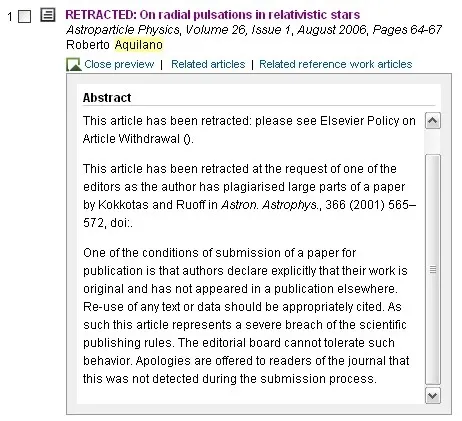
The "Retracted" means "withdrawn". It implies that the article was submitted, published in due course, and later withdrawn by the journal editors. And right there the reason is stated:
Translation: "The article was withdrawn at the request of one of the editors as the author plagiarized large parts of a paper by Kokkotas and Ruoff in Astron. Astrophys. 366 (2011)".
Let it be clear that the statement belongs to the journal editors.
The second case is:
RETRACTED: On the nature of relativistic stars
Astroparticle Physics, Volume 32, Issues 3–4, October–November 2009, Pages 153-159
Silvia Morales, Alejandra Zorzi, Roberto Aquilano http://dx.doi.org/10.1016/j.astropartphys.2009.07.004
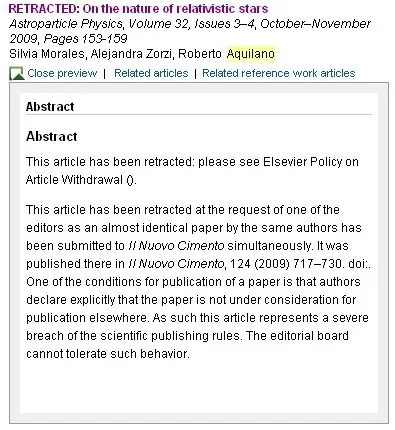
There the editors note: "This article was withdrawn at the request of one of the editors as a nearly identical paper by the same authors has been submitted to Il Nuovo Cimento simultaneously".
In that Italian journal the article is listed as "withdrawn":
Nuovo Cimento B
RETRACTED ARTICLE: view details
Volume 124 Issue 07 pp 717-730
DOI: 10.1393/ncb/i2009-10803-x.
In the details, there, it is indicated, in Spanish: "The attention of the Italian Physical Society has been drawn to the fact that this article should not have been published because it was also published as 'On the nature of relativistic stars' by Silvia Morales, Alejandra Zorzi, Roberto Aquilano, in Astroparticle Physics, vol. 32, 2009, 153. Consequently, this paper has been withdrawn by Il Nuovo Cimento B and should not be cited or referred to in the future".
In both cases, before the articles were withdrawn from Astroparticle Physics there was a "retraction" in each of them.
Note: According to information I was unable to verify, these two papers would have included the reference to Kokkotas's work.
In the first case, Aquilano is the sole author. What the editor of Astroparticle Physics says is that it would have "long fragments of text" from a previous, unrelated paper. That paper is "Radial oscillations of relativistic stars", K. D. Kokkotas and J. Ruoff, A&A 366, 565-572 (2001)
DOI: 10.1051/0004-6361:20000216.
arXiv:gr-qc/0011093v1.
Among these cases the only "victims" would be Kokkotas and Ruoff. I contacted the Greek astronomer, lead author of the referenced work, who told me that the matter is closed from a scientific point of view ("From scientific point of view the issue is over").
Repercussions in Argentina
As I mentioned, I do not know if UNR or if CONICET evaluated this data. But I have become aware of the actions taken by the Asociación Argentina de Astronomía (AAA).
On its website they have a section for Minutes, where the minutes of the previous Board of Directors (CD) before the current one were published, in which the issue was addressed.
Important note: the minutes I am going to refer to were online on the AAA website. They are not secret documents and I was able to download them without invading anyone's privacy. Currently, if one goes to the site, to the Minutes section, only one from 2011 will be found and the rest from previous years and the other ones from 2011 (which were there a few months ago) have "disappeared".
However, if one accesses the 2011 minute that is currently listed, a link for its download will be displayed. The link allows us to glimpse the directory structure of the site and realize that the minutes are in a directory with that name.
If we copy that link, paste it into the browser's address bar and remove the document name up to the backslash, we will access the complete Minutes directory, which is indeed accessible (as of 02-21-2012 at 16:47 inclusive).
There we will be able to see the existing minutes, which I will refer to next. I indicate this so that the source of information for the following data is known. [5]
I will refer to the minutes by their name which includes the date of the Board of Directors meetings.
In AAA_15abril2011 the Aquilano issue is alluded to.
There it is indicated:
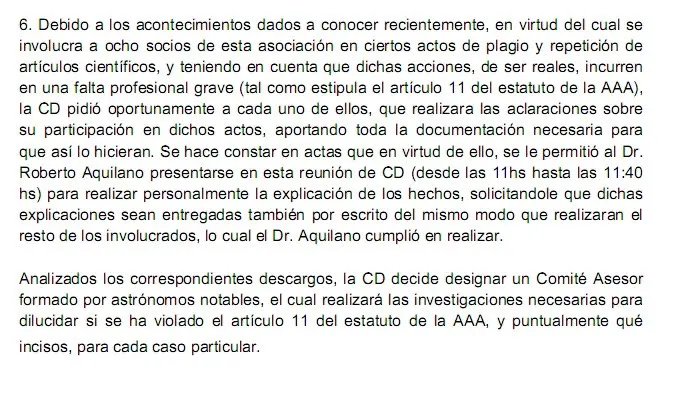
It gives the impression (and as will be seen later it is not just an impression) that the AAA learned about the matter from the newspaper La Capital.
In AAA_1julio2011 it is indicated:
"(...) that Dr. Roberto Aquilano has committed a serious professional misconduct, contemplated in Article 11 subsection c) of the Statute of the Asociación Argentina de Astronomía, for which his expulsion is decided. [The bold is mine]
- that there are no grounds to consider that the rest of those involved..."
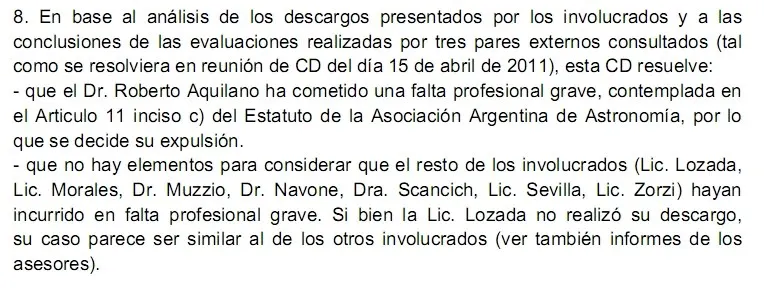
The content of the Statute of the Asociación Argentina de Astronomía can be found on the AAA website.
Then, in AAA_24agosto2011 it is said:
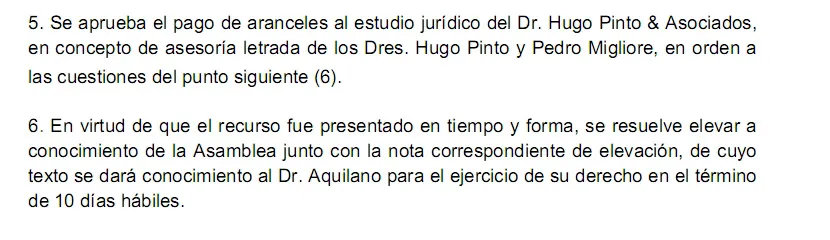
Later, in AAA_2011 (it is from October 5) the issue of reviewing the actions of that CD (previous to the current one) is discussed extensively. That meeting took place in a tense atmosphere. The CD does not usually address these topics and, as if that were not enough, Dr. Aquilano had hinted at initiating legal action against the CD members. Through a lawyer, Aquilano demanded the removal of all information about the case that had been uploaded to the network and the CD is demanded to the reconsideration appeal, which was indeed what they dealt with in the August meeting, but also requesting the annulment of the CD's resolution.
Aquilano preferred not to be present at this meeting.
There, the astronomer's defense statement was read out, which was not distributed among the members not present, but only to those who were there, at the request of Aquilano's lawyer.
According to the Minutes posted on the AAA website, there was great agreement among those present that what was previously decided was correct, but also some members wondered if the procedure followed was appropriate. Finally, what was voted on was whether "the Assembly acknowledges that the basic right to defense was respected and if it endorses the decision made by the CD". And the proposal was voted in favor with 18 votes in favor and 5 abstentions.
The meeting then continued with the agenda, among whose topics was designating where the next meeting would be held and the only proposal indicated by Dr. Marcelo Arnal was voted in favor, so it will be held at IAR.
Another document has information on the matter. It is the 2010-2011 Report, in which it is indicated:
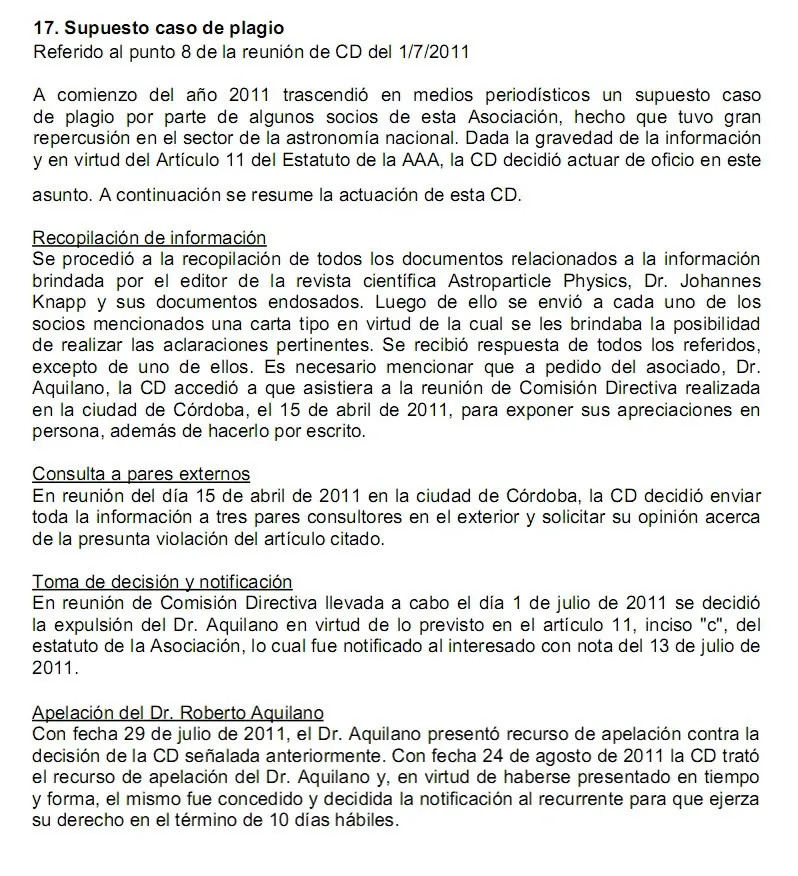
In that record and in other minutes, a second case of alleged plagiarism is mentioned, which I will recount in another post in the coming days.
What has been narrated here is a series of facts, without value judgments on my part. It is not I who points to anyone as the author of plagiarism. Just as I do not accuse, I do not exonerate either. I am not a judge. I do, however, have my own ideas. It does not matter what they are. The reader may -or may not- draw their own conclusions, apart from mine, which are irrelevant. Are these the complete facts? I have tried to get a more detailed statement from Dr. Aquilano, without success. The door remains open for him to clarify anything he wishes, of course.
Given these facts, several questions arise, among them, whether the astronomer in question acted appropriately or whether the papers should be interpreted differently than the AAA did. It is also worth asking whether the AAA acted in an appropriate manner, respecting the right to a legitimate defense. On this point, the legal matter was debated at the October meeting: It was discussed there, as recorded in the minutes, the possibility that Dr. Aquilano might initiate legal actions against the members of the AAA's Board of Directors individually, as well as the Basic Right to Defense. One of the astronomers asked if at the level of an association like the AAA there is a law that indicates how to act in situations of this type. Another professional responded that the AAA's bylaws were made to obtain legal status in La Plata. And added:
"It is the bylaws of a non-profit civil association. Those affected can go to the justice system, which is above the law of civil associations, if controversies arise. This has always functioned as a club of friends and suddenly a catastrophe occurs, which is why we have to worry about things we had no experience with and should have consulted lawyers."
Another member present points out that "He regrets that Dr. Aquilano is not present at the Assembly and that the members of the AAA learned of this news through a newspaper."
There were also those who expressed their doubts regarding the consultation with anonymous external peers.
And so, was there plagiarism or not?
It is not for me to decide on the matter. According to the members of the AAA, yes. How serious would it be if it were so, what consequences will all this have? On the one hand, Dr. Aquilano's prestige within the Argentine professional astronomical community will result in him being considered differently than he had been until now and he will surely no longer be able to publish in Astroparticle Physics or Il Nuovo Cimento, but he should not have problems publishing in other journals. It does not seem that the issue has had significance at UNR or CONICET, so, ultimately, not much will happen. Regarding the recognition of amateur astronomers, particularly those from Santa Fe (Rosario, Casilda), the issue has not had and will not have much significance either and will be quickly forgotten. The astronomer will continue giving talks and collaborating with amateur groups. The knowledge he has, he did not lose.
At least, the view from abroad towards the local astronomical community may show that paper review works (sometimes, only sometimes) and that in our country there was some kind of treatment and consequences.
Is it enough, is it all so serious?
I don't know. I do know that it would be better if everything were more transparent. By not talking about these issues, we do not prevent them from leaking and we promote suspicion. It would be better to explain. If it is not what it seems a priori, then the actions should be able to be justified.
These are topics that NO ONE wants to talk about. There are legal fears and also cultural ones. Apart from our own ideas or value judgments, I do believe it is important to document the facts, even if we don't like them. Not to hide them. There is none so blind as those who will not see. How true that is in astronomy!
Sources and related links
- [1]: Diario La Capital: Denuncian por plagio a un funcionario. Dated 27-03-2011. Accessed 21-02-2012. And Diario La Capital: Ordenan investigar por plagio a un docente de Ingeniería. Dated 28-03-2011. Accessed 21-02-2012.
- [2]:Einstein equation and self-graviting objects. Connotations for high density stars
R. Aquilano, H. Navone, D. Sevilla
Adv. Studies Theor. Phys., Vol. 4, 2010, no. 1-4, 143-150.
Accessed 21-02-2012. - [3]: FCALGP Pipermail. Accessed 20-02-2012.
- [4] Aquilano's profile on LIADA.
- [5]: Minutes of the Asociación Argentina de Astronomía:
Acta_AAA_15abril2011.pdf
Acta_AAA_24ago2011.pdf
ACTA-AAA-2011.pdf
Acta_AAA_1jul2011.pdf
Accessed 21-02-2012.
About the images
- Fig. 1 and 2. Screenshots from the Astroparticle Physics website. Credit: Elsevier.
- Fig. 3, 4, 5 and 6: Excerpts from AAA minutes. Credit: Asociación Argentina de Astronomía.