Is it possible for a researcher to publish a scientific paper containing "long fragments of text" copied from a previous work, without the corresponding reference? Has that happened in astronomy? Does it happen today?
Your color and shape are those of the longing of my love.
You are mine, you are mine, and you live in my infinite dreams.
The Gardener, poem 30, Rabindranath Tagore.
According to the RAE, "Plagiar" is:
(From Lat. plagiāre).
1. tr. To copy substantially the works of others, presenting them as one's own. (The verb is also used in America with the meaning of kidnapping someone).
But the definition gives rise to different instances. It is possible to copy long fragments of someone else's text without citing them for two main reasons: unconsciously, that is, ignoring that it is important to make the appropriate references so that the erroneous idea does not remain that "those ideas/works are from the person who re-publishes them." And it is also possible that it is done on purpose. Although the result in both cases is the same, the intention is different. In the second case, one might think that the goal is to obtain an "intellectual benefit."
There are also other differences: sometimes it is done with the expectation of receiving (undeserved) recognition or profiting from someone else's work by passing it off as one's own. And that is the key.
It is not about ideas being someone's "property." Ultimately, no idea is completely original. It is not about protecting an idea with copyright, in that sense, but about recognizing one's own work, the way a set of ideas is integrated and communicated. One can disseminate what another has done without usurping the work carried out, without appropriating that task, recognizing it to whom it corresponds.
In the preliminary study of El libro de los plagios by Juan-Jacobo Bajarlía [1], Elsa Drucaroff points out, in relation to art: "Where are the limits? Where is the difference between plagiarism and creative works with other texts? Is it enough for a work to subtly allude to the source to show its intention not to steal, but to pay homage or parody? Or can alluding to the source also be a crude excuse to justify the 'I copy and paste' on the computer screen? None of these questions can be answered in the abstract, in an absolute way. I believe that plagiarism is not an eternal essence that each time incarnates, mechanically, in a case of theft or, on the contrary, in one of productive and necessary intertextuality. There is no abstract way to define when there is plagiarism in art. And yet, many times it is glaringly obvious that there is, and other times it is obvious that there is not. In some cases -few, after all- it is difficult, really difficult to discern."
Addressing the topic is, evidently, complicated. Lightly accusing someone of plagiarism can be slanderous. Aside from legal issues, it would be irresponsible to accuse someone of something without evidence. And journalism, sometimes lighter than air, ends up falling into that. I try in these lines to develop the topic with due precautions.
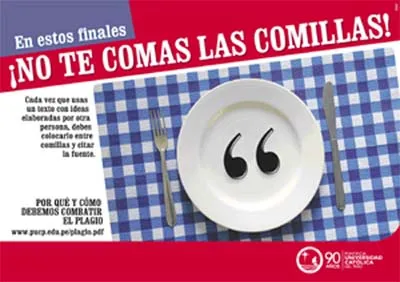
In my twilight sky you are like a cloud and your color and shape are as I desire them
You are mine, you are mine, woman of sweet lips and my infinite dreams live in your life.
Pablo Neruda, 20 love poems and a song of despair, poem 16.
The professional sphere
But in the professional sphere, things change because, in addition to some aspects consistent with art, the creative issue, there is also research, compilation, filtering, and analysis of data to evaluate a hypothesis and reach a conclusion.
Bajarlía points out [1b] in his prologue that: "To plagiarize means to undress one to clothe oneself with their words, to enter another's body to take their thinking organs."
In a professional scientific paper, in "papers," references are indispensable. Mandatory, I would say. Ideas do not arise from nothing. Researchers do not start probing something from scratch. There are previous ideas that are necessary to mention and that have been taken into account in the research and, therefore, it is not possible to omit them in the references. This should be written in stone, a solid, unalterable, immovable concept.
But, as Ducroff asks, are references enough? If a scientist x copies long fragments of text from another previous and external work and then cites it in the references, will there be plagiarism or not?
Evidently, if a large part of what is written in a paper are quotes from previous works, then there is no research, except perhaps a historical compilation of a topic that may have value if that is the objective.
On the other hand, a text containing several fragments of text similar to a previous one does not necessarily indicate a conscious or unconscious copy. It could well be a coincidence.
Let's ask a professional astronomer (or an amateur one) what equatorial coordinates are, and it is very likely that both will refer to the geographical coordinates of latitude and longitude, as an analogy. And not for that are they plagiarizing.
But in research, although there are introductions and passages in papers that allude to previous works or preconceived ideas, there will also be one's own, particular data. "I made such observations, I obtained this data, I analyzed it in this way and I reached this conclusion." In that structure and its formulation, there should not be so many similarities with previous works. If someone already obtained that data and analyzed it in that same way and reached the same conclusion, then there is no point in researching anything. Scientific research always contains added value, something that was not there before, otherwise it makes no sense.
However, there are gray areas. It may be acceptable and necessary to repeat an experiment, for example, in which the same previously observed object is observed, analyzed in the same previous way, and an attempt is made to confirm the previous conclusions. But, in those cases, the objective should be explicitly declared.
In communication, journalism, literature, and other arts, there are many cases of plagiarism. But in science, with its academic rigidity, with its rigor, does this also happen? Isn't this academic-professional "intellectual honesty" a fixed stake in scientific production?

Eppur si muove
And yet...it moves, Galileo would say. The history of astronomy gives us some cases, like that of Titus Bode, Ptolemy vs. Hipparchus. One can also allude, although it is mathematics, to the case of Newton vs. Leibniz. And recently there was talk of the case of Hubble vs. Lemaitre. They are, however, different examples from each other.
But they are all old cases. That doesn't happen today, right? Well, if you think so, you are mistaken. Currently there are more scientists and many more papers are written than before. Furthermore, if a scientist does not publish it seems they are not "working," so to obtain grants and subsidies they must be backed by publications. And if they were done in important journals, with higher impact factors and with many citations obtained from other researchers, there is a quantitative feeling that they are good researchers. It is the famous "Publish or Perish" so debated in different sciences since it generates, in some cases, the "need" to publish even if perhaps one is not in a position to do so, with the goal of remaining.
In universities the topic is considered important, to the point of creating documents to teach this to students. Some examples among many are the notes from the Astronomy Department of the University of Michigan or from the same department at the University of Sheffield.
From the online document of Sheffield, I translate an excerpt that may serve to understand the topic and notice the academic importance:
Plagiarism is passing off the work of another as one's own, whether intentional or not, for our benefit. The work may include ideas, compositions, designs, images, computational codes, and, of course, words. This list is not exhaustive.
If a student submits a piece of work produced by others or copied from another source, that is plagiarism.
If a student produces a piece of work that includes sections taken from other authors, that is plagiarism. The length of the copied section is not relevant, as an act of plagiarism offends the general principle stated above. When copying sections from other authors it is not enough to simply list the source in the bibliography.
If a student paraphrases from another source without proper attribution, it is plagiarism.
If a student copies or resubmits their own previous work from another assignment or task, it is self-plagiarism and is not acceptable.
Collusion is a form of plagiarism when two or more people work together to produce a piece of work submitted wholly or partially by one of them as their own individual work.
Both plagiarism and collusion are strictly prohibited.
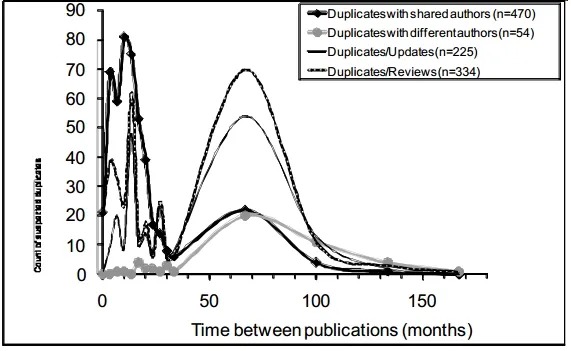
The first aspect, the quantity of current papers, has been recently surveyed by two researchers from the University of Texas [2] in a work in which they point out that these scientific Déjà vu are more frequent than thought. They also point out there another aspect not mentioned above, "duplications": self-plagiarism or duplicates by the same author. That is, the same research published in more than one paper, which inflates the number of works of a researcher, fictitiously. By the way, there are "gray" areas, as Bruce Reider points out in "Under Surveillance."[3]
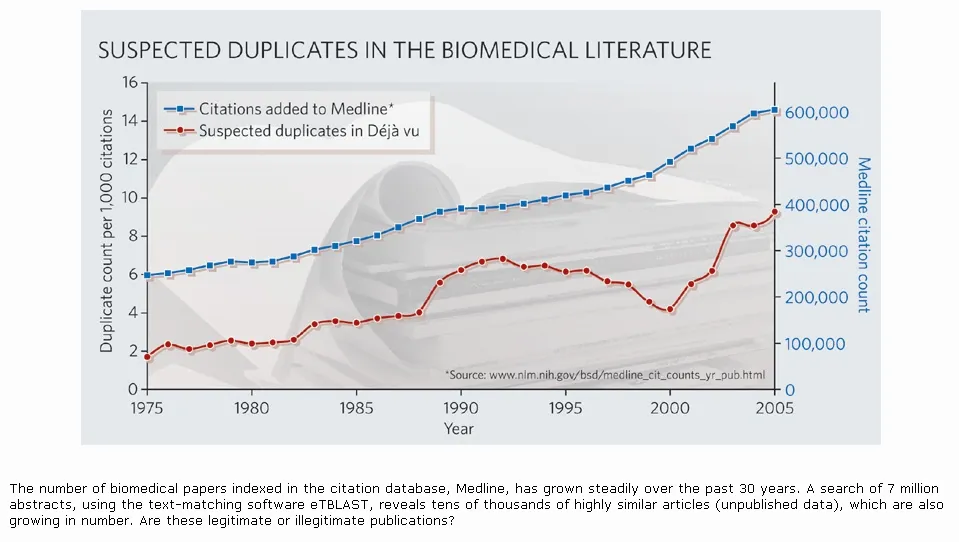
On the horizontal axis (abscissa) are the years from 1975 every 5 years and on the y-axis (ordinate) the number of duplicates per 1000 citations.
The number of biomedical papers indexed in the Medline database has grown regularly in the past 30 years. A search of 7 million abstracts, using the eTBLAST software, reveals hundreds of thousands of highly similar articles (unpublished data), which also grow in number. Are they legitimate or illegitimate publications?
Tara C. Long and other authors (from the same previous team at the University of Texas) point out that cases of plagiarism have increased due to the greater availability of scientific literature on the web.[4] In addition to having detected in the previous work a number of "presumably duplicate" papers, what they did was contact the authors and editors. They received 144 responses. 93% of the original authors did not know that their papers had been duplicated. This study led to about 86 internal investigations being initiated by editors, 50% of which retracted the duplicate articles (removed them from the web and/or added a comment). The responses from authors who would have committed some kind of paramnesia are curious: of the 60 responses from authors, 28% denied having done anything "wrong," 35% admitted having "borrowed" previously published material, and 22% of the co-authors said they had not participated in the writing. An additional 17% said they were unaware that their name appeared on the paper.
It must be said that Paul Brennan also published in Nature a view contrary to that presented by the aforementioned study, pointing out that most of the cases analyzed on that occasion are innocent.[5]
The news of plagiarism
I write this note not only to report that this happens, but as an introduction to other notes to be published soon about two specific cases of plagiarism in Argentine astronomy.
While gathering information on the topic I kept wondering if it made sense to publish something about the particular issue.
But, what does sense mean in this context? For example, what sense does researching in astronomy have?
If we think of sense as the search for a practical, useful benefit, we will realize that although in some aspects astronomy manages to translate its discoveries into an improvement in our quality of life. For example, the study of the Sun has a direct impact on our lives and practical benefits.
But what about research on the rate of expansion of the universe, the unification of physical theories, black holes, variable or binary stars or brown dwarfs?
The true objective meaning of astronomy is to know, as opposed to being ignorant of reality. The alternative path would be to cover our eyes, imagine a nice idea, for example that the universe is static was imagined in ancient times as a more beautiful idea than expansion (because there would be no changes, everything would always be "the same").
Reality may not be beautiful, it may be sad, generate anguish, worry. But there are those of us who prefer this to covering our eyes so as not to see the ugly, because of that saying: out of sight, out of mind.
I, on this point, choose Morpheus's red pill and not the blue one.
I value science as the best path for generating knowledge, for understanding reality, at least a part of it. But that doesn't mean I'm going to hide the dirt under the rug. I can't. It's the only way I can justify approaching these topics.
Plagiarism in the news
It's never good to only look at your own navel, nor is it good to judge what happens outside oneself without looking in the mirror. This is a blog. And it's impossible not to know that in communication -whether professional journalism, understood as an activity with commercial profit, or amateur, as happens with most blogs- there are also cases of what is called "copy&paste".
How many references do we see in a journalistic news story? How many footnotes? Whether for aesthetic reasons, space constraints, or style issues, there aren't many references in journalistic articles in traditional media.
But we must also consider that the objectives of journalistic communication are different from scientific or academic communication. And it's not the same for a text to look similar to others as it is to be a "copy and paste" of complete paragraphs of someone else's authorship without citing them to pass them off as one's own original production. If an article attempts to "compile" two or more articles written by others previously, references should be included even in print media even if they take up a little more space. An example -not a good one- in this regard is El plagio lunar by Walter Goobar, Compiled by Luis Alfonso Gámez. [6]
Blogs are not exempt from the responsibility that implies citing properly and not doing a mere copy&paste, although we sometimes partially fall into that. The use of texts and images created by others must be cited. And not in any way, but in certain ways in some cases at the request of the original authors, as I learned over the years after a reprimand.
Blogs and traditional media, although they form their "literature," do not have academic or scientific requirements. And in part, that's fine. It is possible nowadays to add links or footnotes, but one does not expect monographs from newspapers or Wikipedia-type articles in current affairs magazines. That literary bureaucracy is set aside does not, however, mean that we overlook citing or referencing others' work. It is possible to do so even if not in such a strict, structured, and complete manner as in other fields.
Colophon of the introduction
As I pointed out, this note is an introduction to a much more complex topic with different facets. The mere mention of the word "Plagiarism" has legal implications when referring to a person with a first and last name who may feel insulted or discredited. It's an unpleasant topic, but impossible to ignore. No historiography of Newton will be able to ignore some "dark" aspects of his life, a certain secrecy and occultism, nor can the relationship of Einstein with his cousin and other facts that might perhaps tarnish the shine of the "heroes" of science be ignored. And even so, many times we are told a different or incomplete story. But we don't just want to know what happened last century. We're not going to wait a century to tell what happens today.
I want to say two more things. On one hand, as I said before, I try not to fall into the carelessness of giving personal opinions, value judgments with the index finger pointing at the guilty or innocent. The reader can draw their own conclusions -or not- and in most cases a personal opinion adds nothing. Furthermore, if an accusation is going to be made, one would have to be able to prove what one says.
As noted above, sometimes it is difficult to determine whether a communicative act contains plagiarism or not. In some cases there will be unconsciousness or ignorance (i.e., without negative intentions). But if the same mechanism is repeated several times, it may be an indication that there is an intention. Correlation is not causation, but it says something. Now, when the information one has is limited, the difficulty of determining the facts and pigeonholing or categorizing them is greater. Let's keep this in mind so as not to form an idea too quickly. A person is innocent until proven otherwise. In the courts of ordinary justice and in moral judgments when reading an article or chatting in a café.
And it is also true that, although it may be hard to prove some things, sometimes, we have no doubt. Beware of the latter, because appearances can be deceiving. On this point, I believe, it is better to give information, be transparent, tell things, than to try to hide them. In the end, the truth filters through, like water. Like the light of the stars.
Sources and related links
- [1]: El libro de los plagios, Juan-Jacobo Bajarlía, 1st ed. Buenos Aires, Ediciones Lea, 2011. ISBN 978-987-634-418-0.
- [1b]: Ibid., p. 29.
- [2]: A tale of two citations, Mounir Errami & Harold Garner, Nature 451, 397-399 (24 January 2008)
DOI: 10.1038/451397a - [3]: Under Surveillance; Bruce Reider, MD; Am J Sports Med December 2010 vol. 38 no. 12 2391-2393. DOI: 10.1177/0363546510390477
- [4]: Responding to Possible Plagiarism,
Tara C. Long , Mounir Errami, Angela C. George, Zhaohui Sun & Harold R. Garner
Science 6 March 2009:
Vol. 323 no. 5919 pp. 1293-1294
DOI: 10.1126/science.1167408 - [5]: Duplication: most cases on database are innocent, Paul Brennan, Nature 452, 29 (6 March 2008) | DOI:10.1038/452029d
- [6]: The lunar plagiarism of Walter Goobar. Compiled by Luis Alfonso. Gámez
- on arp-sapc.org, accessed February 20, 2012.
- Plagiarism.org
About the images
- Granada Poster: Credit of the Library of the University of Granada. Accessed 20-02-2012.
- PUCP Poster: "Don't eat the quotation marks". Credit: Pontificia Universidad Católica del Perú. From Welcome Integrity. See PUCP Guide for citing sources.
- Fig. 1: Credit&Copyright: Mounir Errami & Harold Garner, Nature 451, 397-399(24 January 2008) doi:10.1038/451397a.
- Fig. 2: Credit&Copyright: Mounir Errami & Harold Garner, Nature 451, 397-399(24 January 2008) doi:10.1038/451397a. Supplementary material.