A collection of links to music, images and videos relating art and science. Today: Images of RCW 38; POX 186; The great correlator; PKS 0745. Music: Universica, by JT Bruce. Video: Demian Slobinsky at BIFE.

Images of the decade
RCW 38
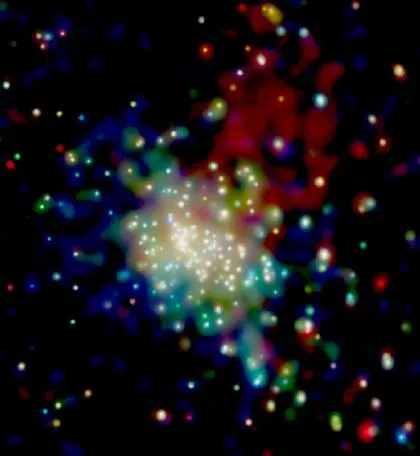
At 6,000 light-years from Earth, this star cluster is a relatively nearby star-forming region. The image covers an area 5 light-years in diameter and contains hundreds of young, hot stars. X-rays from the hot upper layers of the atmospheres of 190 of those stars were detected with NASA's Chandra Observatory.
Furthermore, a diffuse cloud of X-rays was found around the cluster with an excess of high-energy rays, indicating that there are very energetic particles moving in a magnetic field. Such particles are generally produced by a supernova event or in the magnetic fields of a neutron star or black holes, none of which are evident in RCW 38.
The image was published on the Chandra site on December 18, 2002.
Credits: NASA/CXC/CfA/S.Wolk et al.
POX 186: the birth of a small galaxy
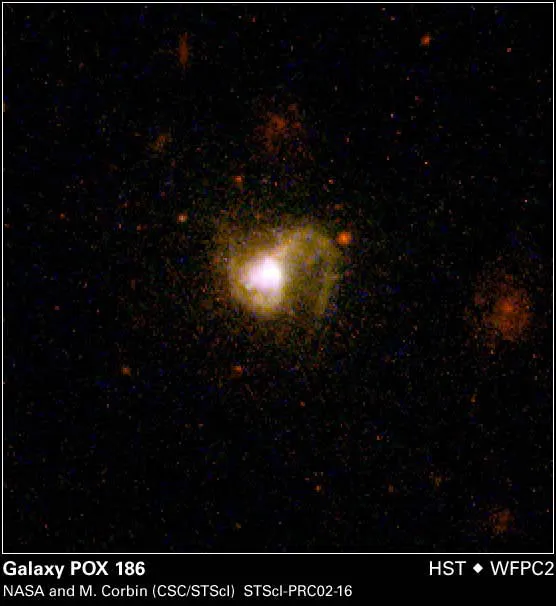
With Hubble, astronomers were able to detect a system of gas and stars that appears to still be developing as there is evidence of much star formation and its shape seems distorted. The galaxy, called POX 186, formed when two clumps of gas and stars collided less than 100 million years ago, which is little considering that larger galaxies, like the Milky Way, formed billions of years ago.
The finding was published by astronomers Michael Corbin and William Vacca in Astrophysical Journal (ApJ 581 1039 doi:10.1086/344297, access is currently free).
"It's a surprising discovery," noted Corbin, adding that "We didn't expect to see any galaxy forming in the nearby universe. POX 186 lies only 68 light-years away, which implies it is relatively close to us in space and time."
POX 186 is a galaxy of the so-called compact blue dwarfs. The term POX comes from the French "prism objectif", that is "objective prism", a device that astronomers place in front of the telescope to obtain spectra. The galaxy was discovered 30 years ago, but the resolution of ground-based observatories was very poor. With Hubble in orbit, the results were much better. The small galaxy is 900 light-years in diameter (in contrast to our galaxy which is 100,000 light-years in diameter).
This young system, according to the astronomers, is located in a "void", a sparsely populated region of space.
The image was published on HubbleSite on December 19, 2002.
Credits: NASA and Michael Corbin (CSC/STScI)
Images of the week
The great correlator
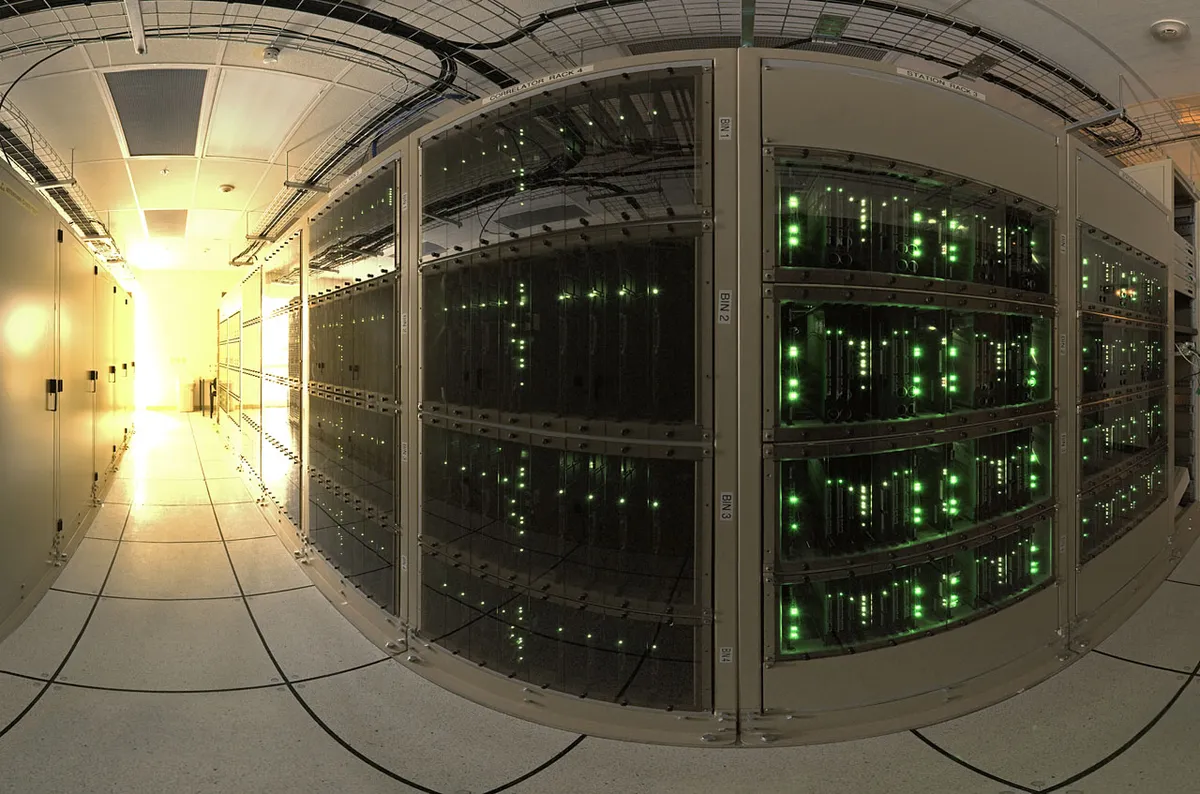
One of the most powerful supercomputers in the world has been installed and tested at high altitude, in its remote facilities located in the Andes of northern Chile. This marks one of the most important milestones on the path to the completion of the Atacama Large Millimeter/submillimeter Array (ALMA), the most sophisticated ground-based telescope in history. ALMA's specialized correlator has over 134 million processors and performs up to 17 thousand trillion operations per second, a speed only comparable to the fastest general-purpose supercomputer in operation today.
In the image, a wide-angle view of the ALMA correlator.
Credit: ESO.
More information at ESO.
The "little" black hole PKS 0745
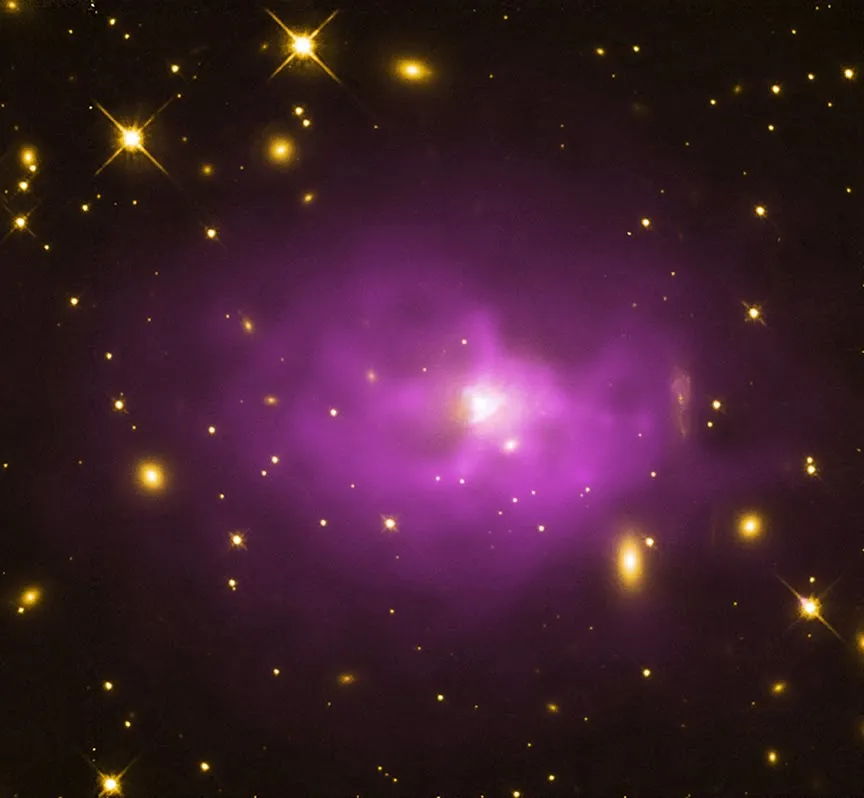
The black hole at the center of this galaxy is part of a study of the 18 largest black holes in the universe. This elliptical galaxy lies at the center of the galaxy cluster PKS 0745, 1.3 billion light-years from Earth. X-ray data detected by Chandra are shown in purple and optical data from Hubble, in yellow.
The researchers found that these black holes may be up to ten times more massive than previously thought, with at least ten of them having masses between 10 and 40 billion times that of the Sun.
That is to say, rather than being supermassive black holes, they should be called ultramassive.
The research was published by Hlavacek-Larrondo, J. et al, 2012, MNRAS, 424, 224; arXiv:1204.5759
Credits: X-ray: NASA/CXC/Stanford/Hlavacek-Larrondo, J. et al; Optical: NASA/STScI; Radio: NSF/NRAO/VLA
The image was published on the Chandra site on December 18, 2012.
Space Music
JT Bruce: Universica
From San Diego, United States, JT Bruce has been making music since 2005 with three albums released on Jamendo. In this case, I share with you the work titled Universica, whose tracks are names of bright and well-known stars.
Animated Science
Demian Slobinsky at TEDxJoven@Riodelaplata Dr. in physics Demian Slobinsky talks to us about BIFE, FPGA and supercomputers in Argentina.
http://youtu.be/V3Hm7udINSM
More at TEDx@Riodelaplata
To access previous editions of this section, consult the Multimedia Selection Series. The series attempts to show that the immensity of the universe can be perceived in different ways. I choose some images from a decade ago -so they don't fall into oblivion- and from the current week that ends, as well as sounds/music and videos that are artistic forms of expression with content related to astronomy and related sciences. I am also collecting these materials on the Pinterest account