A collection of links to music, images and videos relating art and science. Today: Images of Galaxies in a broken dance; The Spirograph Nebula (That star was my luxury); NGC 3627; NGC 7354. Music by HabitantesRock: Black Hole. Video: ESOCast 41: To the South.

Images of the decade
Galaxies in a broken dance
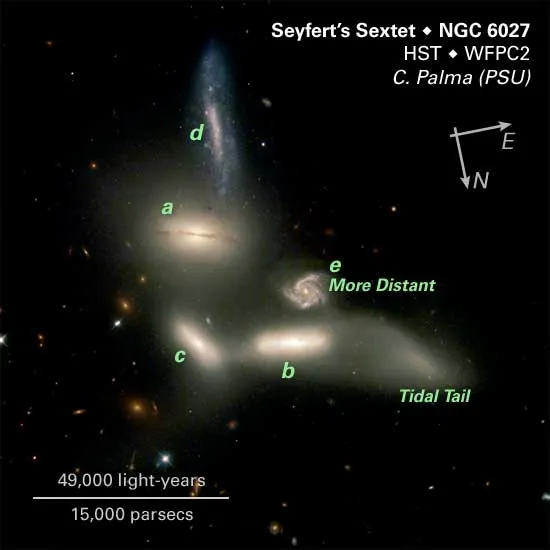
Thanks to the Hubble Space Telescope, astronomers witnessed a group of galaxies participating in a slow dance of destruction that will last billions of years.
The gravitational force pulls these galaxies together, destroying their shape to, finally, converge into one large massive galaxy. These six galaxies make up Seyfert's Sextet, but only four of the objects are dancing this broken dance. The other two, for now, managed to escape, paraphrasing the song by Soda Stéreo. The small spiral galaxy in the center -annotated in the image as e- is very far from the other four. The sixth object is not a galaxy but a "tidal tail", at the bottom right, which belonged to one of the galaxies.
These objects occupy a space smaller than the diameter of the Milky Way. Each galaxy is about 35,000 light-years in diameter, while our galaxy is 100,000 light-years long. In this dance, destruction is not just power. Three of the objects show signs of interactions (the elliptical that appears in the image as the second from the top -annotated as a in the image-; and the two spirals at the bottom -b and c). The gravitational forces have already changed their shapes, distorting them. The edge-on galaxy, at the top -d-, is, however, almost intact.
The group is known as Seyfert's Sextet in honor of the astronomer who discovered it: Carl Seyfert. In the New General Catalogue the grouping is listed as NGC 6027. The group of galaxies is located about 190 million light-years away.
This sextet is not the only one "prisoner of a cruel rhythm". Other compact groups are Stephan's Quintet and Robert's Quartet.
Image credits: NASA, J. English (U. Manitoba), S. Hunsberger, S. Zonak, J. Charlton, S. Gallagher (PSU), and L. Frattare (STScI)
Scientific credits: NASA, C. Palma, S. Zonak, S. Hunsberger, J. Charlton, S. Gallagher, P. Durrell (The Pennsylvania State University) and J. English (University of Manitoba)
The image was published on HubbleSite on December 12, 2002.
IC 418: The Spirograph Nebula
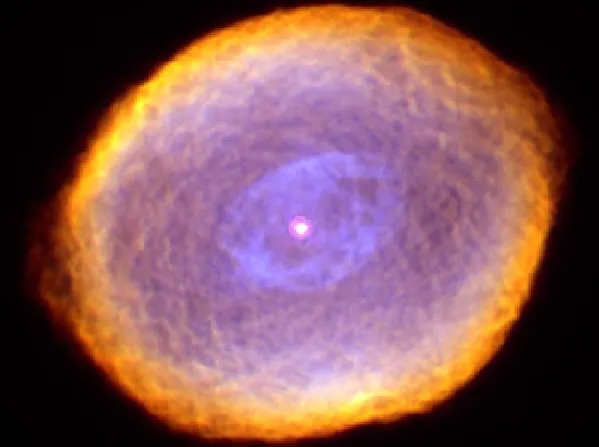
IC 418 is a planetary nebula. It is called spirographic in relation to the spirograph, an instrument for drawing curves. The central star was similar to our Sun, then went through a red giant phase and later expelled its outer layers leaving a remnant core that will eventually become a white dwarf.
Ultimately, "our star ran out/ and it was my luxury" as Los Redonditos de Ricota would say...
The expelled material glows due to the radiation from the central star, about 2,000 light-years from Earth.
The image is a false-color representation, made with exposures from Hubble's WFPC2 with filters. Red shows the emission of ionized hydrogen (the coldest gas in the nebula, far from the nucleus), green the emission of hydrogen and blue the emission of oxygen (the hottest gas, near the nucleus).
Credits: R. Sahai (JPL) et al.,Hubble Heritage Team (STScI /AURA), NASA
It was the Astronomy Picture of the Day (APOD) on December 14, 2012. And on Observatorio.
Images of the week
Black holes, revealed
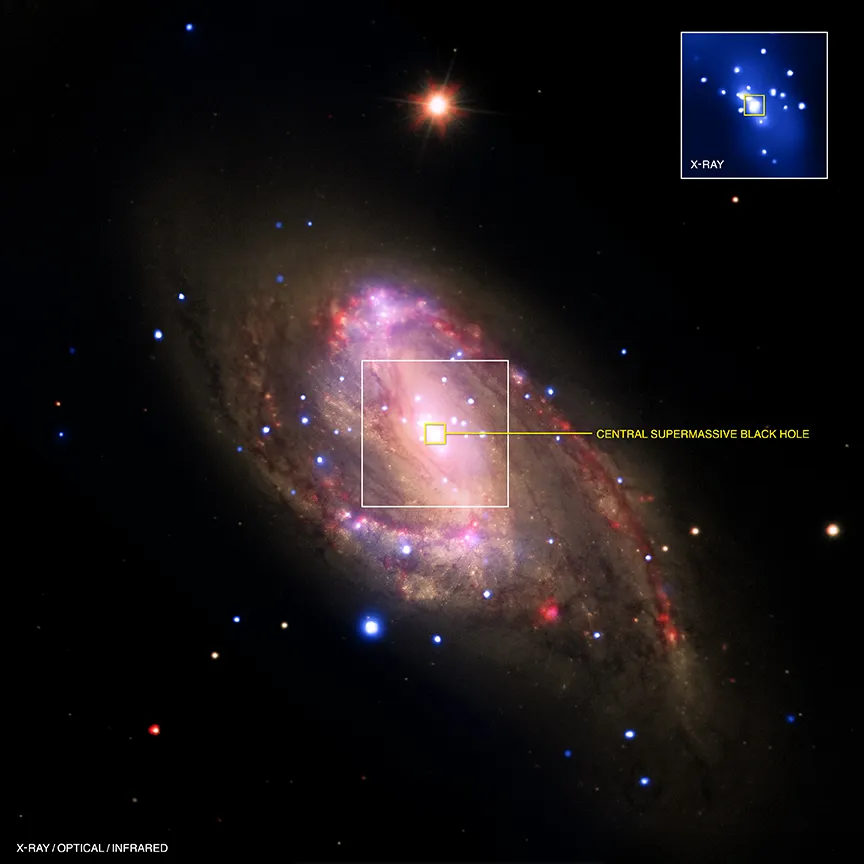
NGC 3627 is a spiral galaxy about 30 million light-years away from Earth. This image contains data from the Chandra Observatory in X-rays, in blue; from the Spitzer Telescope in infrared, in red; and optical data from Hubble and the VLT, in yellow. The inset shows the central region, which contains a bright X-ray source, probably generated by material falling toward a supermassive black hole.
A search conducted using archival material from Chandra observations of a sample of 62 nearby galaxies showed that 37 of those objects, including NGC 3627, contain X-ray sources at their centers. Of those 37 sources, 7 are new identifications of possible supermassive black holes.
The scientific work indicates that the fraction of galaxies containing an AGN (an active nucleus) is 60%, much higher than what is found with optical surveys, showing the effectiveness of X-ray observations for finding black holes in galaxies that optically do not have them. They also note that the X-ray sources in the nuclei are present, preferentially, in early-type galaxies (ellipticals or lenticulars).
Credits: NASA/CXC/Ohio State Univ./C.Grier et al.; Optical: NASA/STScI, ESO/WFI; Infrared: NASA/JPL-Caltech
The image was published on the Chandra site on December 13, 2012.
NGC 7354
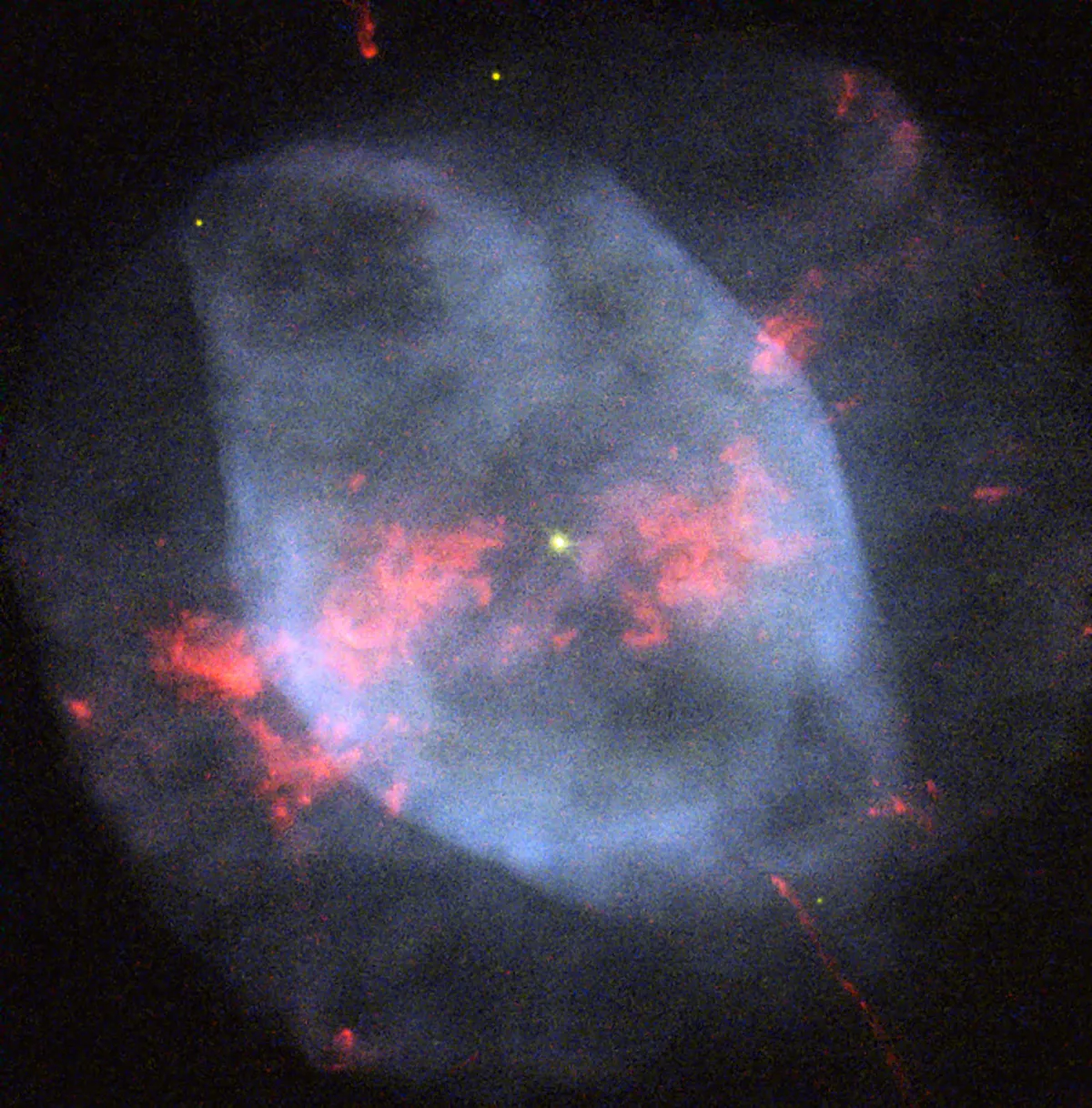
Located in a relatively empty region of space, about 4,200 light-years away and difficult to see with a medium-sized telescope, the planetary nebula NGC 7354 is often overlooked.
It is always good to remember that these objects have nothing to do with planets, but in the past, with instruments less sensitive than today's, they looked like gaseous planets such as Uranus and since then the name planetary nebulae has stuck.
From the central star, two symmetrical jets of matter (in red) are perceived, on each side, which suggested the presence of a companion star, so far undiscovered.
The image was published on SpaceTelescope on December 10, 2012.
Credits: ESA/Hubble & NASA
Space Music
Habitantes Rock: Black hole
I don't really know this band, but from a video of this same song, on YouTube, it seems to be made up of Argentinians:
Fede Bacigalupo on guitar, Pipi Garófalo on bass, Fabio Barraza on drums.
I discovered them on SoundCloud and they have their place on MySpace.
Animated Science
ESOCast 41: To the South
On the occasion of the celebration of ESO's 50th anniversary in October 2012, the observatory's staff edited eight special episodes of the ESOcasts series, which are part of the film “Europe to the Stars — ESO’s First 50 Years of Exploring the Southern Sky”.
This first special episode — titled “To the South” — describes the birth of ESO, particularly the reason why astronomers from European countries decided to explore the southern sky by installing an astronomical observatory in Chile.
I take the opportunity to thank the ESO staff (led by Lars Lindberg Christensen) who sent me the DVD Europe to the stars. It is highly recommended. The technological deployment that Europe has made on Chilean soil is impressive.
This episode can also be viewed on the ESO website, as well as the remaining ones in the ESOCast series.
http://dotsub.com/view/60ef3413-a7a9-49ea-a0cc-36464ed46711
To access previous editions of this section, consult the Multimedia Selection Series. The series attempts to show that the immensity of the universe can be perceived in different ways. I choose some images from a decade ago -so they don't fall into oblivion- and from the current week that ends, as well as sounds/music and videos that are artistic forms of expression with content related to astronomy and related sciences. I am also collecting these materials in the Pinterest account