A collection of links to music, images and videos that relate art and science. Today: images of Sagittarius A*; NGC 6960; A "Black Beauty" from the Red Planet; 5011B and NGC 5011C. Music: Terra Lumina. Video: Miguel San Martín at TedxRiodelaPlata.

Images of the decade
Sagittarius A*
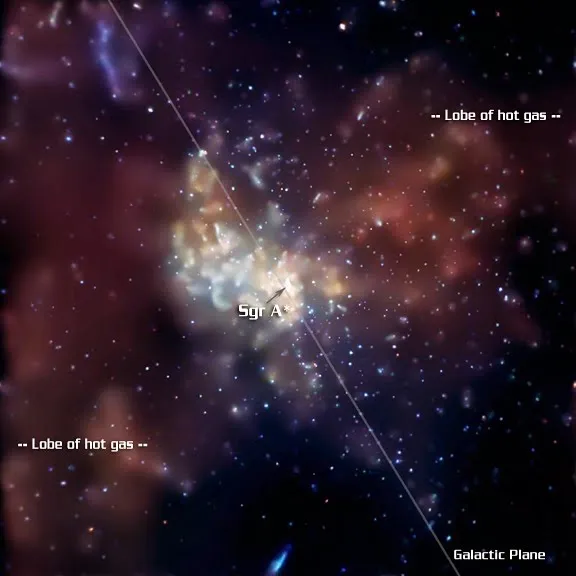
This image obtained with the Chandra Observatory in an exposure of more than two weeks of the center of our galaxy, where Sagittarius A* or Sgr A* and more than two hundred other X-ray sources lie.
Sagittarius A* is a source of X-rays and radio that, through indirect observations, was determined to be a very massive compact object, more than 2 million times the mass of our sun, that is, a supermassive black hole.
During the observation period, half a dozen X-ray outbursts were recorded. The speed with which such phenomena occurred and faded indicates that they occurred near the event horizon.
In the image there is data that reveals such outbursts: enormous lobes of hot gas can be seen in red, approximately at the 2 and 7 o'clock positions if it were a clock (where it says "Lobe of hot gas"). Those zones extend tens of light-years on each side of the black hole.
Sagittarius A* is located about 26,000 light-years away in the constellation that gives it its name.
The image was published on the Chandra site on January 6, 2003.
Credit: NASA/CXC/MIT/F.K. Baganoff et al.
NGC 6960: The Witch's Broom Nebula
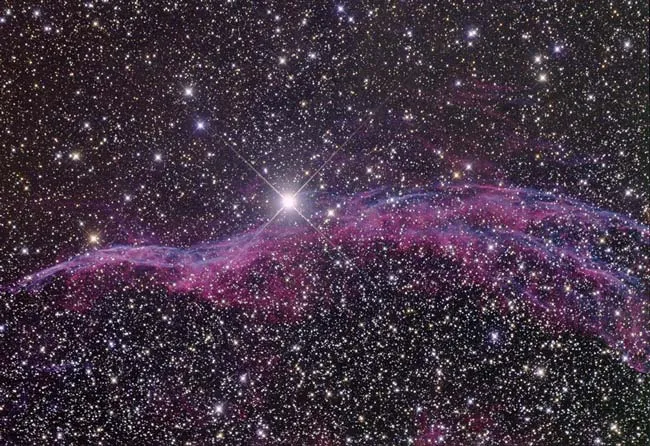
NGC 6960, known as the Veil Nebula and also as the Witch's Broom Nebula, is the result of the explosion of a star about 10,000 years ago.
This supernova remnant lies about 1,400 light-years away in Cygnus.
The bright star 52 Cygni, in the middle of the photo, can be seen with the naked eye in a place with dark night skies.
It was the Astronomy Picture of the Day (APOD) for January 1, 2003.
And at Observatorio.
Credits & Copyright: Loke Kun Tan (StarryScapes)
Images of the week
A "black beauty" from the Red Planet
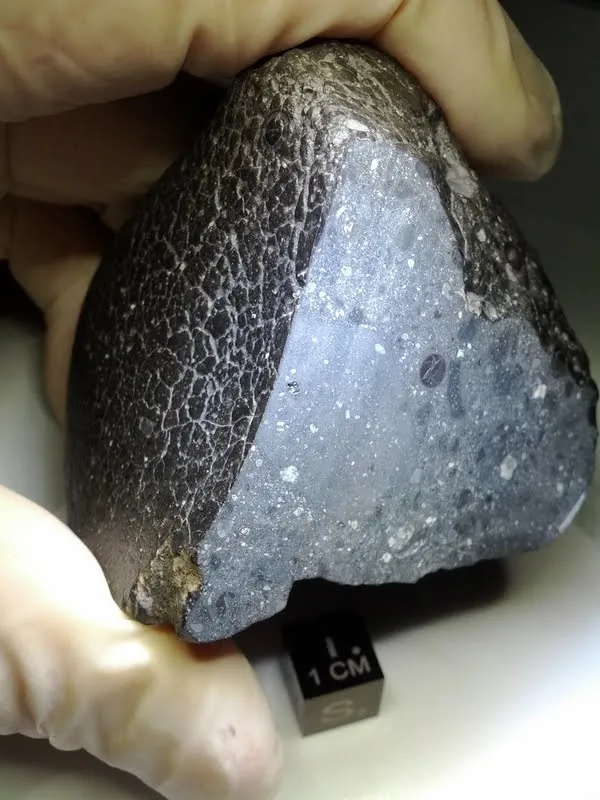
Scientists analyzed a small meteorite that could be the first discovered from the Martian surface or crust and found that it contains 10 times more water than other Martian meteorites of unknown origins. Thousands of meteorites have been discovered on Earth, but only a few have been identified as originating from Mars. Those meteorites are known as SNC for Shergottite, Nakhlite, and Chassignite after the places where they were found.
This new class of meteorite was found in 2011 in the Sahara Desert. Designated as Northwest Africa (NWA) 7034 and nicknamed "Black Beauty," it weighs 320 grams. After more than a year of studies, a team of U.S. scientists determined that it formed more than 2 billion years ago during the most recent geological period on Mars known as the Amazonian.
"The age of NWA 7034 is important because it is significantly older than most other Martian meteorites," explained Mitch Schulte, a scientist in the Mars Exploration program, in a NASA statement.
The meteorite is composed of fragments of basalt, rock that forms from the rapid cooling of lava. The fragments are mainly feldspar and pyroxene, probably from volcanic activity.
NWA 7034 shares some petrological and geochemical characteristics with known Martian meteorites (the SNCs), but it also possesses unique characteristics that would exclude it from such a category. Its composition is similar to the Martian basalts and crust measured by the rovers in recent missions, the authors note in Science Express.
Image Credit: NASA.
Don't trust your eyes
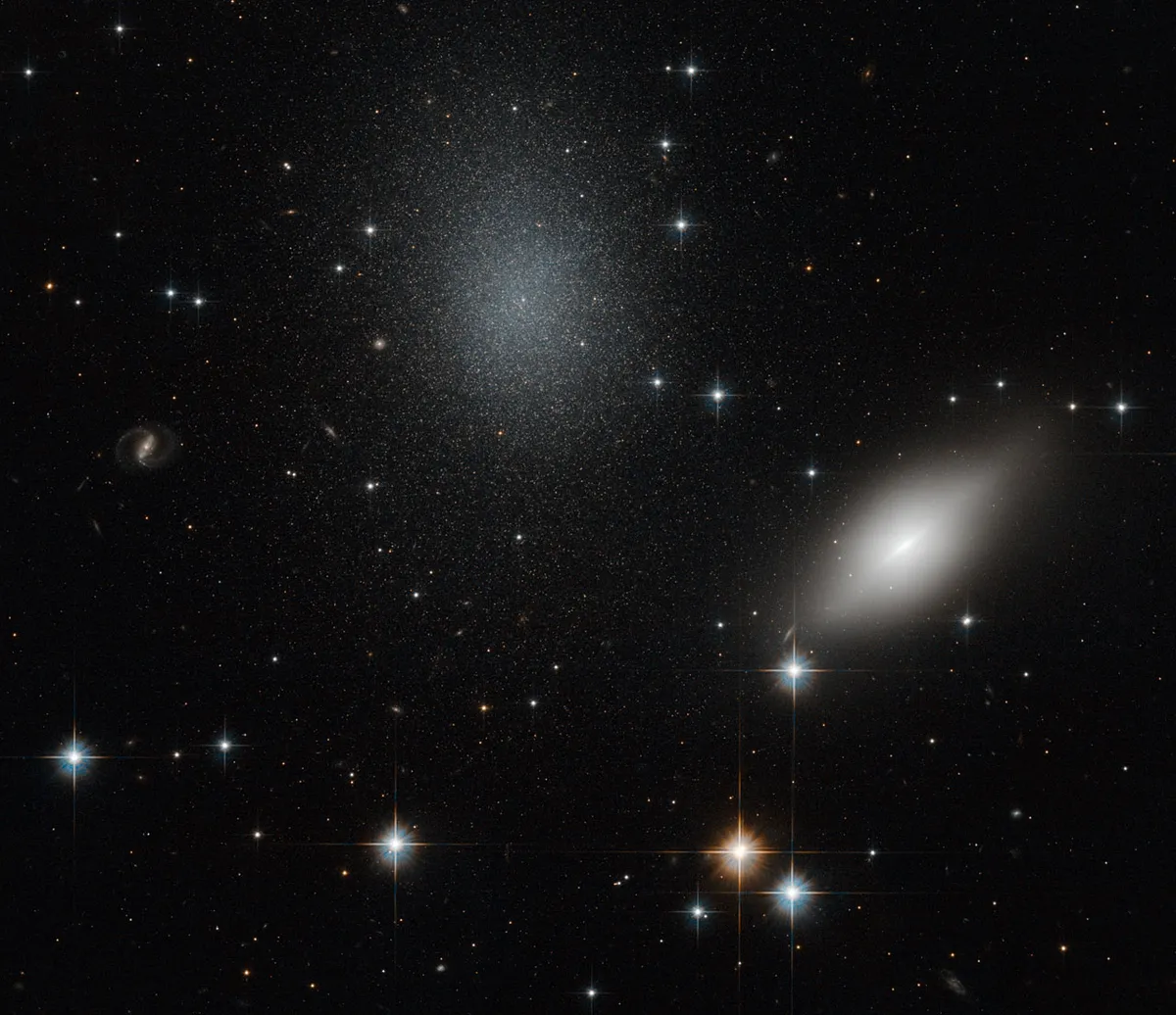
The universe cannot be known solely through the senses, because they play tricks on us. A good example is this image obtained with Hubble of the galaxies NGC 5011B and NGC 5011C.
Located in Centaurus, these two galaxies were a problem for astronomers. NGC 5011B (on the right) is a spiral galaxy that belongs to the Centaurus Galaxy Cluster (A3526), which lies 156 million light-years away from Earth. NGC 5011C, which for a long time was also considered part of that same cluster (the bluish galaxy in the center of the image) is a peculiar object that looks like a nearby dwarf galaxy with the size of an early-type spiral.
Astronomers thought that if they were at the same distance from Earth, they should show signs of interaction, but that was not seen. So they studied the recession velocity of both and found that NGC 5011C is moving away more slowly than its apparent neighbor and its motion is more consistent with that of Centaurus A/M83, a group of galaxies that contains NGC 5128 and lies about 13 million light-years away. Thus, NGC 5011C, with only ten million times the mass of the Sun in its stars, must be a nearby dwarf galaxy instead of a member of the Centaurus Cluster, as was thought for many years.
Credit: ESA/Hubble & NASA
It was the Hubble Space Telescope Image of the Week.
Space Music
Terra Lumina
From the creator of Symphony of Science, John D Boswell, comes this new work that united him with William Crowley. They raised funds on Kickstarter and thus managed to produce this album that contains 11 folk/rock/electronic songs about the most fascinating concepts in science.
More info at http://terraluminamusic.com/
Animated Science
Bound for Mars: Miguel San Martin at TEDxRiodelaPlata
Miguel San Martin, with a Master's degree awarded by the Massachusetts Institute of Technology (MIT) in Aeronautical and Astronautical Engineering, has worked for twenty-seven years at Jet Propulsion Laboratory (JPL), the NASA center that specializes in planetary exploration.
He was born on January 6, 1959, on his family's farm in Villa Regina, Río Negro, and grew up in Buenos Aires. He decided to become a space engineer one winter night in 1976, while looking at the sky on his parents' farm and listening through a shortwave radio to the BBC broadcast of the arrival of Viking, the first successful mission to Mars.
Once graduated, he was hired by Jet Propulsion Laboratory (JPL).
More at TedxRiodelaPlata
Music by Dexter Britain http://www.dexterbritain.co.uk/
Spanish Subtitles: Daniela Garufi
Subtitle Coordination: Gisela Giardino
To access previous editions of this section, consult the Multimedia Selection Series. The series attempts to show that the immensity of the universe can be perceived in different ways. I choose some images from a decade ago—so they are not forgotten—and from the current week that is ending, as well as sounds/music and videos that are artistic forms of expression with content related to astronomy and related sciences. I am also collecting these materials on the Pinterest account