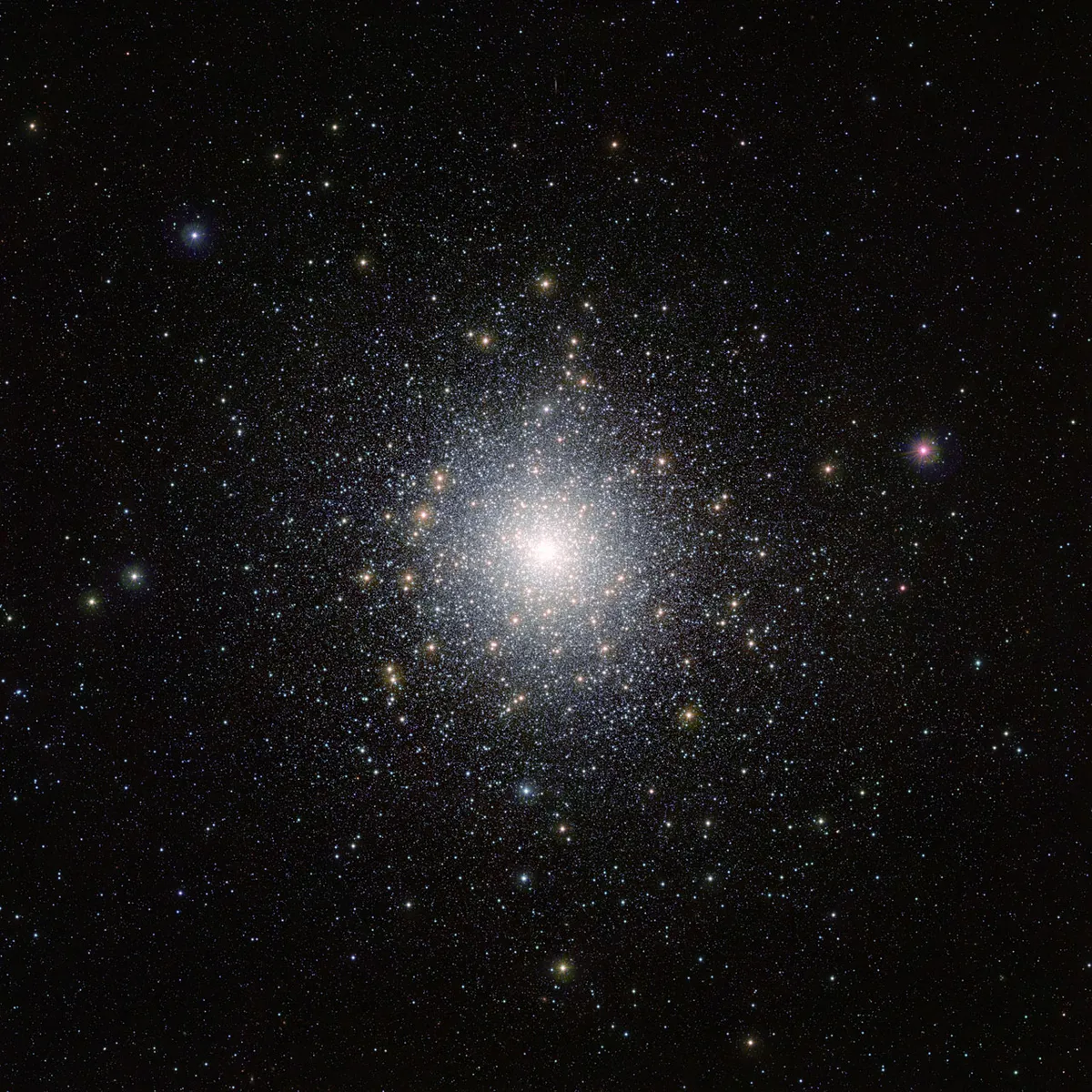
This new infrared image from ESO's VISTA telescope shows the globular cluster 47 Tucanae in astonishing detail. This cluster contains millions of stars, and there are many nestled in its core that are very exotic and have unusual properties.
Globular clusters are huge spherical clouds of old stars bound together by gravity. They are found orbiting the cores of galaxies, like satellites orbiting Earth. These groups of stars contain very little gas and dust — it is believed that most of it has been expelled from the cluster by winds and explosions from the stars it contains, or has been stripped away by interstellar gas that may have interacted with the cluster. Any remaining material fused to form stars billions of years ago.
47 Tucanae, also known as NGC 104, is a huge and ancient globular cluster located about 15,000 light-years from us, and is known for containing many strange and interesting star systems.
Located in the southern constellation of Tucana, the cluster orbits our Milky Way. About 120 light-years in size, it is so large that, despite the distance, it appears as large as the full Moon. It houses millions of stars, is visible to the naked eye, and is one of the brightest and most massive globular clusters known. Among the jumble of stars in its core are many intriguing systems, including X-ray sources, variable stars, vampire stars, blue straggler stars that shine in an unexpectedly 'normal' way, and tiny objects known as millisecond pulsars, small dead stars that spin at an incredible speed.
Red giants, stars that have exhausted the fuel in their cores and have swollen in size, are scattered throughout this image obtained by VISTA and are easily identifiable, glowing like deep amber against the bright background of yellow and white stars. The compact and dense core contrasts with the outer regions of the cluster, which are more scattered, and in the background, numerous stars of the Small Magellanic Cloud can be seen.
This image was obtained using ESO's VISTA (Visible and Infrared Survey Telescope for Astronomy) as part of the VMC Survey, which is a survey of a region of the Magellanic Clouds, two of the closest known galaxies. 47 Tucanae, although closer than the Clouds, happens to lie between us and the Small Magellanic Cloud, and was captured during this survey. The principal investigator of the survey is Maria-Rosa Cioni, University of Hertfordshire. Among the project's associated members is Dr. Andrés Piatti (UBA-IAFE).

VISTA is the world's largest telescope dedicated to mapping the sky. Located at ESO's Paranal Observatory in Chile, this infrared telescope, with its huge mirror, wide field of view, and very sensitive detectors, is revealing a new view of the southern skies. By combining highly precise infrared images — like the VISTA image shown — with observations carried out in the visible range, astronomers can probe the contents and history of objects like 47 Tucanae in great detail.
Sources and related links
About the images
- Image of 47 Tuc. Credits: ESO/M.-R. Cioni/VISTA Magellanic Cloud survey. Acknowledgment: Cambridge Astronomical Survey Unit
- Image of VISTA. Credits: ESO/B. Tafreshi (twanight.org)