A collection of links to music, images and videos that relate art and science. Today: Images of A small world surrounded by dreams; Filaments in the Cygnus Loop; The Great Attractor; and the Orion Service Module. Music: The moons of Uranus. Video: Questions that have no answer.

Images of the decade
A small world surrounded by dreams
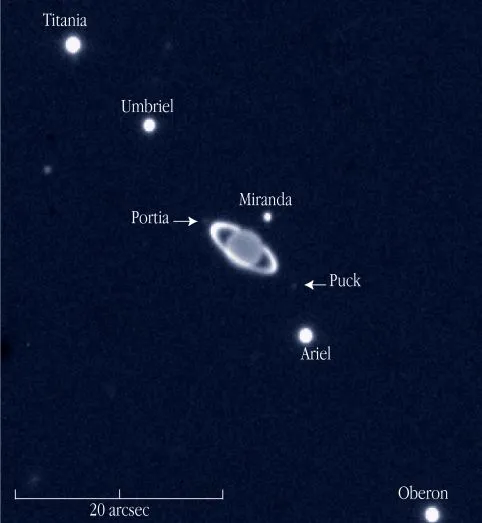
Yes, it looks like Saturn, but it so happens that it is not the only planet with a ring system. In the image obtained in near-infrared light by the Antu telescope at ESO Paranal, what is observed is Uranus and its moons. Since the methane atmosphere of the blue planet absorbs sunlight in the near-infrared, the planet appears very darkened, enhancing the contrast between the planet and its very faint rings. In fact, Uranus's rings are impossible to see in visible light with telescopes on the Earth's surface and were only discovered in 1977. It is thought that the rings formed in the last 100 million years, perhaps from the collision of some moon with an asteroid. The moons of Uranus, which are 27, get their names from characters in certain works by Shakespeare and Alexander Pope. Some rings and moons were discovered in 1986 with the passage of the Voyager 2 probe.
Credit: E. Lellouch, T. Encrenaz (Obs. Paris), J. Cuby , A. Jaunsen (ESO-Chile), VLT Antu, ESO.
It was the Astronomy Picture of the Day (APOD) for January 15, 2003. And at Observatorio.
Filaments in the Cygnus Loop
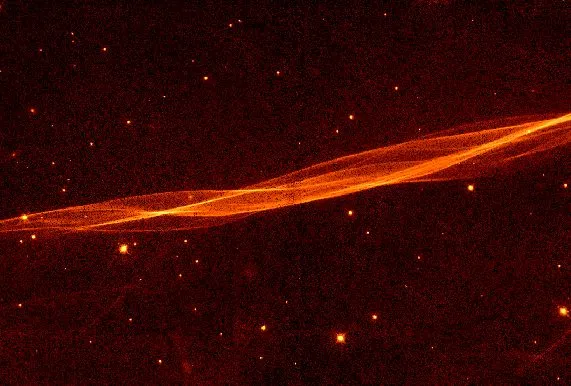
Seemingly subtle and delicate, these filaments of interstellar gas are part of a shock wave from a violent interstellar explosion.
The image, taken in 1997 with the Wide Field and Planetary Camera 2 aboard the Hubble Space Telescope, is a close-up of a supernova remnant known as the Cygnus Loop (Sharpless 103). This edge shows a small portion of the immense shock front moving at a speed of 170 kilometers per second while glowing in light emitted by excited hydrogen atoms.
It is not just another beautiful photograph: this particular image has yielded some fantastic scientific results. For example, in 1999, researchers used the data to recalculate the distance and age estimates of the remnant.
It was determined to lie only 1,440 light-years away.
Credit: William P. Blair and Ravi Sankrit (Johns Hopkins University), NASA.
It was NASA's Astronomy Picture of the Day (APOD) for January 18, 2003.
In Spanish at Observatorio.
Images of the week
The Great Attractor
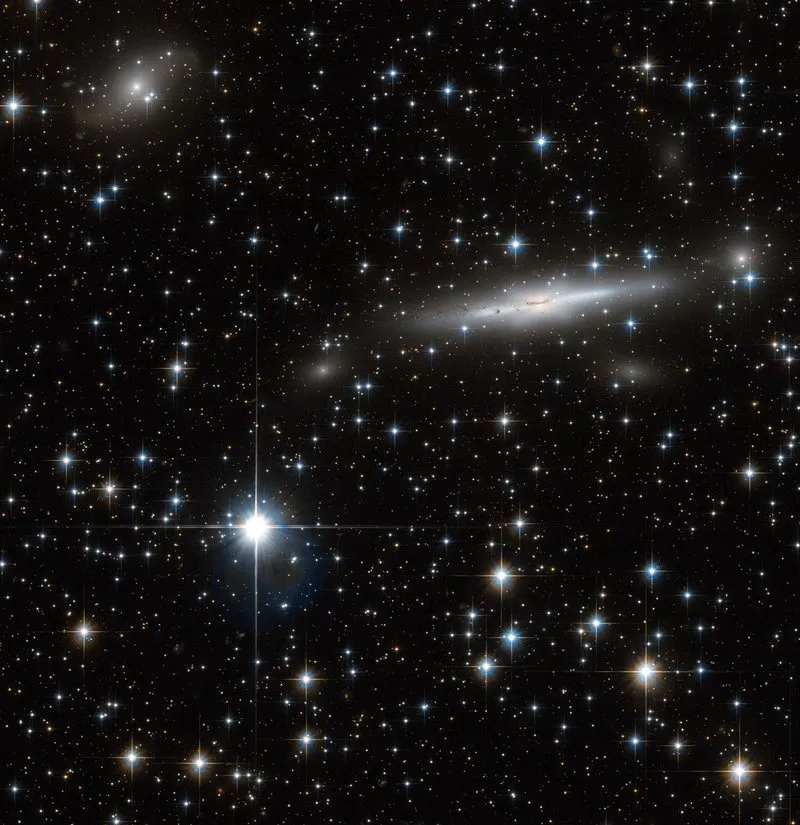
A "busy" patch of sky was captured in this image by Hubble. Located at the border of Triangulum Australe and Norma, this field covers part of the Norma cluster (Abell 3627) as well as a dense area of the Milky Way.
The Norma cluster is the closest galaxy cluster to our galaxy, at 220 million light-years away. The enormous mass concentrated there and its consequent gravitational pull makes it understandable that this region is known as The Great Attractor.
The largest visible galaxy in the image is ESO 137-002, a spiral seen edge-on.
Observing the Great Attractor is difficult at optical wavelengths. The plane of our galaxy, responsible for the numerous bright stars in the image, eclipses (with stars) and obscures (with dust) many of the objects in the region. It is possible to penetrate the dust with radio or infrared observations, but the region behind the center of the Milky Way, where the dust is densest, remains almost a complete mystery to astronomers.
Credit: ESA/Hubble & NASA
It was the Hubble Space Telescope Picture of the Week.
Orion Service Module
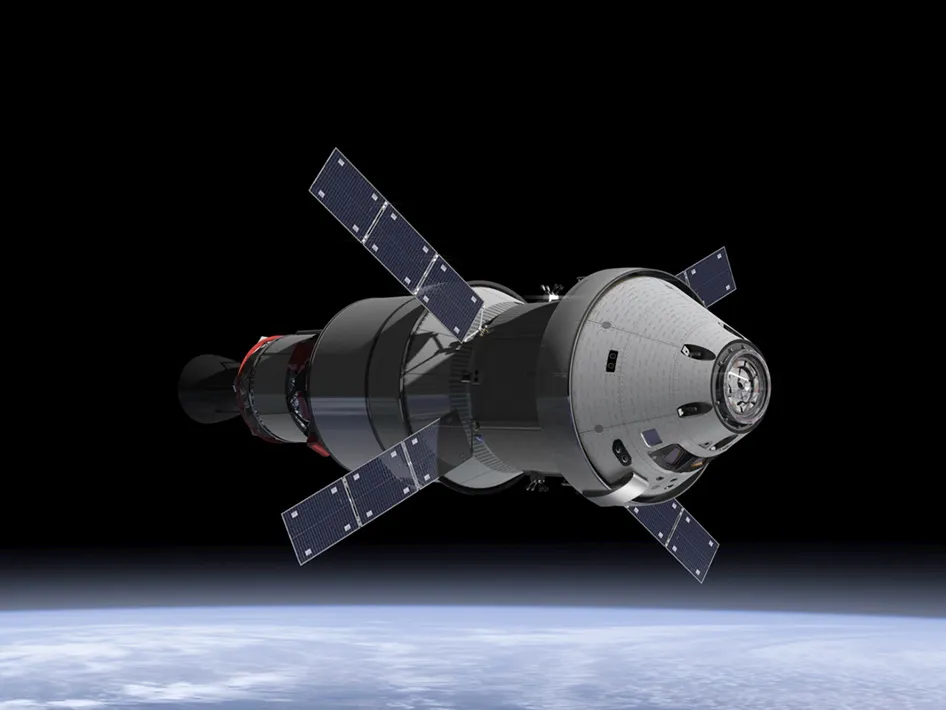
This artist's concept of the Orion Service Module was presented this week. When the Orion spacecraft launches on a rocket in 2017, it will have an ESA service module that will provide fuel for the spacecraft.
Orion will be the most advanced spacecraft and will carry astronauts farther into space than ever before.
This January 16 it was learned that NASA signed an agreement in mid-December with the European Space Agency for it to provide a service module for the Exploration Mission-1.
There are three major components in the Orion vehicle: the crew capsule, which will carry the astronauts; the launch abort system that will operate in case there is a problem during launch; and the service module, which will provide the propulsion systems.
In the NASA press release there are other images and a link to an animation about what the vehicle will be like.
Image credit: NASA.
Space Music
Camilo y la NGA 2: The moons of Uranus
This musician from Chile, Camilo Acevedo Saiz, created a track about the Moons of Uranus, available on SoundCloud.
https://soundcloud.com/camiloylanga2/las-lunas-de-urano
Animated Science
Questions that have no answer
This is a video from TED-Ed. Its animator was Andrew Park (http://www.cognitivemedia.co.uk).
Here we dive into two questions that have no answers: Do other universes exist? and Why has no evidence of extraterrestrial life been found?
To access previous editions of this section, consult the Multimedia Selection Series. The series attempts to show that the immensity of the universe can be perceived in different ways. I choose some images from a decade ago -so they don't fall into oblivion- and from the current week that ends, as well as sounds/music and videos that are artistic forms of expression with content related to astronomy and related sciences. I am also collecting these materials in the Pinterest account