A collection of links to music, images and videos relating art and science. Today: Images of M83; BHR 71; NGC 411; N11 in the Large Magellanic Cloud. Music: Muse by 2Cellos. Video: Luminoir.

Images of the decade
M83
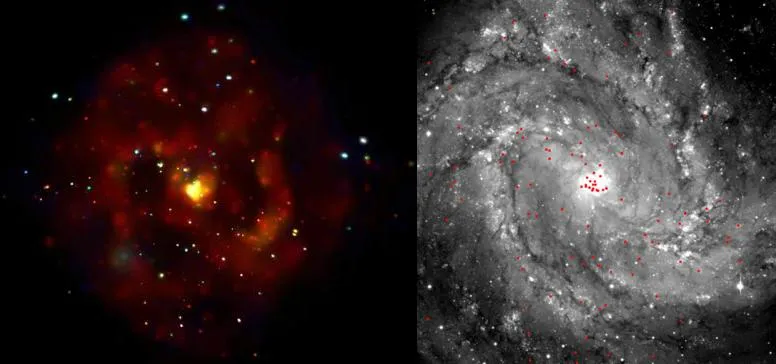
This image of the galaxy Messier 83 shows many X-ray sources associated with neutron stars and black holes scattered across the disk of the spiral galaxy. The bright central region of the galaxy shines due to a burst of star formation. The observation reveals that in the nucleus there is a higher concentration of these sources than in the rest of the object. A cloud of hot gas enveloping the nucleus region was also discovered.
The major star formation in the center would have produced massive stars and consequently more supernova explosions and the generation of neutron stars and black holes. That activity would also explain the presence of the gas cloud which shows evidence of an excess of carbon, neon, magnesium, silicon and sulfur.
The galaxy, in the constellation Hydra, is located 15 million light-years away and bears the number 5236 in the New General Catalogue.
The image on the reader's left was taken by Chandra, in X-rays. The image on the right is optical, obtained with the VLT of ESO in Chile and has the X-ray sources detected by Chandra superimposed as red dots.
Credits: NASA/CXC/U.Leicester/U.London/R.Soria & K.Wu
The image was published on the Chandra site on January 22, 2003.
BHR 71
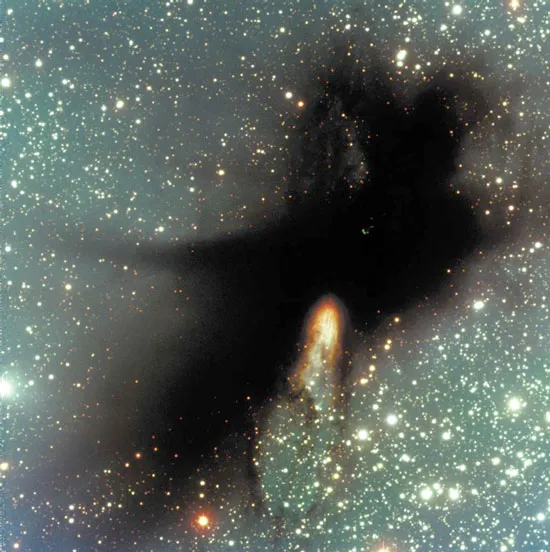
What is perceived in this image is what is called a molecular cloud or Bok Globule. There, a binary system is possibly forming. Most stars in our galaxy are part of a binary system, but few have been observed while forming. Recent observations of the area obscured by dust, however, show evidence of two young stars forming in the cloud, close enough to form a binary system. One light-year across, the isolated BHR 71 lies 600 light-years away.
The name BHR comes from a catalogue made in 1995 by three astronomers: Bourke, Hyland & Robinson. It is also found in the literature as Sa136 (from the Sandqvist catalogue) and as IRAS 11590-6452.
It was the Astronomy Picture of the Day (APOD) on January 27, 2003. And on Observatorio.
Images of the week
Appearances can be deceiving
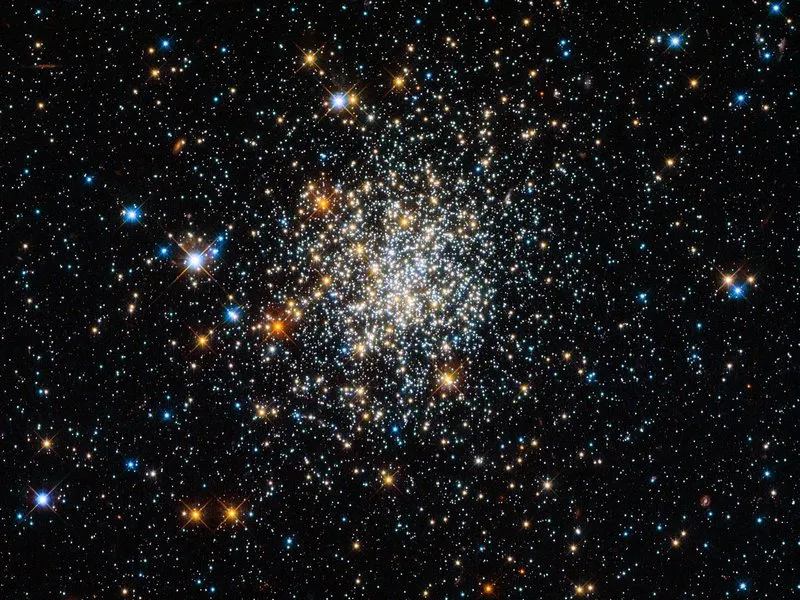
Globular clusters are nearly spheroidal collections of very old stars. There are about 150 around our Milky Way. All these clusters are quite similar to each other and it is hard to tell them apart. In fact, NGC 411, portrayed here with Hubble, is not a globular cluster, its stars are not that old. And it is not in our galaxy.
NGC 411 is considered an open cluster. Unlike globulars, which are accumulations of stars that remain bound together for over 10 billion years, open clusters tend to disperse their stars over time. This object is relatively young, about one billion years old.
Its stars are the same age, having formed from the same gas cloud, but they have different sizes. The Hubble image shows a wide variety of colors and brightnesses, which astronomers translate as different mass, temperature and evolutionary stage.
The image is a composite produced in ultraviolet, visible and infrared, with the WFC3.
Credit: ESA/Hubble & NASA
It was the Hubble Space Telescope Picture of the Week.
Hidden treasure in the Large Magellanic Cloud
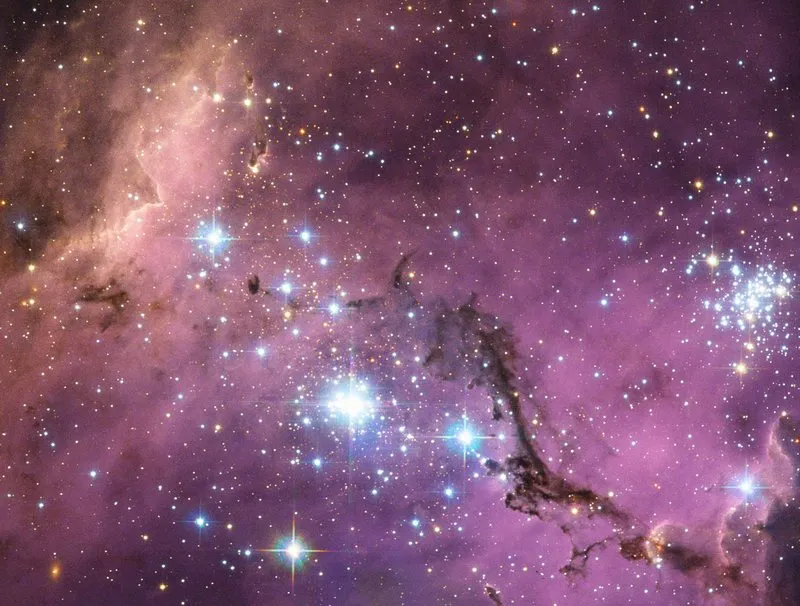
The Large Magellanic Cloud is full of star-forming regions. From the Tarantula Nebula, the brightest stellar nursery in our cosmic neighborhood, to LHA 120-N 11 (or more easily N11) part of which is portrayed in this Hubble image, the small, irregular galaxy is scattered with bright nebulae that denote star formation.
N11 is a particularly bright region in the Large Cloud, consisting of several "pockets" of gas and forming stars. NGC 1769 (in the center of the image) and NGC 1763 are some of the brightest parts.
The data in the image were identified by Josh Lake, an astronomy teacher from a Connecticut school in the Hubble Hidden Treasures competition.
Credits: ESA/NASA/Hubble
The image was published on NASA on January 23, 2013.
Space Music
2CELLOS - Supermassive Black Hole
The following track, called Supermassive Black Hole, is by the English band Muse, one of my favorites. In this section it is not common to select works by established artists, since the idea is, as far as possible, to point to new talents, independent or alternative, who also produce good music.
In this case, I allow myself the pleasure of putting a Muse track (a band that was chosen as the best of the year 2012 according to a poll by NO in Página/12 and their latest album 2ndLaw as one of the best among those polled by the Sí of Clarín), but performed by 2cellos, who as their name indicates are two cellists: Luka Sulic and Stjepan Hauser. They are accompanied by the voice of Naya Rivera. This track is part of their upcoming album called In2ition. I recommend listening to the tracks that make up their first production, self-titled, which is flawless.
https://soundcloud.com/2cellos/supermassive-black-hole
Animated Science
Luminoir
This French animated short, produced by Grégory Coelho, Mathieu Assemat, Yannick Lecoffre, Michaël Hunault, is about a girl who is afraid of the dark, from which a creature emerges that will take away the fear that has been instilled in her about darkness, the dark, the black. The audio is in French and has English subtitles, but without knowing both languages it is still easy to understand. The Luminoir, of which there is one for each child's room, are in charge of keeping the night dark.
It is time to look at reality with different eyes, in the light of new ideas.
Certainly, the creators worked hard to achieve a synthetic animation about the beauty of the night.
To access previous editions of this section, consult the Multimedia Selection Series. The series attempts to show that the immensity of the universe can be perceived in different ways. I choose some images from a decade ago -so they don't fall into oblivion- and from the current week that ends, as well as sounds/music and videos that are artistic forms of expression with content related to astronomy and related sciences. I am also collecting these materials in the Pinterest account