A collection of links to music, images and videos relating art and science. Today: Images of Barnard 33; Barnard 68; Abell 901/902; Day of Remembrance at NASA. Music: IC 434. Video: The Office Black Hole.

Images of the decade
Horsehead
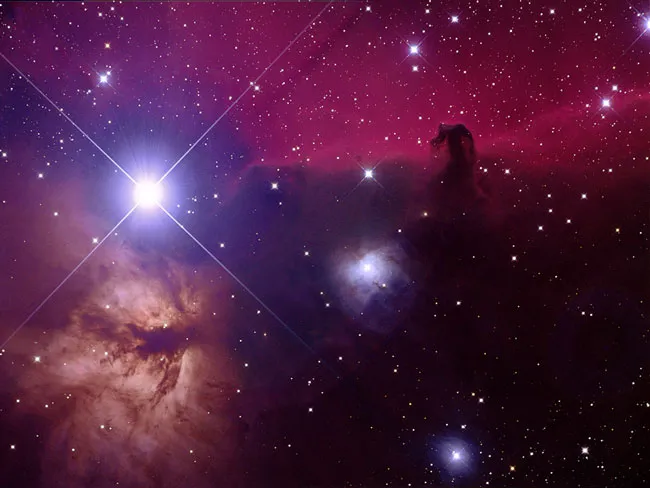
Telling someone they have a Horsehead could be considered an insult, but nebulae don't get offended. On the other hand, such a nickname, along with its beautiful appearance in photographs like the one above, made Barnard 33 one of the most famous nebulae in the sky. The image also shows two other regions of interest, such as the Flame Nebula (NGC 2024) and a smaller nebula NGC 2023.
The bright star on the left is Alnitak (Zeta Orionis), one of the three Marias of Orion's Belt. But the nebula's glow is due to the ionization of hydrogen by the nearby star Sigma Orionis.
The Horsehead or IC 434 is located 1500 light-years away from Earth.
Credits & Copyright: Loke Kun Tan (StarryScapes)
It was the Astronomy Picture of the Day (APOD) on January 29, 2003. And at Observatorio.
A black hole
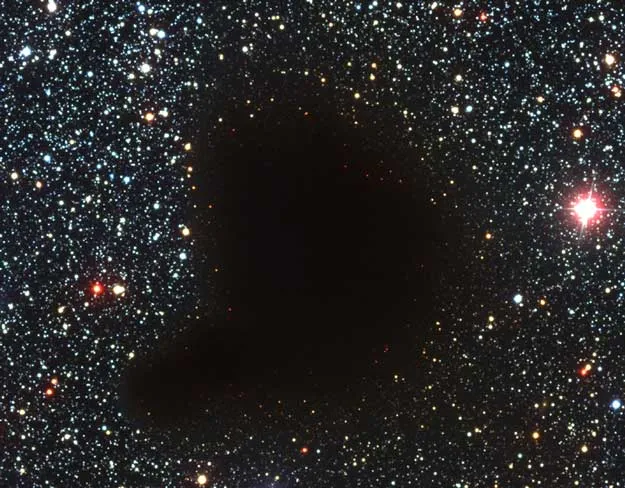
Where did the stars go? Did ink spill on the sky? Is it a black hole? No, there is no "hole," but dust in this dark molecular cloud called Barnard 68. The dust and molecular gas absorb almost all the visible light emitted by the background stars. However, clever astronomers discovered that infrared light can indeed penetrate the dust and observe through its layers the stars that, otherwise, would not be seen. With ESO's VLT it has been possible to lift that dusty veil.
Barnard 68 is located about 500 light-years away, in Ophiuchus.
Since the previous image was about another object, also cataloged as Barnard, it is worth saying that in both cases the name is in honor of the American astronomer Edward Emerson Barnard (1857-1923) who discovered the star that bears his name, as well as his eponymous catalog of dark nebulae.
Credits: FORS Team, 8.2-meter VLT Antu, ESO
It was the Astronomy Picture of the Day (APOD) February 2, 2003. In Spanish at Observatorio.
Images of the week
An intergalactic heavyweight
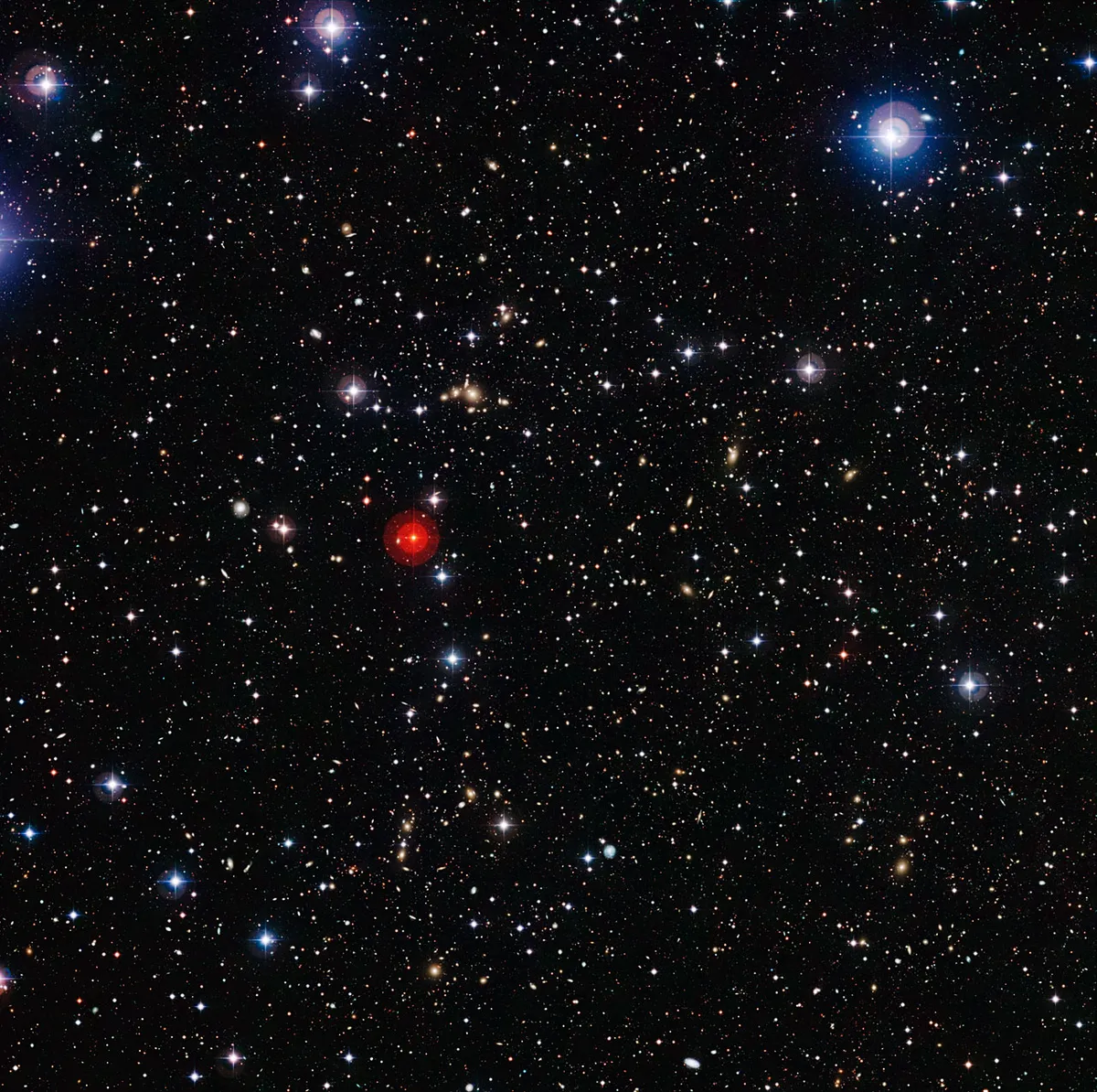
This deep field image shows what is known as a supercluster of galaxies — a gigantic group of galaxy clusters that are themselves clustered. This one in particular, known as Abell 901/902, includes three main independent clusters and numerous filaments of galaxies, typical of these superstructures. Above, to the right of the prominent red background star near the center of the image, a cluster, Abell 901a, can be seen. Even further to the right of Abell 901a, and slightly lower, is another cluster, Abell 901b. Finally, just below the red star, towards the edge of the image, is cluster Abell 902.
The Abell 901/902 supercluster is located just over two billion light-years from Earth, and contains hundreds of galaxies in a region about 16 million light-years across. For comparison, the Local Group of galaxies — which contains our Milky Way among more than 50 others — measures approximately ten million light-years.
More information at ESO.
Credit: ESO.
Day of remembrance
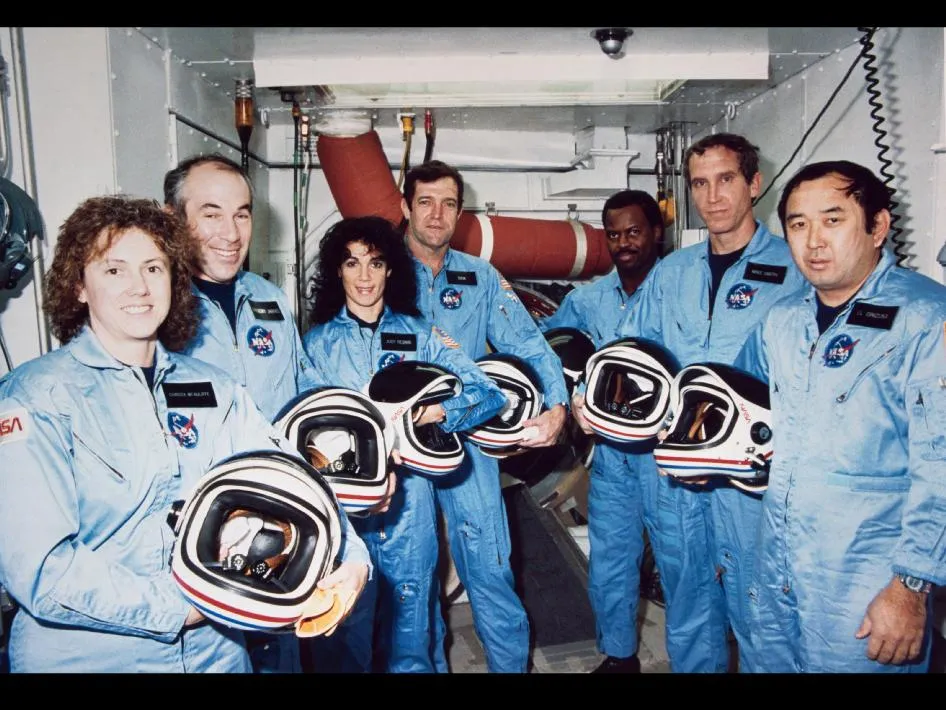
NASA remembered fallen space explorers in what they called the Day of Remembrance. That's because on the morning of January 28, 1986, when a booster failed (the SRB seals), Challenger exploded 73 seconds after launch.
In this photo, from January 9 of that year, the Challenger crew poses at Kennedy Space Center. From left to right appear specialist and teacher Christa McAuliffe; Gregory Jarvis; Judith A. Resnik; Francis R. (Dick) Scobee; Ronald E. McNair; Mike J. Smith; Ellison S. Onizuka.
The crew of Columbia on STS-107, which broke apart 16 minutes after its launch on February 1, 2003, was also remembered.
Likewise, on January 27, 1967, Gus Grissom, Ed White and Roger Chaffee were victims of the fatal Apollo 1 accident.
http://www.youtube.com/playlist?list=PLf4AErF-dN4OmOvxZW2HK6qQdaDt3DuG_
NASA dedicated a set of materials to the so-called Day of Remembrance, including tribute videos to the three crews and words from Charles Bolden, NASA Administrator, and Barack Obama.
Space Music
IC 434: Barnard 33
Above I mentioned that the Horsehead Nebula was known as Barnard 33 and as IC 434. The latter name was taken by a music group from Belgium whose music is cataloged as "dark electro" and the association with the astronomical object is not mere coincidence, as they tell on the website www.ic434.com.
The name of the track, therefore, is also not mere chance, as explicitly indicated on SoundCloud.
https://soundcloud.com/ic434/barnard-33
Animated Science
The black hole
At the beginning we "saw" what looks like a "black hole." In this video, an office worker finds a "black hole" that seems very useful, although...
Short film directed by Diamond Dogs/HSI. Also on Vimeo.
http://youtu.be/P5_Msrdg3Hk
To access previous editions of this section, consult the Multimedia Selection Series. The series attempts to show that the vastness of the universe can be perceived in different ways. I choose some of the images from a decade ago -so they don't fall into oblivion- and from the current week that ends, as well as sounds/music and videos that are artistic forms of expression with content related to astronomy and related sciences. I am also collecting these materials in the Pinterest account