A collection of links to music, images and videos relating art and science. Today: Images of M27; Orion; the Seagull Nebula; and Messier 106. Music by Silmi. Video: Unmovable object vs unstoppable force

Images of the decade
Close-up of M27
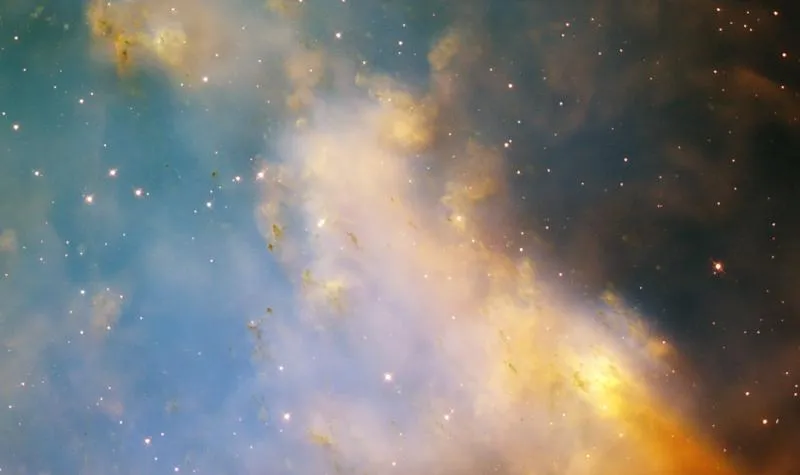
The last gasps of a dying star are creating a burst of bright knots of gas that appear to be spreading through space in this close-up image of the Dumbbell Nebula, a planetary nebula lying more than 1,200 light-years away.
The image taken with the Hubble Space Telescope shows many "knots" of varied shapes. Some look like fingers pointing toward the central star, located near the upper left of the image; and there are also isolated clouds with or without "tails".
These knots of gas and dust are common in planetary nebulae. They form in the early stages and their shape changes as the nebula expands.
Credit: NASA and The Hubble Heritage Team (STScI/AURA)//Acknowledgement: C.R. O'Dell (Vanderbilt University)
The image was published on HubbleSite on February 10, 2003.
The hunter hunted
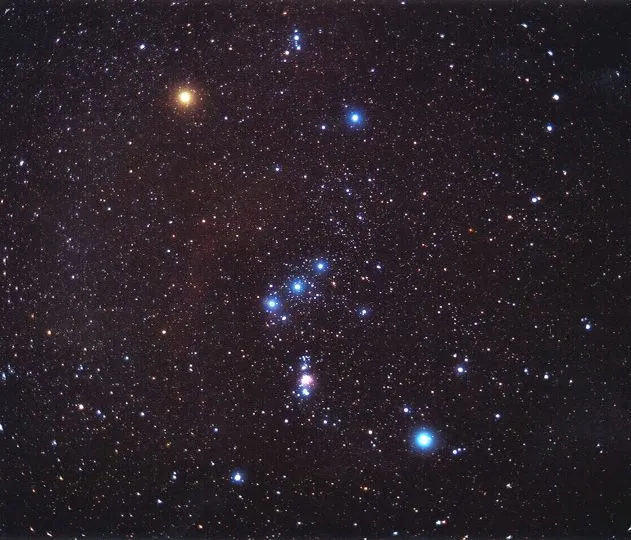
Orion is one of the most easily recognizable constellations in the sky. But its stars and nebula do not appear as colorful to the eye as in this charming photograph taken from Phoenix, Arizona, USA.
The reddish Betelgeuse, top left, and Rigel, the bright bluish one, bottom right, we see in inverted position in the Southern Hemisphere.
The famous "belt" of the hunter are the popular "Three Marys": Alnitak, Alnilam, and Mintaka, about 1,500 light-years away. Below the belt, in this photo, lies his sword, which contains a true jewel: the Orion Nebula.
Credit & Copyright: Matthew Spinelli
It was the Astronomy Picture of the Day (APOD) on February 7, 2003. In Spanish at Observatorio.
Images of the week
The wings of the Seagull Nebula
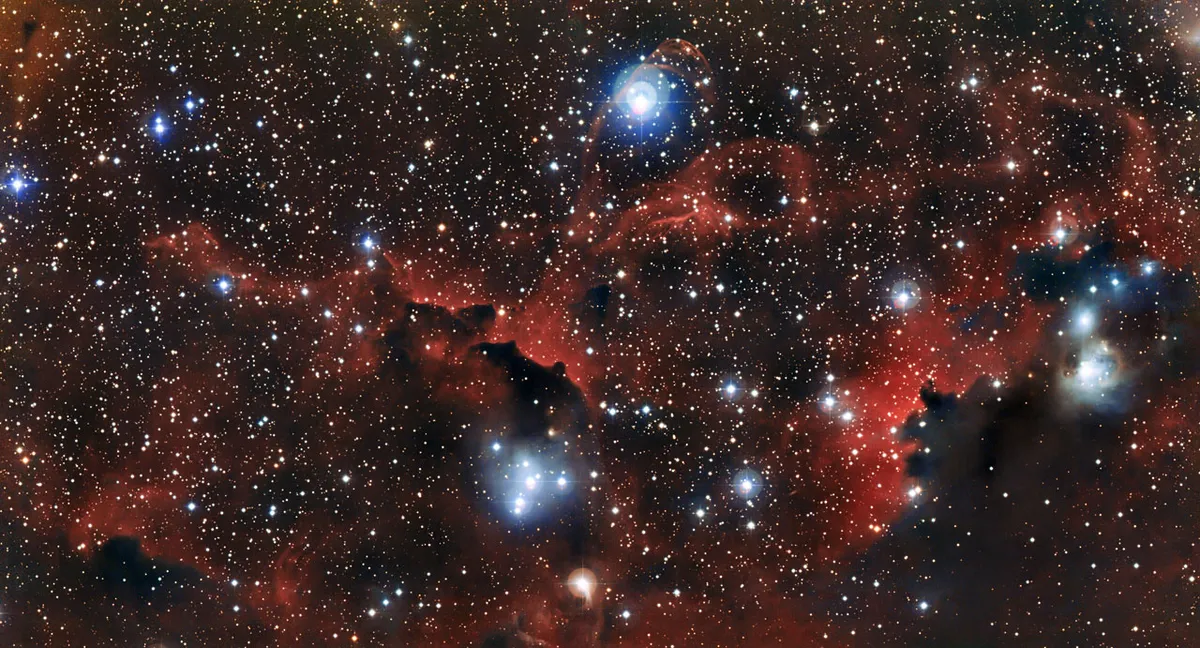
This new image from ESO shows part of a cloud of glowing dust and gas called the Seagull Nebula. These few red clouds form part of the "wings" of this celestial bird and the image reveals a fascinating mix of dark clouds and bright red clouds, mingled with shining stars. This new image was captured by the Wide Field Imager instrument, installed on the MPG/ESO 2.2-meter telescope at ESO's La Silla Observatory in Chile.
Located on the border between the constellations of Canis Major (The Great Dog) and Monoceros (The Unicorn) in the southern sky, the Seagull Nebula is a huge cloud composed mainly of hydrogen. It is an example of what astronomers call an HII region. Inside these clouds, new hot stars are forming and their intense ultraviolet radiation causes the surrounding gas to glow brightly.
The reddish hue in this image indicates the presence of ionized hydrogen. The Seagull Nebula is a complex object, shaped like a bird, composed of three large gas clouds — Sharpless 2-292 forms the "head," and this new image shows part of Sharpless 2-296 (IC 2177), which comprises the huge "wings," and Sharpless 2-297, a small, tangled addition located at the tip of the seagull's right "wing." This HII region is centered around the Be-type star cataloged as HD 53367.
This seagull is located 3,600 light-years from Earth.
All these objects are inscribed in the Sharpless catalog of nebulae, a list of about 300 glowing gas clouds compiled by American astronomer Stewart Sharpless in the 1950s. Before publishing this catalog, Sharpless was a graduate student at Yerkes Observatory, near Chicago (USA), where he and his colleagues published observational work that helped demonstrate that the Milky Way is a spiral galaxy with huge curved arms.
Credit: ESO
The image was published on ESO on February 6, 2013.
A spiral galaxy with a secret
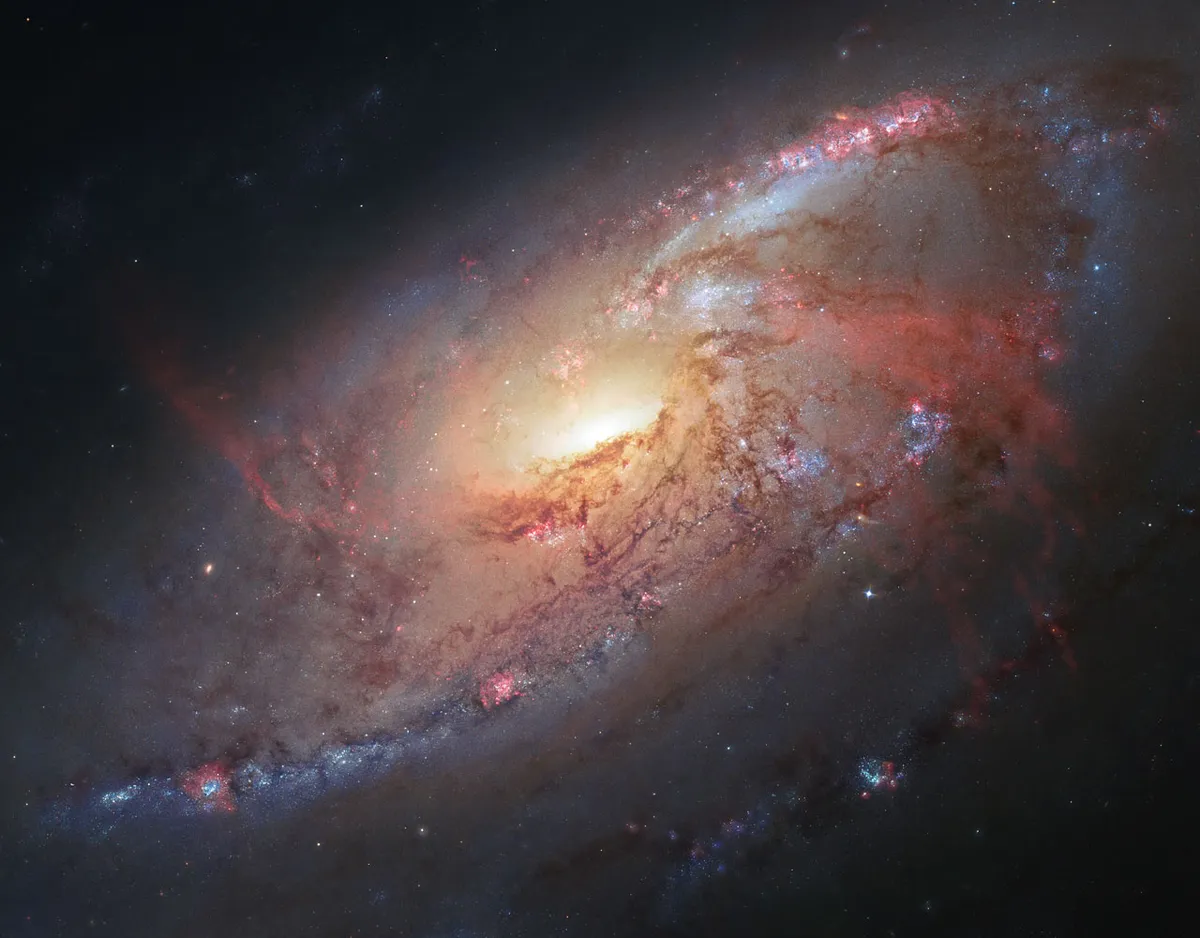
With Hubble and the help of an amateur astronomer, one of the best views of the nearby spiral Messier 106, located more than 20 million light-years away, was achieved.
Although it looks similar to other galaxies, M106 has its secrets. Unlike the central black hole of the Milky Way, which is not very active, the one in M106 is.
Furthermore, instead of having two spiral arms, it appears to have four, although the second pair is not perceived in visible light and is not composed of stars, but of gas.
The mysterious galaxy is part of the Messier catalog, but it was discovered by his assistant Pierre Méchain, and was only added to the catalog in the 20th century.
Amateur astronomer Robert Gendler retrieved Hubble archive material of this galaxy to assemble a mosaic of the object's center and also used his own material, as well as that of astrophotographer Jay GaBany. These amateurs have extensive experience and excellent equipment (12.5 and 20 inches) located in remote and very dark sites in New Mexico, USA.
Gendler was one of the winners of the Hubble Hidden Treasures competition.
Credit: NASA, ESA, the Hubble Heritage Team (STScI/AURA), and R. Gendler (for the Hubble Heritage Team). Acknowledgement: J. GaBany
The image was published on SpaceTelescope on February 5, 2013.
Space Music
SilMi (abstract_electronic)
Silvery Midge (Silmi) is Russian and composed a series of tracks that have some relation to astronomical objects, such as M27, which we talked about at the beginning, Antares and M92.
Animated Science
Unmovable object vs unstoppable force: Who wins?
In this video from Minute Physics, with Spanish subtitles, we are invited to think, from physics, whether it is possible for an unmovable object to exist or what that could mean.
Ideal to keep in mind before going to the movies to see films like Upside Down.
To access previous editions of this section, consult the Multimedia Selection Series. The series attempts to show that the immensity of the universe can be perceived in different ways. I choose some images from a decade ago -so they don't fall into oblivion- and from the current week that ends, as well as sounds/music and videos that are artistic forms of expression with content related to astronomy and related sciences. I am also collecting these materials on the Pinterest account