A collection of links to music, images and videos that relate art and science. Today: Images of NGC 3079; Fermions and bosons; Mercury; Super-thin mirror at ESO. Music by Dyz Lecticus. Video: The power of the force of gravity on Earth.

Images of the decade
The superwinds of gas in NGC 3079
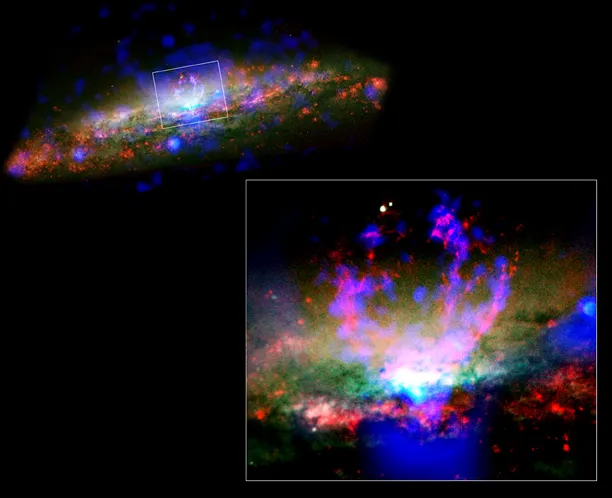
Combined images from Chandra in X-rays (blue) and Hubble in visible light (green and red) compose this portrait of the spiral galaxy NGC 3079. Imposing filaments of hot gas (from tens of thousands to tens of millions of degrees) create the bright horseshoe-shaped structure seen in the detail inset.
The correlation between the hot gas and the filaments suggests they formed as a superwind of gas from the central region of the galaxy that excavated a cavity in the cooler gas of the galactic disk. Such superwinds can be generated by the activity of a supermassive black hole or by supernovae and, as astrophysicists think, play a key role in the evolution of galaxies.
The galaxy lies in Ursa Major, 55 million light-years away from Earth.
The image was published on the Chandra site on February 19, 2003.
Credits: NASA/CXC/STScI/U.North Carolina/G.Cecil
Fermions and bosons
Why doesn't matter collapse? The same principle that prevents neutron stars and white dwarfs from imploding makes us not implode and makes normal matter be mostly empty space. If normal matter is composed of atoms and the nucleus of atoms occupies very little space, then atoms are almost totally empty. And then everything else is too. A wall is made of atoms, but if they are almost totally empty, why can't we pass through walls? (Well, we can, with the help of a mass...)
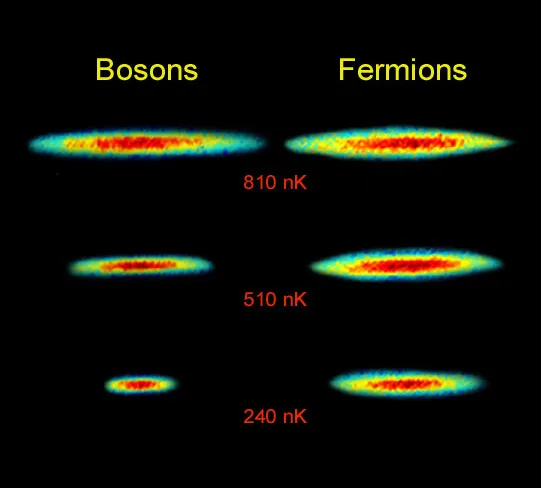
The cause of this is known as the Pauli exclusion principle. The principle states that two identical fermions — a type of fundamental matter — cannot be in the same place at the same time and with the same orientation. The other type of matter, bosons, does not have this property, as Bose-Einstein condensates clearly demonstrate. The Pauli exclusion principle was recently demonstrated graphically with the image above, which shows clouds of two lithium isotopes — the one on the left is of bosons, while the one on the right is composed of fermions. As the temperature drops, bosons compress; in contrast, fermions keep their distance better.
The image shows clouds of ultracold atoms, with temperatures expressed in nK, that is, nano-Kelvin (one billionth of a degree above absolute zero).
But, if atoms are composed of protons, neutrons and electrons (which are all fermions, since the components of the atomic nucleus are in turn formed by quarks, and electrons are leptons, i.e., fermions), how is it possible that one type of lithium is considered a boson?
It happens, as physicist and blogger Dr. RKafle explains, that particles with half-integer spin, for example, 1/2, are fermions, while particles with integer spin are bosons. And atoms of the same element, whose nuclei have a different number of neutrons, are called isotopes. Thus, Li-6 and Li-7 differ by one neutron. Now, Li-7 has three protons, four neutrons and three electrons. Each of these particles has spin 1/2, but in total, being an even number, they form a net integer spin, so it is a composite boson. In contrast, with Li-6, what we get is a half-integer spin, so it is a composite fermion.
Credits: Andrew Truscott & Randall Hulet (Rice U.)
It was the Astronomy Picture of the Day (APOD) on February 19, 2003. In Spanish at Observatorio.
Images of the week
The mineral colors of Mercury
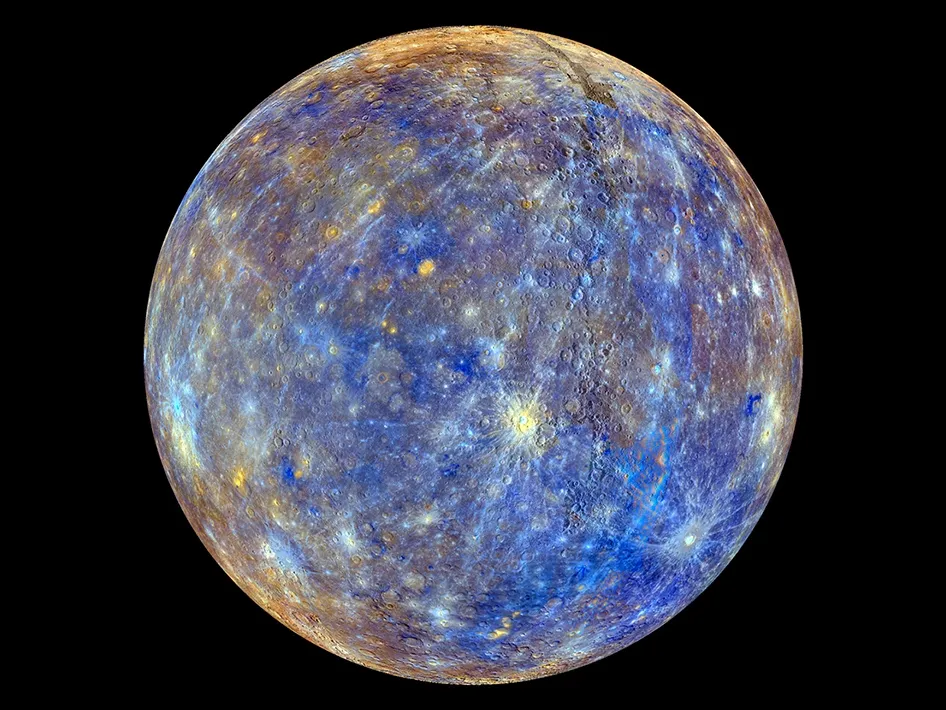
This colorful view of the planet closest to the Sun was produced with images taken by the MESSENGER mission. They are not the colors we would see with our eyes on the planet's surface, but a map of its mineral composition and physical differences between the rocks that make up the planetary surface.
Credit: NASA/Johns Hopkins University Applied Physics Laboratory/Carnegie Institution of Washington
The image was published this week on NASA.
Tests of the super-thin mirror at ESO
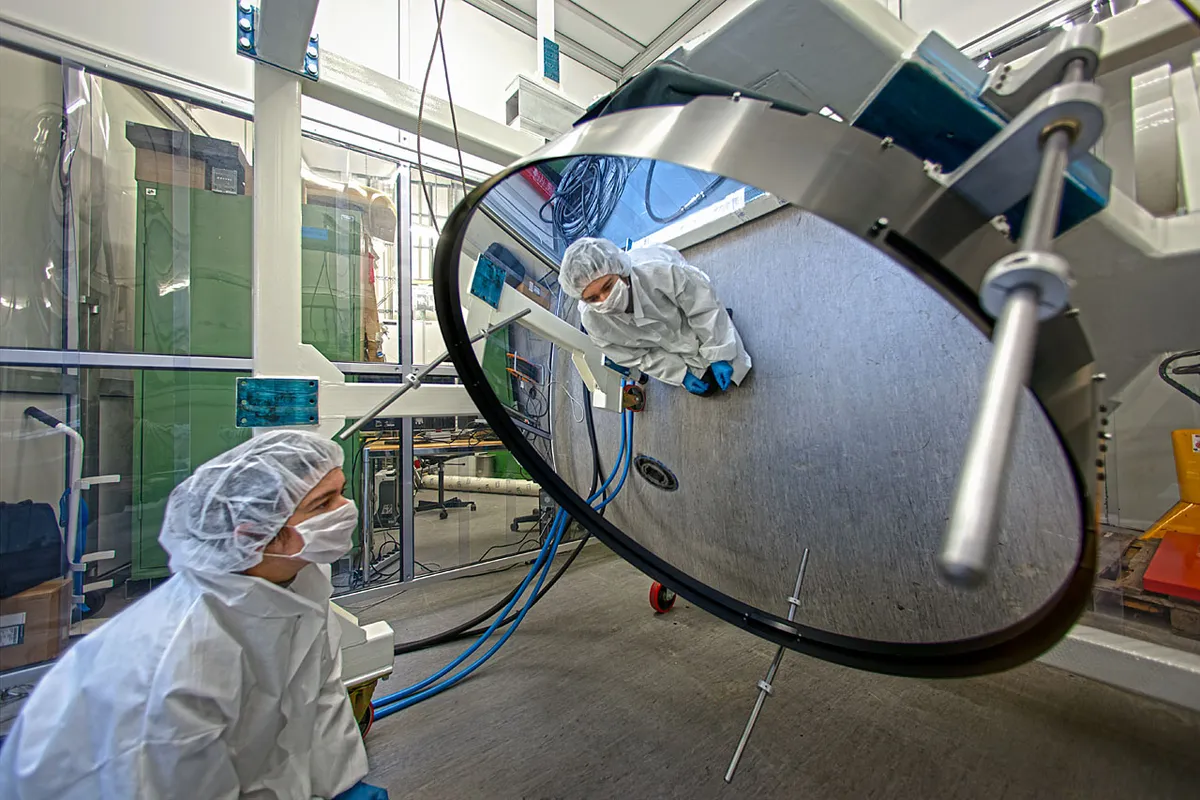
This impressive thin deformable mirror has been delivered to ESO in Garching, Germany, and in the photo it is shown undergoing one of its tests. It is 1,120 millimeters in size, but only 2 millimeters thick, making it much thinner than most glass windows. The mirror is very thin, so it is flexible enough for applied magnetic forces to alter the shape of its reflective surface. When installed, the mirror's surface will constantly change by small amounts from these forces that will correct the deforming effects of Earth's atmosphere, thus generating much more precise images.
The new Deformable Secondary Mirror (DSM) will replace the current secondary mirror in one of the VLT Unit Telescopes. The complete secondary structure includes a set of 1,170 actuators that apply force to 1,170 magnets glued to the back of the thin mirror. A sophisticated electronic system, developed specifically for this device, controls the behavior of the thin mirror. The reflective surface can be deformed more than a thousand times per second thanks to the action of the actuators.
The new mirror is one of the main components of the deformable secondary mirror that will replace the current secondary mirror in one of the four VLT Unit Telescopes. This is part of the new Adaptive Optics System for the VLT.
More information at ESO.
Image credit: ESO.
Space Music
Dyz Lecticus: Majorana fermion
André van der Zee is a Dutch musician who, as he tells on SoundCloud, was diagnosed with mild dyslexia when he was 13 years old, hence his stage name. Despite having problems reading and writing, his brain works very well when it comes to mathematical abstractions, physics, music and software.
Here, one of his compositions, about Majorana fermions.
https://soundcloud.com/dyz-lecticus/majorana-fermion
Animated Science
ESA Euronews: The power of the force of gravity on Earth
Gravity is a fundamental force of nature, an invisible force that dominates our planet, from its rocky depths to the oceans. It is a phenomenon of constant attraction, studied centuries ago, but which still raises questions for the scientific community. If we remove or add mass at a specific geographic point, the force of gravity changes. Knowing exactly how much is complicated, because several factors influence the gravitational phenomenon.
To access previous editions of this section, consult the Multimedia Selection Series. The series attempts to show that the immensity of the universe can be perceived in different ways. I choose some images from a decade ago -so they don't fall into oblivion- and from the current week that ends, as well as sounds/music and videos that are artistic forms of expression with content related to astronomy and related sciences. I am also compiling these materials on the Pinterest account