A collection of links to music, images, and videos that relate art and science. Today: Images of Stellar Valentine's Day (NGC 346); On Verne's Moon; SN 1006; W49B. Music: Requiem for W49B. Video: Does the Universe Have a Purpose?

Images of the decade
Stellar Valentine's Day: A heart in the darkness
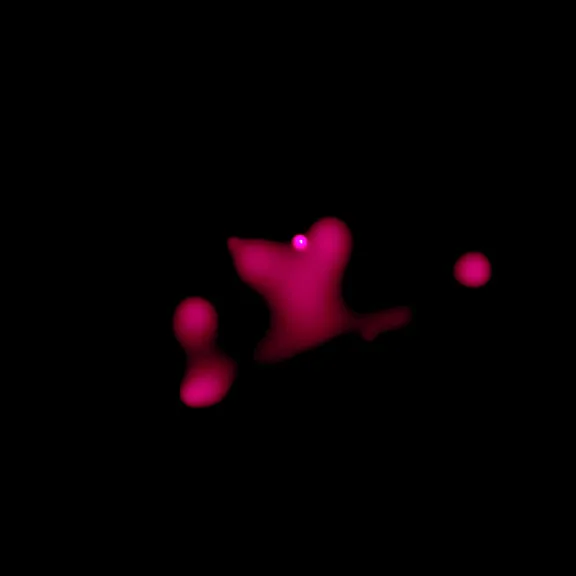
In this image obtained with Chandra in X-rays of the young open star cluster NGC 346, a red heart seems to be seen in the cosmic penumbra. It has a lot of passion: this heart-shaped cloud at the center of the cluster is gas at 8 million degrees Celsius. Deadly romantic. Radio, optical, and ultraviolet evidence suggests that the central cloud, which is 100 light-years in diameter, is the remnant of a supernova that occurred thousands of years ago.
The progenitor could have been a companion of the massive star that is responsible for the bright X-rays at the top center of the image. That star, HD 5980, one of the most massive known, has had dramatic eruptions over the last few decades.
NGC 346 is located in the Small Magellanic Cloud, in Tucana, about 210,000 light-years away.
Credits: NASA/CXC/U.Liege/Y.Nazé et al.
The image was published on the Chandra site on February 12, 2003.
On Verne's Moon

Lovers often seem to be on the moon of Valencia, that is, to be distracted, absent-minded.
The phrase originated, apparently, in the walled Spanish city that closed its gates at nightfall. Those who got distracted and arrived late had to spend the night outside the walls, under the moon of Valencia.
On February 8, 1828, a man was born who had his head on the Moon, in another sense. Beyond his love life, he was in love with literature and scientific fiction. In 1863 he published Five Weeks in a Balloon, the first novel in the Extraordinary Voyages series, which included, in 1865, the work From the Earth to the Moon.
104 years later, NASA managed to land two men on the lunar surface, in another series of extraordinary voyages. There is no doubt: the passion of Jules Verne influenced NASA engineers. Let's compare the French author's spacecraft with the type of lunar module sent to the moon a century later.
This image shows Apollo 11 aboard the Saturn V rocket.
It was the Astronomy Picture of the Day on February 15, 2003. In Spanish, Observatorio.
Credits: NASA
Images of the week
Clues to the mysterious origin of cosmic rays
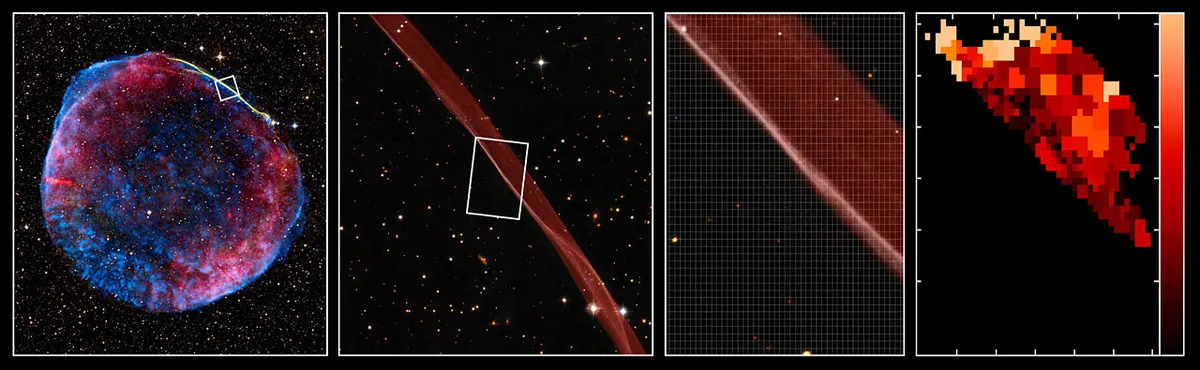
New, very detailed observations of the remains of a thousand-year-old supernova, carried out with ESO's Very Large Telescope (VLT), have revealed clues about the origin of cosmic rays. For the first time, the observations suggest the presence of fast-moving particles in the supernova remnants that could be precursors of these cosmic rays. The results appear in the February 14, 2013 issue of the journal Science.
In the year 1006, a new star could be seen in the southern skies, and its presence was widely recorded around the world.
For a long time it was believed that this type of supernova remnant is where a certain type of cosmic rays are formed — very high-energy particles originating outside the Solar System that travel at a speed close to that of light. But until now the details of how this happens have been a mystery.
A team of astronomers led by Sladjana Nikolić (Max Planck Institute for Astronomy, Heidelberg, Germany) has used the VIMOS instrument, installed on the VLT telescope, to observe, in more detail than ever before, the remnant of SN 1006, a thousand years old. Their intention was to study what was happening at the place where material was ejected from the supernova at high speed, boring through the stationary interstellar matter — the shock front. This rapidly expanding shock front is similar to the sonic boom produced by an airplane breaking the sound barrier and is a natural candidate for a cosmic particle accelerator.
For the first time the team has not only obtained information about the material in the shock front at one point, but has also mapped the properties of the gas, and how those properties change along the shock front. This has provided clues to solving the mystery.
More information at ESO.
Credits:
ESO, Radio: NRAO/AUI/NSF/GBT/VLA/Dyer, Maddalena & Cornwell, X-ray: Chandra X-ray Observatory; NASA/CXC/Rutgers/G. Cassam-Chenaï, J. Hughes et al., Visible light: 0.9-metre Curtis Schmidt optical telescope; NOAO/AURA/NSF/CTIO/Middlebury College/F. Winkler and Digitized Sky Survey.
W49B: Rare explosion may have created the youngest black hole in our galaxy
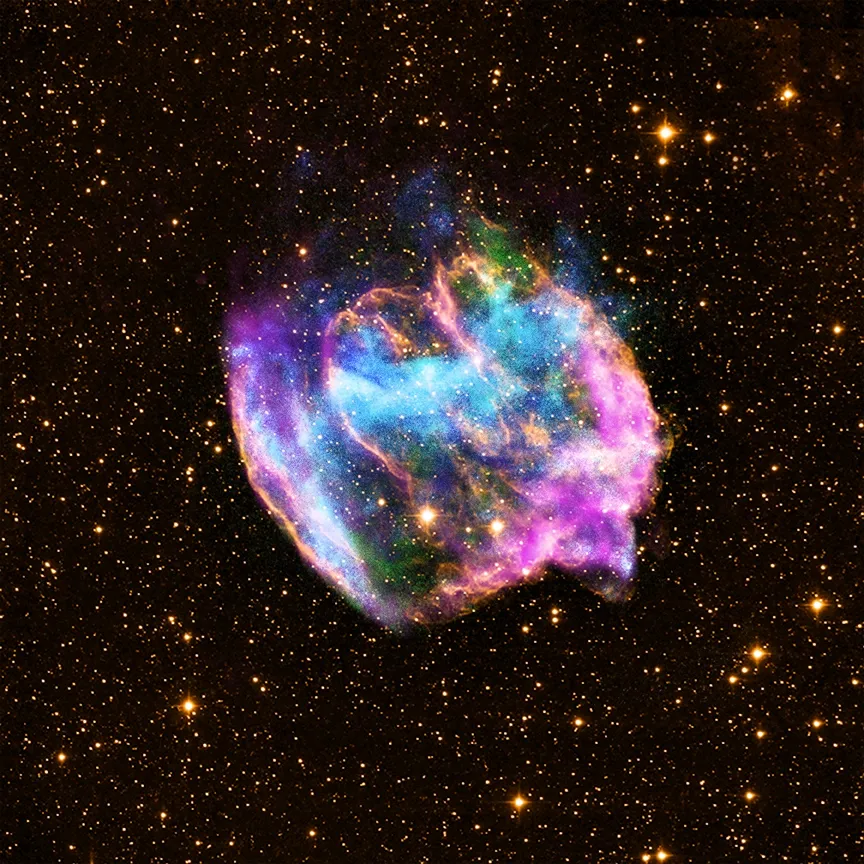
We return to talking about supernova remnants. In this image, which combines Chandra X-rays in blue and green, VLA radio data in pink, and Palomar infrared in yellow, we observe W49B, about 1,000 years old as seen from Earth, at a distance of 26,000 light-years.
Supernova explosions that destroy massive stars are generally symmetrical, but in W49B the material near the star's poles was ejected at a much higher speed than the material emanating from its equator. By tracing the distribution and amounts of different elements in the stellar debris, the researchers (led by Laura A López, MIT) were able to compare the data with theoretical models of how stars explode. They found iron in half of the remnant, while other elements such as sulfur and silicon were more widely distributed (the press release has an image with the distribution).
They also studied what compact object remained after the supernova. Usually neutron stars are found, but they did not find one here, which implies that, perhaps, a black hole formed after the explosion.
And that, in turn, would mean that such an object could be the youngest black hole in the Milky Way, only a thousand years old. Clarification: the explosion was detected on Earth a thousand years ago, but it "occurred" 26,000 years earlier, since the light takes that long to reach us, given the distance at which the object is located. However, from a human point of view it is possible to say, Protagorically, that "Esse est percipi," paraphrasing Berkeley and Bustos Domeq.
The research was published in Astrophysical Journal.
Credits: X-ray: NASA/CXC/MIT/L.Lopez et al.; Infrared: Palomar; Radio: NSF/NRAO/VLA
The image was published on Chandra on February 13, 2013.
Space Music
Theoretical Limit: Requiem for W49B
From SoundCloud, French musician Theoretical Limit composed a Requiem (music for the deceased) for this supernova remnant.
Animated science
Does the Universe have a purpose?
Neil deGrasse Tyson (American astronomer) gives us his point of view, through cartoons and in just two and a half minutes, thanks to MinutePhysics. The topic, however, is suitable for hours of conversation. In fact, it is a question we have been asking ourselves for millennia and answering in many ways.
Perhaps some reader has started thinking about the topic due to the alarming proliferation of news about the passage of asteroid DA14 and the meteorite fall in Russia.
Tyson says: "...if the purpose of the universe were to create an environment suitable for life, then our cosmic surroundings have a strange way of showing it..."
Regarding whether it is possible to predict this type of phenomenon, Dr. Adrián Brunini explains why we should continue sleeping peacefully, in Clarín.
To access previous editions of this section, consult the Multimedia Selection Series. The series attempts to show that the immensity of the universe can be perceived in different ways. I choose some images from a decade ago -so they don't fall into oblivion- and from the current week that ends, as well as sounds/music and videos that are artistic forms of expression with content related to astronomy and related sciences. I am also compiling these materials in the Pinterest account