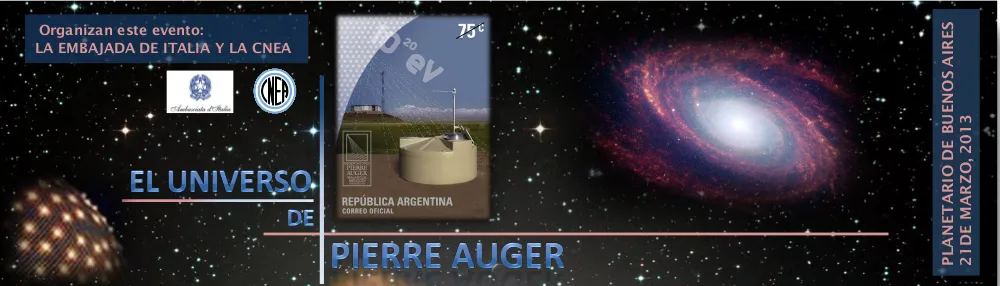
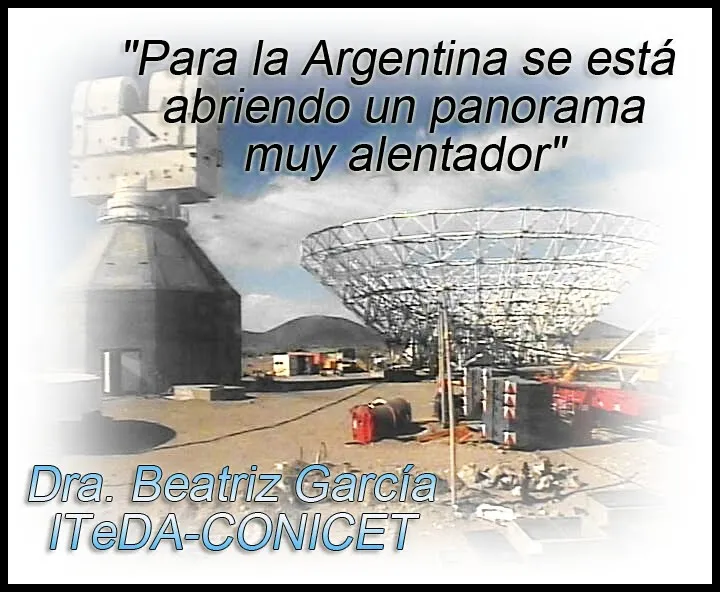
A workshop was held at the Planetarium in which the national interest in the study of astroparticles was made clear. For this purpose, the country signed an agreement with Italy and promotes the local installation of the CTA.
The day began with introductory words from Argentine and Italian authorities: the Manager of the Area of Research and Non-Nuclear Applications of CNEA, Alberto Lamagna; the Ambassador of Italy in Argentina, Guido La Tella; the National Vice-Minister of Science and Technology, Alejandro Ceccatto; the Cultural Attaché of Italy, Gabriele Paparo.
Subsequently, Lic. Lucía Sendón de Valery, director of the Galileo Galilei Planetarium of the City of Buenos Aires, summarized the reforms carried out in the iconic building, as well as its usefulness in astronomical outreach, and gave a demonstration of the new capabilities of the equipment.
Then the scientific day properly began with the participation of Giorgio Matthiae (University of Rome) and the director of the Institute of Technologies in Astroparticle Detection (CNEA, CONICET, UNSAM), Alberto Etchegoyen, who spoke about the Auger Project.
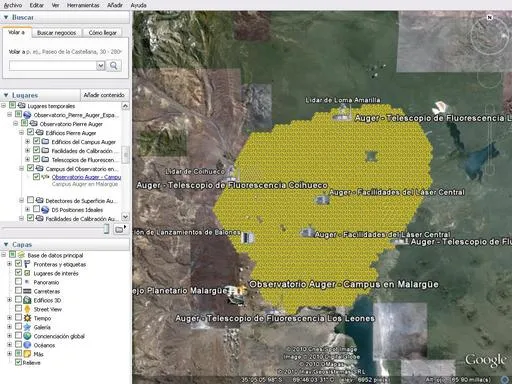
As we already know, the Auger Observatory is located in the departments of Malargüe and San Rafael, Mendoza and has an area of 3,000 km2, making it the largest experimental facility in the world.
The scientific collaboration brings together 500 scientists from 18 countries who study the data recorded by 16,000 surface detectors and 27 fluorescence telescopes. The detectors are water tanks with 12,000 liters and allow the detection of astroparticles through the Cerenkov effect by which a charged particle traveling at a speed greater than that of light in the medium emits photons. The telescopes measure the fluorescence emitted in the atmosphere as a consequence of cosmic rays.
Both detection systems include very sophisticated local developments in mechanics, electronics, telecommunications, and data acquisition and analysis systems.
The scientific panorama narrated by Dr. Etchegoyen is honestly colossal regarding the high-precision technological deployment that is possible, among other reasons, thanks to local impetus.
That same day, an agreement for cooperation was signed between Argentina and Italy for the design, construction, and commissioning of the Pierre Auger Observatory. More detailed information on this is available at CNEA.
After a short break, the talks resumed. At that moment, a detestable discovery occurred: two backpacks (containing notebooks, scientific and personal documents) belonging to the two speakers who were next had "disappeared".
Despite the bad experience, Dr. Félix Mirabel spoke about his participation in the CTA project, in which he holds the international coordination of the infrastructure.
As happened with other international projects, such as SKA, our country is a candidate for the installation of CTA, along with others such as Chile and Namibia in the Southern Hemisphere and Spain, the United States and Mexico in the Northern Hemisphere. But CTA will be installed in both hemispheres.
This "Observatory" will consist of about 100 telescopes for the study of cosmic emission of very high-energy gamma radiation (from tens of GeVs to tens of TeVs). They would be 4 telescopes of 24m (LST), 25 of 12m (MST) and 70 of 6m (SST). In this case, the collaboration is between 25 countries with an estimated cost of 200 million Euros. Its construction is planned for next year and it will be able to complement Auger by indirectly studying with gamma rays the sources of cosmic rays (neutron stars, supernova remnants, AGNs).
Argentina has proposed two installation sites: San Juan, in El Leoncito, and Salta (where the Llama Project is being developed with Brazil, which will be able to operate together with ALMA). It should be noted that there are optimal conditions for the installation of the project: the sites must be at about 30º north and south latitude, have a flat area of 10 km2 (in the south, in the North the installation will be smaller, 1km2) and with an altitude between 1,500 and 4,000 meters above sea level. The best sites must have 60% to 80% clear nights, no light pollution, mild winds (less than 10 m/s), and little seismic activity. The pre-existence of infrastructure as a result of observatories is an advantage. Scientific-political conditions (related to political-legal stability) are also considered. According to what Mirabel indicated, Salta is better positioned than San Juan.
After Mirabel, Fulvio Ricci (INFN Rome) took the floor and spoke about Gravitational Waves.
A longer break followed, during which I had to leave, but according to the program, the day would continue with Dr. Xavier Bertou (CNEA) who is the coordinator of the Andes Project, an underground laboratory to be built in the Agua Negra tunnel between San Juan and Coquimbo, Chile, from which cutting-edge experiments in neutrino physics and dark matter search can be conducted.
Perspective of Argentine science
These data clearly mark a national intention to promote and support large-scale scientific projects, without neglecting financial aspects, and which allow exploiting to the maximum the continental location of our country in the world, as well as the geographical environment of some localities and the local development of human and technological resources.
Undertaking cutting-edge scientific projects always requires a lot of money. Our country, even though it has grown economically in the last decade, cannot afford to make multi-billion dollar investments in R&D ignoring that there are still many unmet basic needs. But that does not prevent, through international collaborations, carrying out cutting-edge basic science with long-term investments among several countries.
Importance of the study of astroparticles
Since Pierre Auger discovered cosmic showers in 1938, a new field of transdisciplinary study began to open up: astroparticle physics, emerging from the intersection of nuclear and elementary particle physics, astronomy, and cosmology. Cosmic rays, dark matter, dark energy, gravitational waves, proton decay, and the properties of neutrinos are areas within astroparticle physics that make up the study topics of modern astrophysics and whose primary and fundamental objective is to understand how the universe is composed and how it works from the micro to the macro scale.
In this field, data acquisition seems to be ahead of theoretical development, making it a less speculative discipline that requires facilities and technological developments to prevent data from being confused with background noise with great precision. This inevitably generates technology and knowledge transfer, as well as synergies with different areas of industry and the promotion of higher education.
Sources and related links
- CNEA promotes Italo-Argentine cooperation in astroparticles
- Argentina, taking steps to host the immense CTA project
- CTA-Argentina
- CTA-ITeDA
- CTA International