A collection of links to music, images and videos relating art and science. Today: Images of M57; The false sunset of Europe and Africa; IRAS 23436+5257; The Universe of Planck. Music: Circular Rhythms - Planck Observation. Video: Have a coffee with ExpC.

Images of the decade
M57
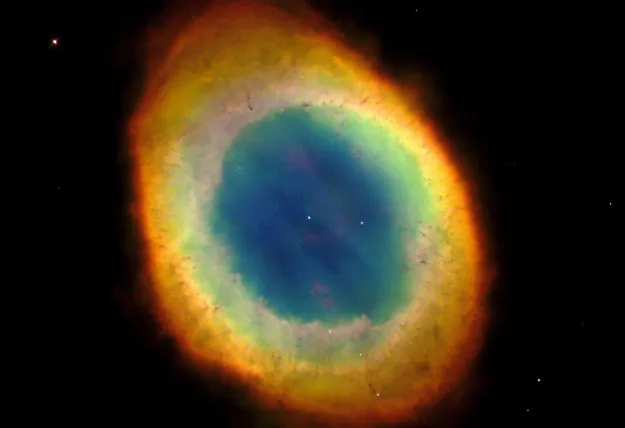
Last week, in this same space, we talked about rings. Among the most famous are those of Saturn (despite Jupiter, Uranus and Neptune also having rings), as well as that of Messier object 57, the Ring Nebula. It is a planetary nebula that has a barrel shape, although we perceive it as in the photograph due to the perspective we have of the object seen from our planet. At its center lies a dying star. The image was produced with Hubble photos and contains a color coding that indicates the temperature of the gas in descending order from the hottest center, in blue, to the cooler outer edge, in red. This structure is one light-year in diameter, which implies that if we were at one end of the nebula and turned on a flashlight, its light would reach the opposite position after traveling for a year through empty space. In contrast, light from the Sun takes 8 minutes to reach Earth. M57 lies 2,000 light-years away, in Lyra.
Credits: H. Bond et al., Hubble Heritage Team (STScI / AURA), NASA.
It was the Astronomy Picture of the Day (APOD) of March 22, 2003.
In Spanish at Observatorio.
The false sunset of Europe and Africa
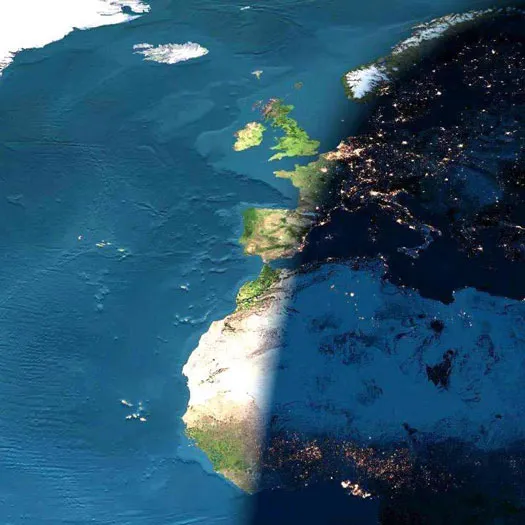
For some time, back in 2003, this image circulated with a text indicating it had been recorded by an astronaut.
It is a digital composition of archive images from many satellites orbiting Earth.
Similar images can be obtained digitally for any place on Earth from the Earth and Moon Viewer by John Walker on his website.
Specifically, the daytime images were taken by MODIS, an instrument on NASA's Terra satellite, while the nighttime images were taken by DMSP satellites.
This image is very different from what an astronaut would see, for reasons such as the total absence of clouds and an unrealistic exaggeration of lights and contrasts.
The digital image became a full-fledged urban legend, particularly because it circulated then with a text indicating it had been taken by the crew aboard Columbia during its last mission. In fact, that comment was not part of the text initially, but only after the shuttle's fatal accident on February 1, 2003.
They are "real" images taken by satellite at different times, but they do not reflect what a person would see at a single moment from space.
One might then wonder if it is possible to say there are "false photographs" or whether what can be false or not is what is said about a photograph.
I therefore allow myself to reflect on the role of the media and the increasingly urgent need for citizens to exercise our critical sense, as well as freedom of expression.
On March 24, 1976, the bloodiest authoritarian process in the country's history began in Argentina.
The media echoed what the official voice wanted to be said, which, of course, was not reality.
Credit: NASA. Copyright: The Living Earth, Inc.
It was NASA's Astronomy Picture of the Day (APOD) of March 24, 2003. In Spanish at Observatorio.
Images of the week
IRAS 23436+5257
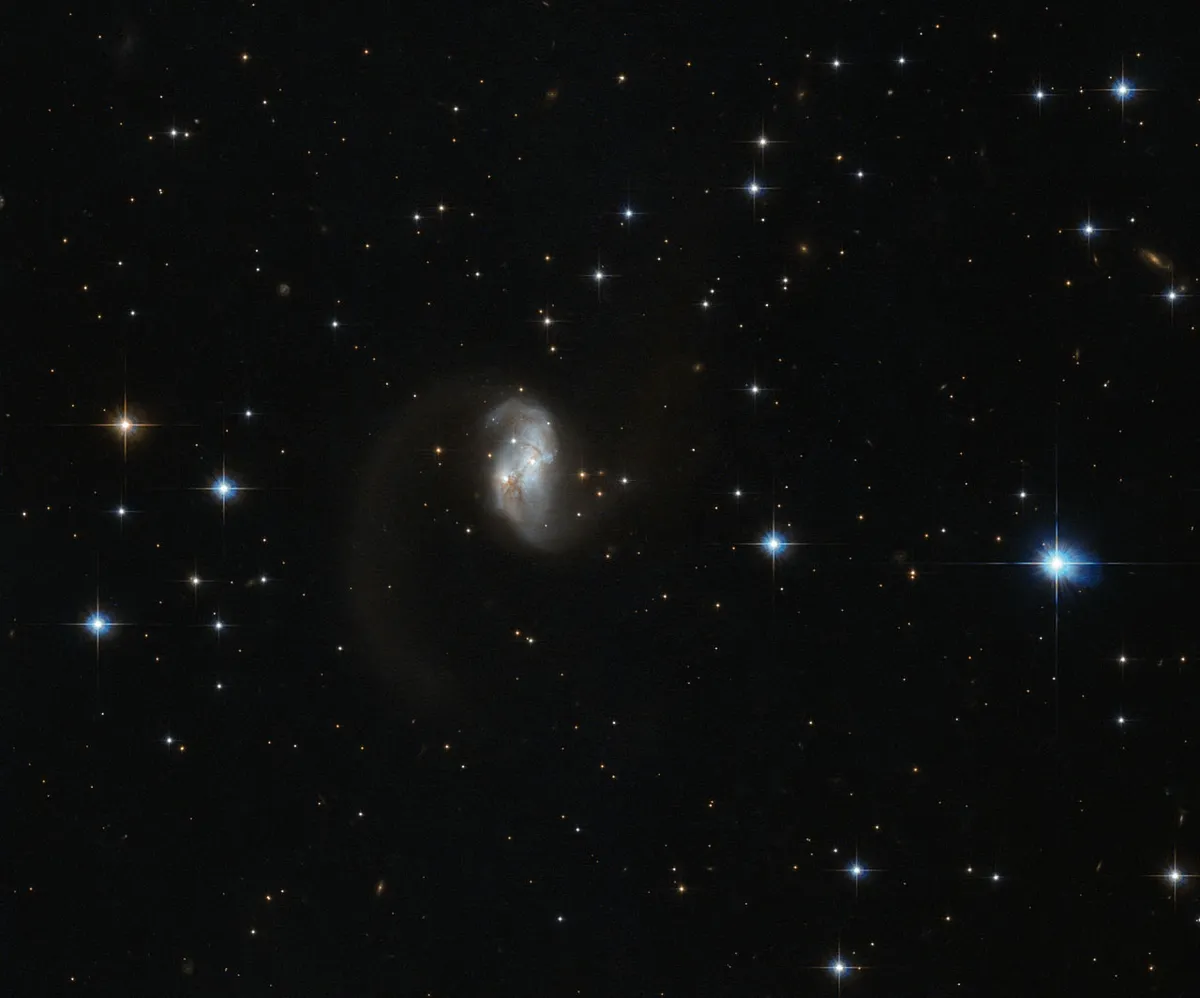
The bright, twisted galaxy in the photo, cataloged as the title indicates, was photographed by Hubble.
The structure is probably the result of the collision and merger of two galaxies. When we look up at the sky, the stars, nebulae and clusters we can observe with small instruments do not seem to indicate that the cosmos is tumultuous, but rather calm, static. But this record shows that it is not so, despite the enormous distances and time scales giving us the impression that nothing happens out there. Again, appearances are deceiving.
Credit: ESA/Hubble & NASA/Acknowledgement: Judy Schmidt
It was the Image of the Week from SpaceTelescope.
A more precise look at the universe with Planck
It has been, in a sense, the news of the week. It must be said, however, that locally an important announcement was made in astronomy which I hope to comment on soon.
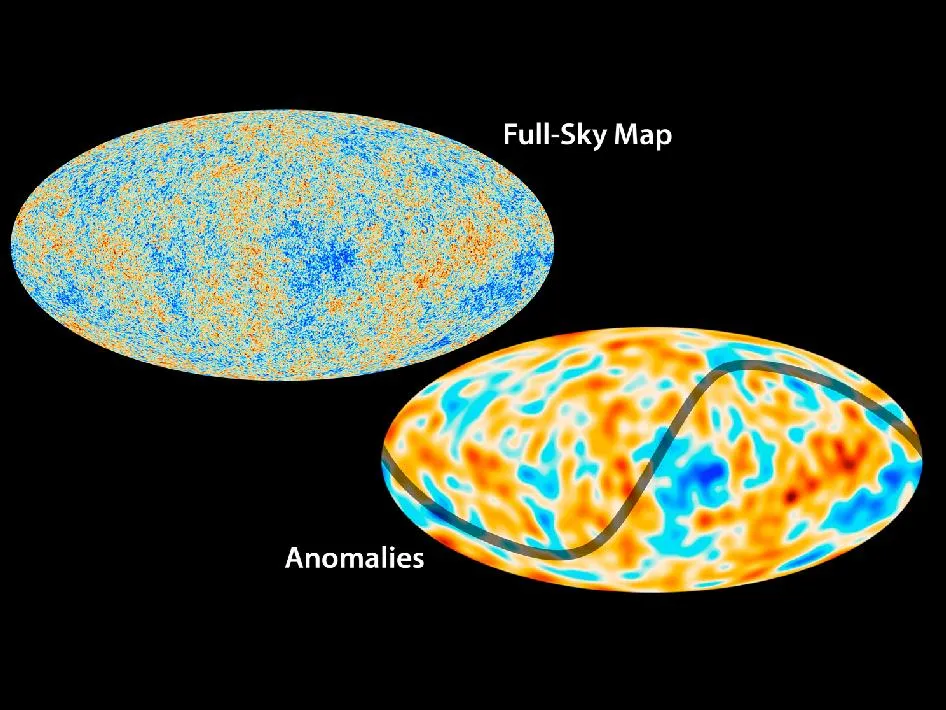
It happens that the Planck mission published the most precise and detailed map of the oldest light in the Universe, revealing new information about its age, content and origin.
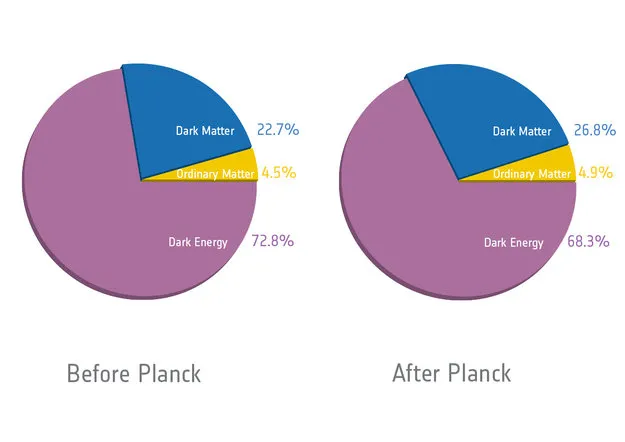
Among the results, it stands out that the Universe appears to be expanding slower than thought, and that it is 13.8 billion years old. Until now it was thought to be 13.7 billion (that is, a difference of 100 million years). But the data also indicate there is less dark energy and more matter (dark and baryonic).
Another significant piece of data are the so-called anomalies or asymmetries between both hemispheres of the sky, already predicted by WMAP and confirmed with greater precision by Planck.
The following charts show comparatively the composition of the universe measured by Planck (on the right, After) and before Planck, done by WMAP (on the left, Before).
Another way to show the difference between both missions, Planck and WMAP, is with these other charts:
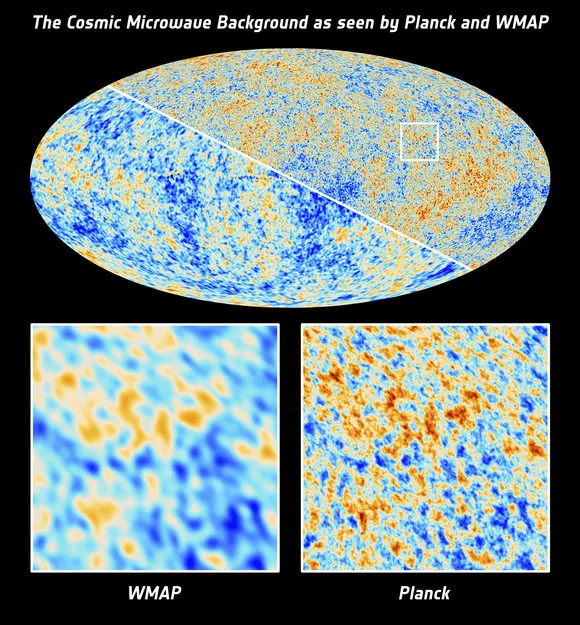
In both cases, what is shown is the Cosmic Microwave Background, according to both missions, noting a greater precision in the latest mission which has 15 months of data, while the WMAP data is based on its nine years of data.
Copyright ESA and the Planck Collaboration; NASA / WMAP Science Team
Space Music
Circular Rhythms - Planck Observation
This British artist published a few hours ago, on SoundCloud, this techno track, probably inspired by the ESA publication commented above.
https://soundcloud.com/circular_rhythms/circular-rhythms-planck
Animated Science
Have a Coffee with ExpC
I have commented on this blog several times about Expedición Ciencia. Scientific outreach and education IS an essential task of the State, but also of the private sector and initiatives arising from the researchers themselves. The members of ExpC fulfill that priority role of teaching science, which ultimately is to encourage critical thinking.
Now, we can help fulfill that task, through our collaboration. Donating is Doing, to the point that the participle of the second verb, in English, is written the same as the simple past of the first one, in Spanish: Done. And donating is an imperative of the will.
In this video, Melina Fourman, co-founder with Gabriel Gellon of Expedición Ciencia, explains that it is possible to help them in their task by donating each month what we would spend at a café for a coffee.
It depends on the State, of course. But a commitment from each of us is also possible (and necessary), those of us who believe that developing critical thinking in the education of children and young people is indispensable.
I make the suggestion my own: Have a coffee with ExpC.
To access previous editions of this section, consult the Multimedia Selection Series. The series attempts to show that the immensity of the universe can be perceived in different ways. I choose some images from a decade ago -so they don't fall into oblivion- and from the current week that ends, as well as sounds/music and videos that are artistic forms of expression with content related to astronomy and related sciences. I am also collecting these materials on the Pinterest account