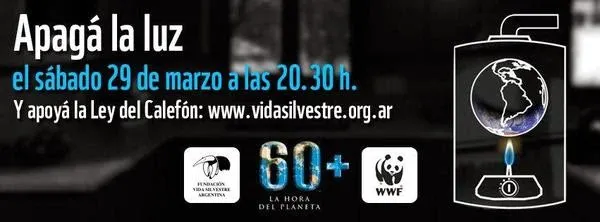
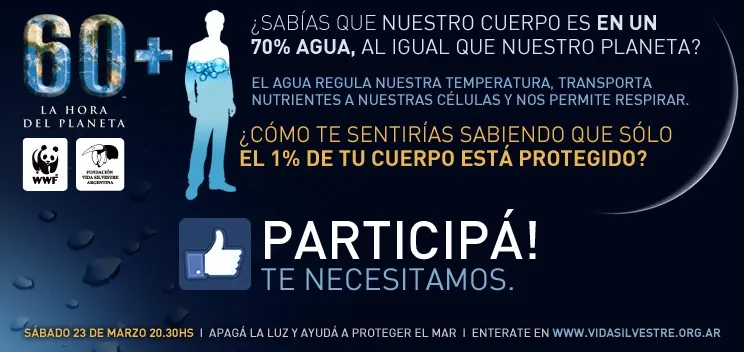
Saturday, March 23 at 20:30 h
Earth Hour is a global awareness campaign by WWF, the World Wildlife Fund, organized in Argentina by Vida Silvestre, which invites individuals, governments and businesses to turn off their lights for one hour to show that we care about climate change.
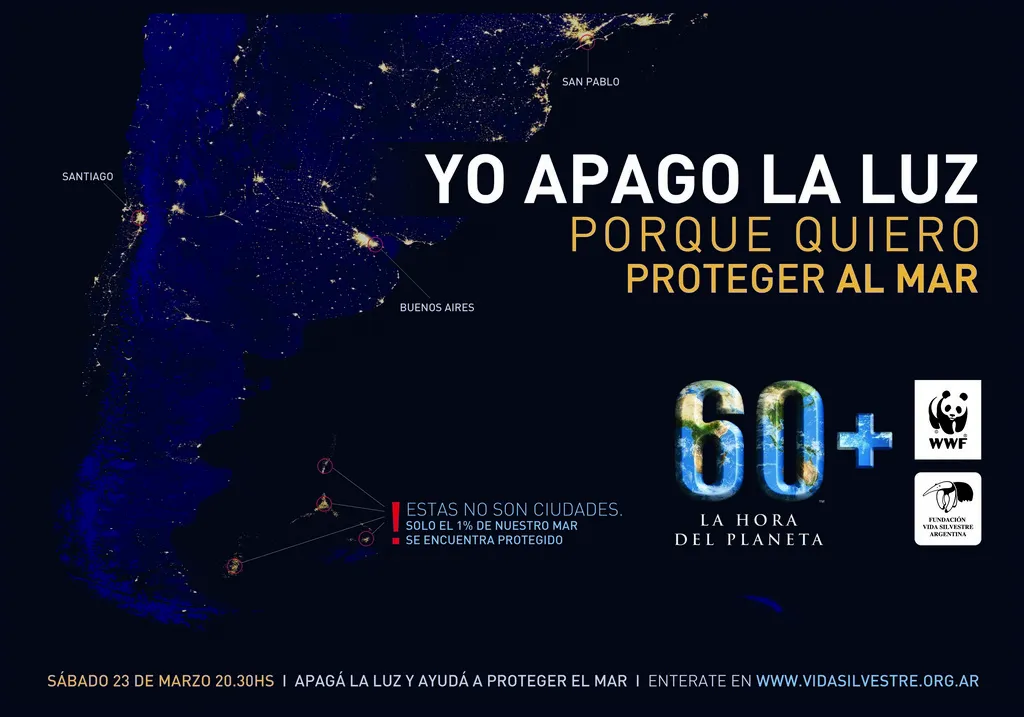
The Fundación Vida Silvestre Argentina (FVSA) invites you to turn off the lights on Saturday, March 23 between 20:30 and 21:30 hours to support the creation of more marine protected areas. In particular, it promotes the treatment in the National Senate of a bill for the creation of the Marine Protected Area “Namuncurá Bank (Burdwood)”, an area of approximately 34,000 km2 of high biodiversity and vulnerability to environmental changes. It would be the first oceanic marine protected area, located within Argentina's exclusive economic zone. After its creation, the protection of the Argentine Sea will increase from 1% to 4%.
The initiative began in Sydney, Australia, in 2007 and brought together two million people. Six years later, in 2012, citizens in more than 6000 cities in 152 countries across all continents turned off their lights; more than 1500 iconic monuments and buildings went dark, such as the Opera House in Sydney, City Hall in London, the Empire State Building in New York, the Eiffel Tower in Paris and the Obelisk in Buenos Aires.
In the 2013 edition the focus is on the sea
This year, in Argentina, Earth Hour will be held to invite all Argentines to learn about the situation of our sea and commit to its conservation. The ocean, far from being an area without human activity, is now threatened by indiscriminate fishing, oil exploration and exploitation, pollution and climate change.
Indiscriminate fishing, inside and outside the Exclusive Economic Zone, causes the over-exploitation of stocks of many commercial species, and impacts on seabed species or the incidental catch of fish, birds, turtles and marine mammals due to the use of inappropriate fishing gear. The introduction of exotic species and biological invasions are also a significant danger, as it translates into competition for the survival of native species.
Climate change is another of the threats affecting the world's oceans. In the seas surrounding Antarctica, for example, increases in water temperature have been recorded down to 3,000 meters deep. And, the melting of ice in areas such as the Antarctic Peninsula, is already having effects on ocean salinity and temperature and ocean currents. These changes affect the entire ocean food chain, from krill to large cetaceans.
In the world, the seas are not sufficiently protected. In our country, only 1% of the surface of the Argentine Sea is dedicated to conservation and legally protected. There are 48 coastal-marine protected areas, covering an approximate area of more than 1 million hectares.
The Sea to Congress
Within the framework of Earth Hour, on Thursday, March 14, FVSA made a presentation before more than 30 legislators, advisors and journalists in the National Congress to promote the passage of the bill that will create the Marine Protected Area “Namuncurá / Burdwood Bank.
Is it a solution?
Many people think that turning off electronic devices for an hour doesn't help at all, that it's not a solution. Certainly it is not. Doing nothing isn't either. Earth Hour is a dissemination and awareness campaign, it is also an event to show that we care about our world. It is, in that sense, symbolic.
However, popular demonstrations, sufficiently massive and properly argued, are not harmless. They have influence on public opinion and the political agenda.
Secondly, not using electronic devices, even if only for an hour, if the event is massive, implies an energy saving that is not so negligible.
What to do? Add your drop
In addition to joining the event, by turning off all possible electronic devices between 20:30 and 21:30 hours on Saturday, March 23, 2013, another way to collaborate with the initiative is to participate via the web of Fundación Vida Silvestre or its Facebook page to express our explicit support, as well as spreading the event among our acquaintances.
Another way to help, beyond Earth Hour, is by joining the Fundación Vida Silvestre or collaborating through the Volunteer program.
Sources and related links
- Fundación Vida Silvestre: Earth Hour
- FVSA/Earth Hour on Facebook
About the images
- © Earth Hour 2013 Ad - Fundación Vida Silvestre
- © Earth Hour 2013 Facebook Ad - FVSA