A collection of links to music, images and videos that relate art and science. Today: Images of DEM L71; Iridescent Clouds; Alpha Centauri; Zw II 28; Comets over Paranal. Music: This is what the Higgs boson sounds like. Video: The ALMA movie.

Images of the decade
DEM L71
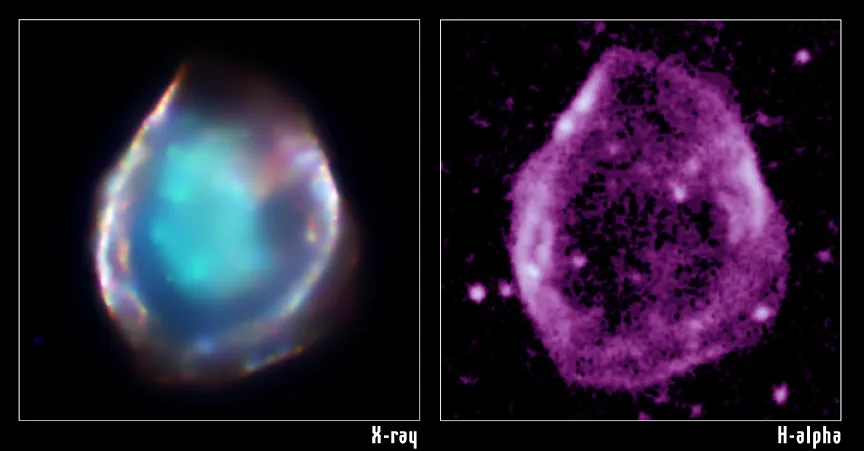
An image from the Chandra X-ray Observatory (left) of the supernova remnant DEM L71 reveals a hot inner cloud (light blue) of bright iron and silicon surrounded by an outer shock wave. The wave is also visible at optical wavelengths (right). Chandra data show that the central cloud, at ten million degrees Celsius, is the remnant of a supernova explosion that destroyed a white dwarf.
DEM L71 is a classic example of a double structure like the one expected to develop when a star explodes and ejects material at high speeds into the interstellar medium.
The object is located 160,000 light-years from Earth.
Credits: X-ray: NASA/CXC/Rutgers/J.Hughes et al; Optical: Rutgers Fabry-Perot
References: J. Hughes, et al. "Iron-rich Ejecta in the Supernova Remnant DEM L71" Astrophysical Journal, 582, L95, 2003 Jan 10.
The image was published on the Chandra site on March 12, 2003.
Iridescent Clouds
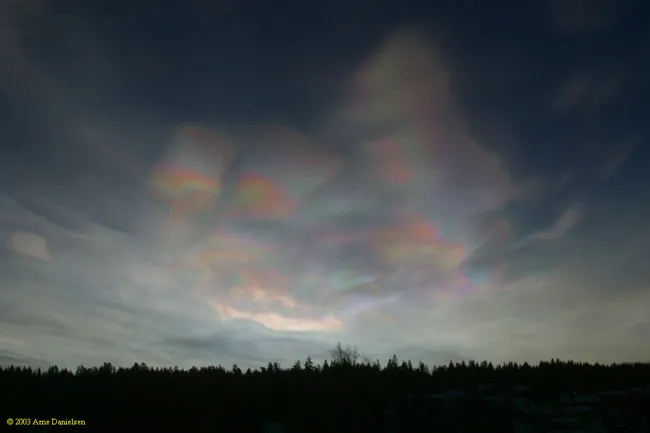
If we take a photograph of a natural landscape, the record can be interpreted as a document of reality at a given moment, but also as a work of art. Even more so if we manipulate the image to enhance the contrast or add colors that were not really there.
This photo shows a real phenomenon in which the color palette was provided by nature. We could consider these iridescent clouds as "natural art" (if you'll allow me the expression).
Iridescence is the property of some surfaces to vary the hue of light depending on the viewing angle. In this case, the surface is the clouds formed by small water droplets of similar size. When the Sun is behind thin clouds, they diffract sunlight forming these color patterns. It is similar to a rainbow, although in the case of iridescence it is a phenomenon of diffraction, that is, the deviation of light waves when hitting an opaque object, while the rainbow is formed by refraction, which is the change in direction of light when passing from one medium to another.
The iridescent clouds were photographed over Norway.
Credit & Copyright: Arne Danielsen
It was the Astronomy Picture of the Day (APOD) on March 11, 2003.
In Spanish at Observatorio.
Family portrait of the Alpha Centauri System
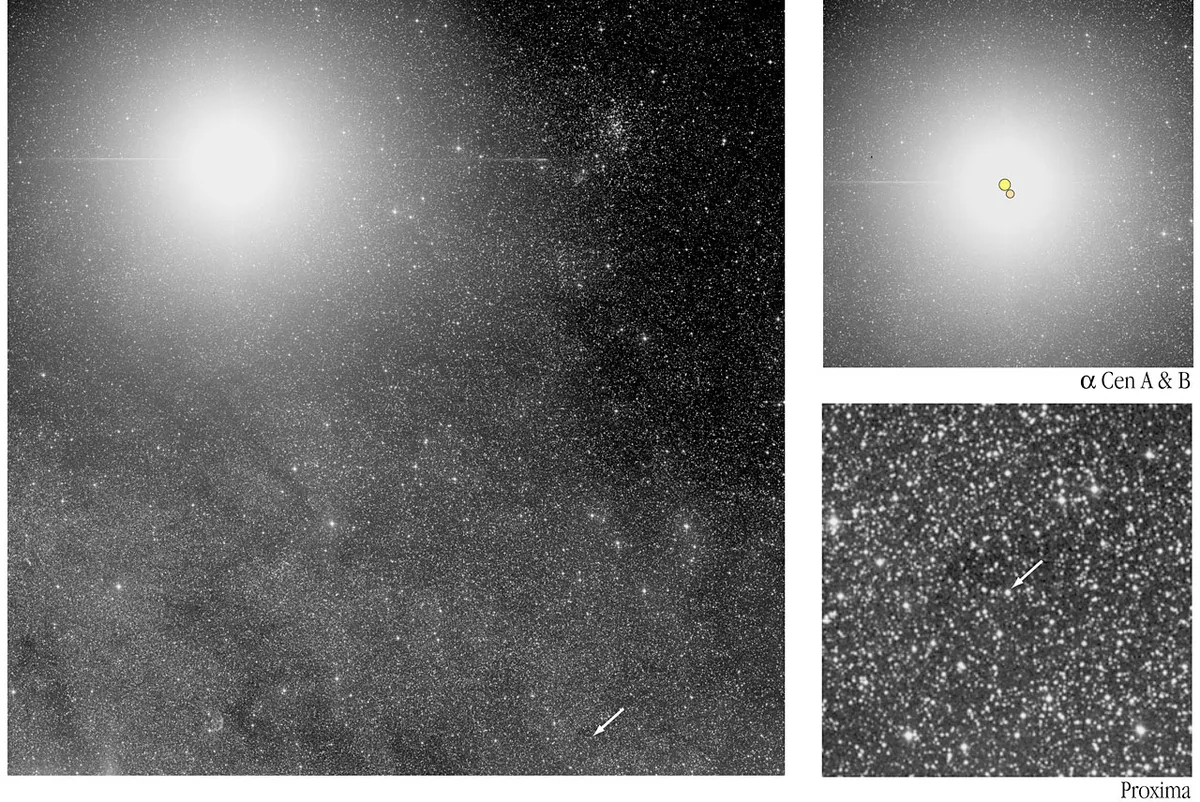
Recently a planet was detected in the star system closest to ours and researchers continue to investigate the region in search of more exoplanets.
A decade ago, with the VLT interferometer of ESO at Paranal, researchers were able to determine the angular sizes of the disks of the components of this particular system, which was not only the closest, but also the best known.
On March 15, 2003, ESO issued a press release with photographs of the system and a chart with the relative sizes of the components.
The Planetary Society is running a fundraising campaign to allow Debra Fischer and the FINDS Exo-Earth team to have access to a telescope in the Southern Hemisphere for 20 nights. For that, they need to hire the services of Cerro Tololo, whose cost is USD 1650 per night (USD 206 per hour). For 20 nights, they require USD 33,000.
Those who wish to contribute to that campaign, visit the Planetary Society site.
Images of the week
One ring to rule them all
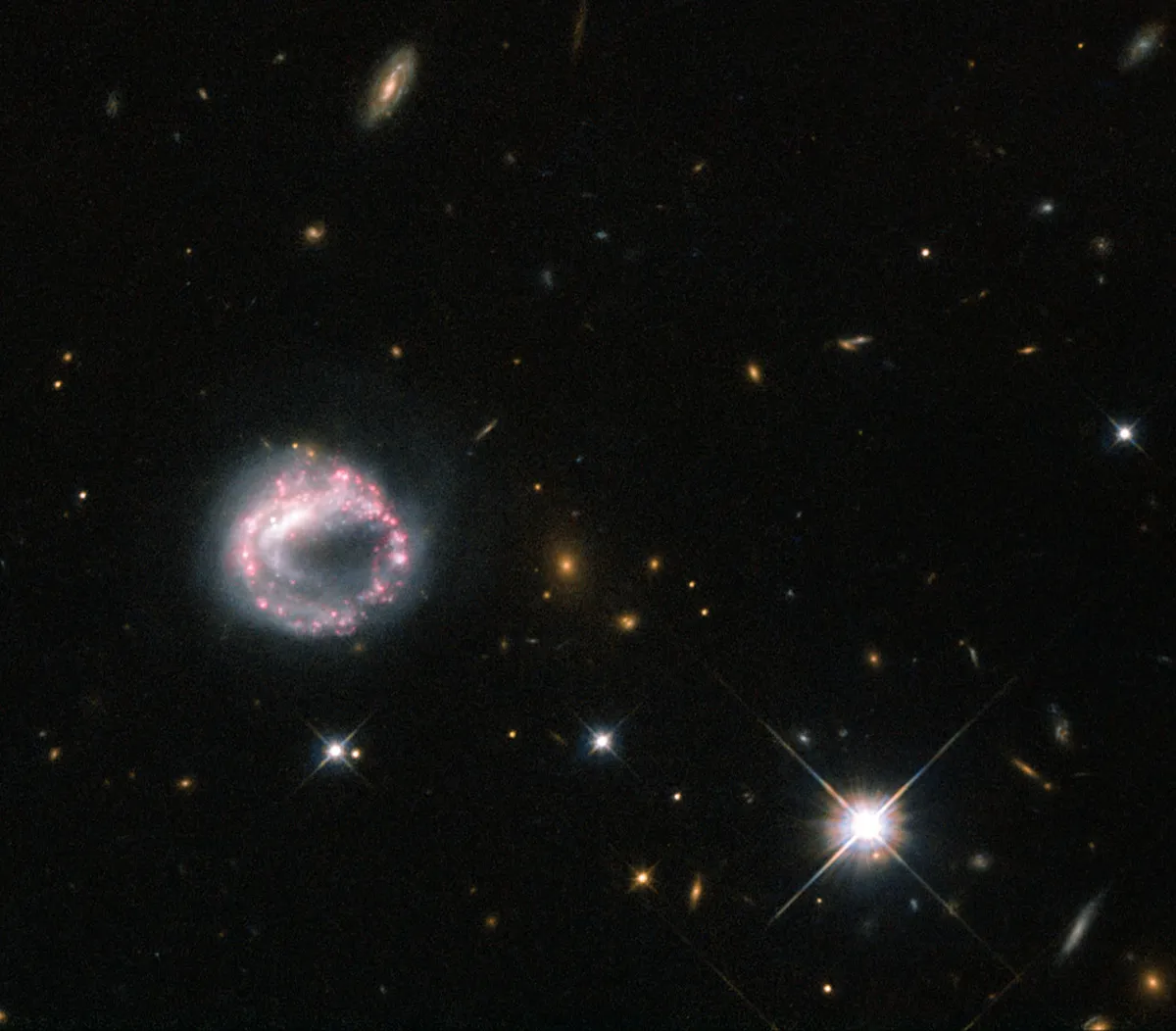
Galaxies can have different shapes: elliptical, spiral, with bulges and disks. But they can also have a ring shape, like this galaxy captured by Hubble: Zw II 28.
These ring galaxies are mysterious. It is thought that they form when one galaxy interacts with another, passing through the disk, which causes an alteration and redistribution of the shape of the dense nucleus.
But Zw II 28, also known as VV 790b, is not a typical ring galaxy due to its lack of a central companion (seen in the optical). But Hubble observations show that it is possible that a star is hidden just inside the ring.
The distance provided is in relation to its redshift (z=0.028). Using Ned Wright's calculator it is possible to calculate an approximate distance of 383 million light-years (117.6 Mpc).
It was the SpaceTelescope Image of the Week.
Credit: ESA Hubble & NASA/Judy Schmidt.
Comets and shooting stars dance over Paranal
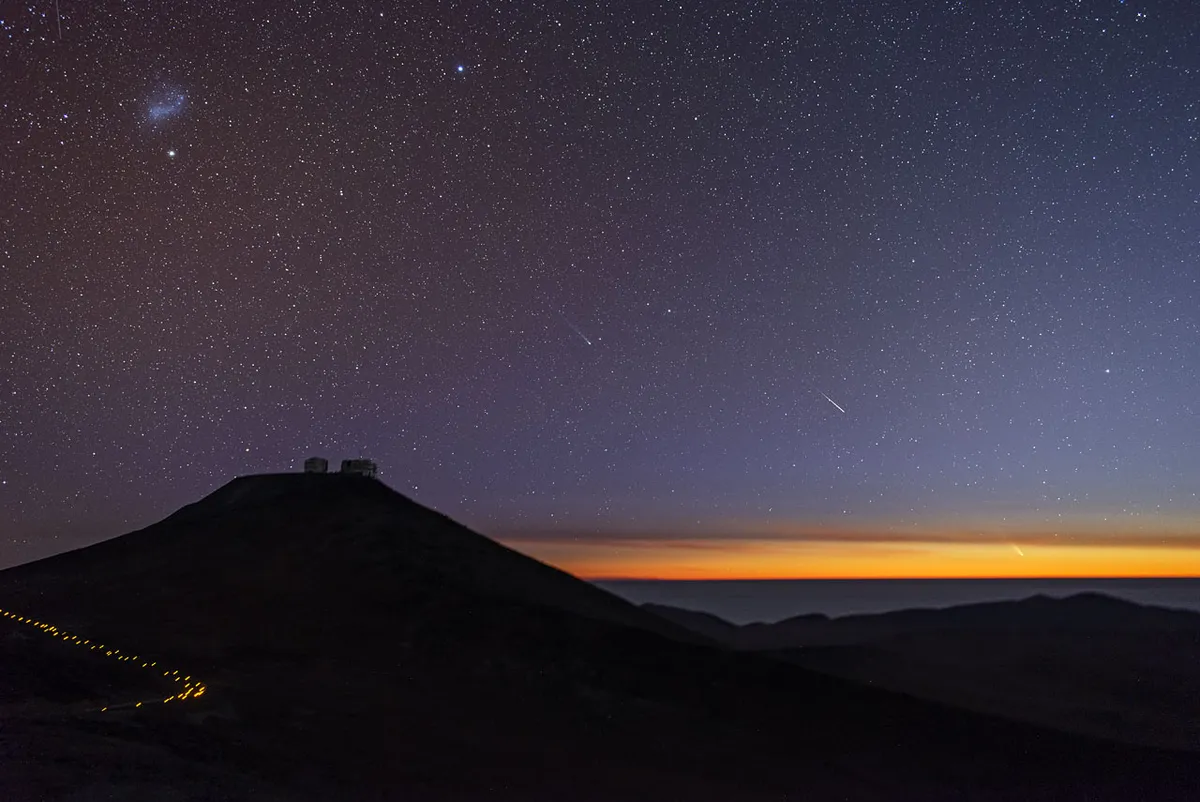
This impressive image was taken by Gabriel Brammer, one of ESO's Photo Ambassadors, and shows a sunset at the Paranal Observatory, with two comets speeding across the southern skies as protagonists. Near the horizon, on the right side of the image, comet C/2011 L4 (PAN-STARRS), the brighter of the two, shows its bright tail generated mainly by reflections of the Sun on dust. In the center of the image, just above the right slope of Paranal mountain, the greenish coma—a nebulous envelope surrounding the nucleus—of comet C/2012 F6 (Lemmon) can be distinguished, followed by a fainter tail. The green color is the result of the ionization of gases in the coma caused by sunlight. You might be fooled into thinking there is a third comet visible in this photograph, but the bright object zipping between the Lemmon and Pan-STARRS comets is a fortuitous shooting star burning up in the atmosphere in the right place at the right time.
Credit: G. Brammer/ESO
It was the ESO Picture of the Week.
Space Music
This is what "the Higgs boson" sounds like
Earlier we talked about a ring galaxy, under the title One ring to rule them all, alluding to The Lord of the Rings, of course.
In reality there are also "rings to rule". For example, on the very day of ALMA's inauguration, the one who would wear the new "Fisherman's Ring" was chosen.
The next day, March 14 (Einstein's birthday, Pi Day in the United States), it was announced that the particle discovered last year is indeed a Higgs boson.
And that was thanks to another ring, that of CERN's LHC.
Through a combination of high-speed research networks, advanced sonification techniques and grid computing, the world can now "hear" the recently discovered particle, a Higgs boson.
More at: Geant
https://soundcloud.com/gebla/higgs-boson-atlas
Animated science
ALMA: In search of our cosmic origins
This week, one day before Einstein's birthday, the world's largest radio telescope was inaugurated in Chile.
Here, the ALMA film about what this colossal infrastructure means for astronomy, with Spanish subtitles, thanks to Julián Pardo Cepeda. More information at ESO.
http://youtu.be/fG27oz-jAL4
To access previous editions of this section, consult the Multimedia Selection Series. The series attempts to show that the immensity of the universe can be perceived in different ways. I choose some images from a decade ago -so they don't fall into oblivion- and from the current week that ends, as well as sounds/music and videos that are artistic forms of expression with content related to astronomy and related sciences. I am also collecting these materials in the Pinterest account