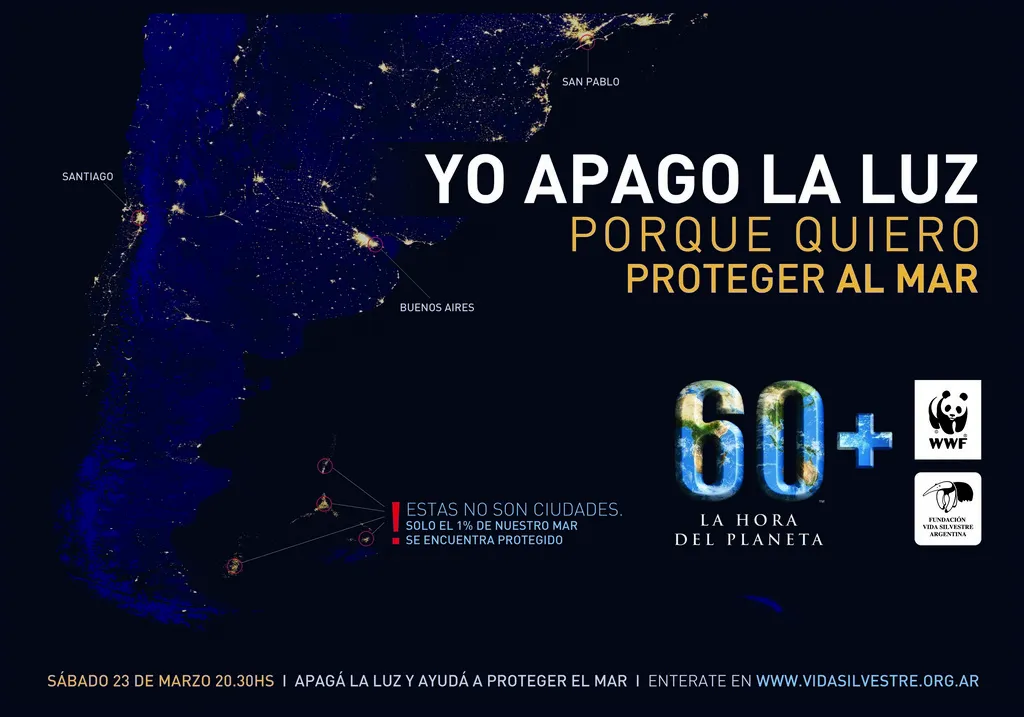
This year it will take place on Saturday, March 29, at 20:30 h when millions of people from different countries turn off their lights to show their support for the campaign.
Earth Hour is a global awareness campaign by WWF, the World Wildlife Fund, organized in Argentina by Vida Silvestre, which invites individuals, governments and companies to turn off the lights for one hour to show that we care about climate change.
The Water Heater Law
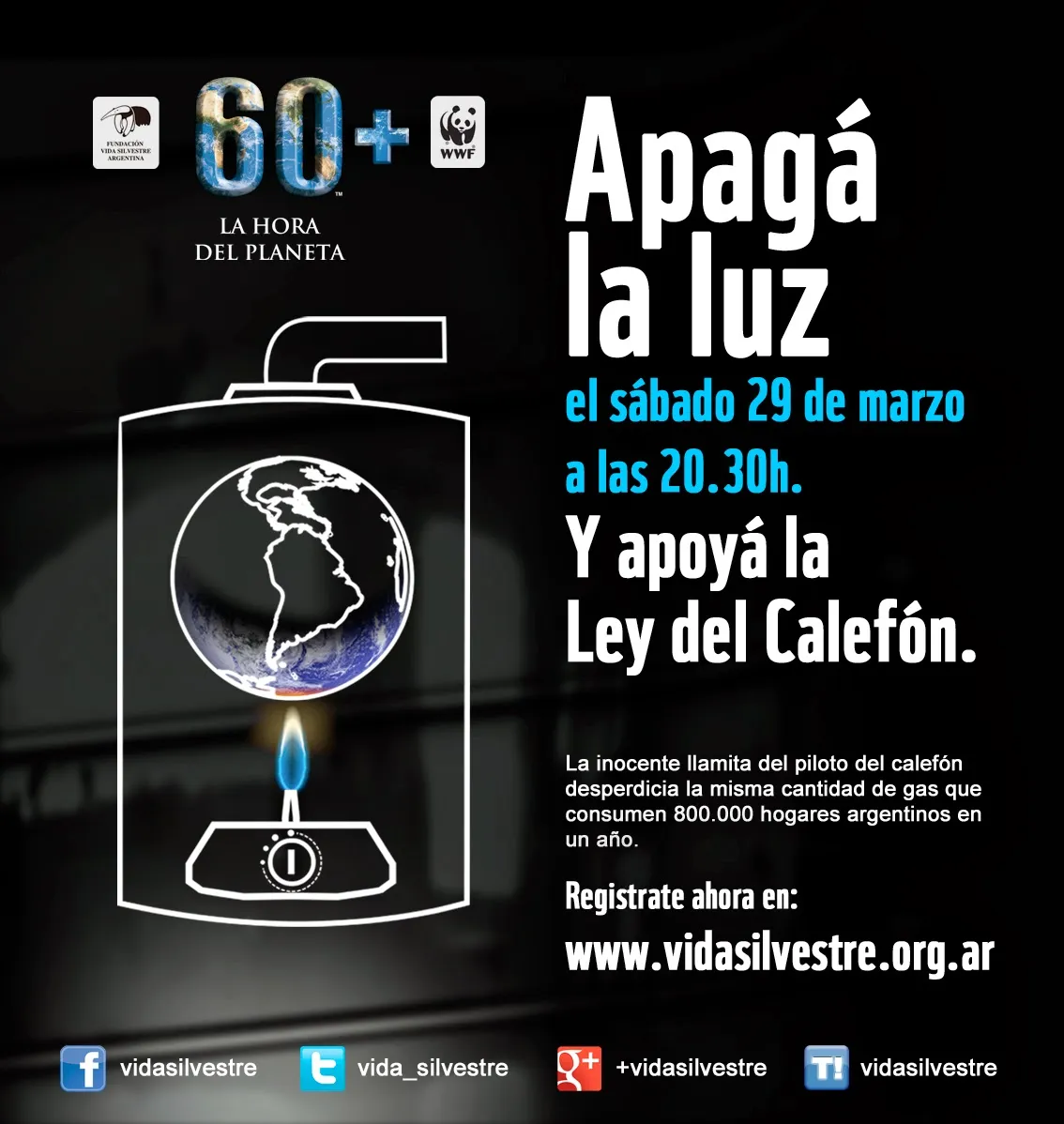
This year WWF invites people to turn off the lights during Earth Hour to promote a measure that replaces water heater ignition systems with electric and efficient systems to avoid passive gas consumption and help mitigate climate change.
The pilot lights of gas appliances alone consume, in their passive mode, 0.5 m3 per day. It is estimated that in Argentina there are about 6 million water heaters with a total constant and passive consumption of about 3 million m3 per day. The import of this gas by ship costs about 1.5 million U$S/day, that is, about 500 million U$S/year.
Given the possibility of using electronic devices (very common in other regions) that perform this function, this volume of gas could be saved in its entirety. The amount of gas saved by this measure is equivalent to: 1) the energy generated by the Embalse Río Tercero power plant; 2) the gas consumed in 800,000 Argentine homes in one year; 3) 20% of the gas we import from Bolivia.
In addition to saving energy and money, this measure would help mitigate climate change by reducing greenhouse gas emissions: if we consider that for each m3 of natural gas 1.9 kg of CO2 are emitted, a reduction of 3 million m3/day is equivalent to a reduction of approximately 5.5 Gg/day of CO2 emissions.
Therefore, this year Earth Hour calls for the urgent treatment of the Water Heater Law (pdf) and we can support the initiative by registering here.
If you want to learn more about the work of the Fundación Vida Silvestre Argentina on the topic: "Energy Scenarios for Argentina (2013- 2030) with efficiency policies" (pdf). There, not only are the results of the implementation of this and other measures on gas consumption analyzed, but also on the main energy consumption sectors in our country.
It is understood as:
Water heaters: Instantaneous hot water production appliances for sanitary uses, equipped with atmospheric burners that use gaseous fuels
Pilot light: Device that keeps the gas supply open, and interrupts it in case the monitored flame disappears, based on a signal from the flame detection element.
Passive consumption: Consumption resulting from the use of the pilot light, which is not used for heating water, but to keep the appliance on when not in use.
Does this really do any good?
My personal position (I represent no one, except myself) is as follows:
1-It is better to do something than to do nothing.
2-The initiative is, above all, a search for awareness, individual and collective.
3-The energy "saving" by itself is somewhat fallacious. If the only thing that changes is the energy expenditure in pursuit of a level of savings, we must consider that, in modern societies, what is saved here is spent there. And we citizens DO NOT DECIDE what to spend on and what not to, even though we supposedly live in a democracy. We can only decide with a certain degree of freedom what each of us does individually, but the energy expenditure by companies (especially) and States is not something we have much say in.
However, the political class, which is the one with real power (along with corporations), must know what we want and why. That political class does not listen only to the people, but also to its own interests. But that changes with quantity.(*1) Faced with a critical amount of social pressure, qualitative changes occur, just like water boiling at 100ºC.
If this is not clear, then the Water Heater Law becomes the Law of the Funnel.
4-Where should energy be spent? On what is necessary. But then we would have to define "need". If need is that which is indispensable, then desire is that which is not needed. I am not talking about "minimum" needs, but about carrying out those activities that are necessary to have a dignified life. A dignified life is neither insufficient nor luxurious.
5-What was said in 3 and 4 points towards a radical change in our way of living that depends primarily on the concept of property. As long as resources are in the hands of a few, whose goals are to obtain the maximum possible economic profit, regardless of the means to that end, then we will not have the "necessary" society for all, but some will have much more than they need to live with dignity, and others will have less than enough.
5-Energy, like land and water, is a resource for all human beings. The planet was not divided naturally, but culturally, politically, unfairly and inequitably. The main way to distribute land has been war (physical violence) and then trade (economic violence).
6-So if we citizens save energy so that this saving is squandered by corporations, which manufacture products we do not need and sell them to us through advertising violence rooted in desire, then there will be no real change.
7-The "green discourse" cannot be disconnected from the rest of social discourses. It must not be a "romantic" proclamation. Energy problems are political and economic. Therefore, it is contradictory that this initiative is sponsored by companies.
8-Finally: all of us have our contradictions. It is difficult to get rid of them. Even more so if we are not even aware of them.
That said: It would be inconsistent on our part to raise the flag of energy saving and then VOTE for a ruling class that does not want to transform reality, but to preserve it in favor of those who have real power. Real change will only occur when Earth Hour is The People's Hour.
Sources and related links
- Earth Hour at Fundación Vida Silvestre Argentina.
- (*1) It is also possible for 100 thousand imbeciles to gather in a square to demand the death penalty. Therefore it is not just a matter of the number of people, but of scientific and moral arguments.
About the images
- Campaign images. Fundación Vida Silvestre Argentina.