A collection of links to music, images, and videos that relate art and science. Today: Images of Messier 8; Messier 101; Venus from Saturn; Abell 68 and Space Invaders. Music: The Secret of the Stars. Video: The Scientific Method.

Images of the Decade
Lagoon Nebula
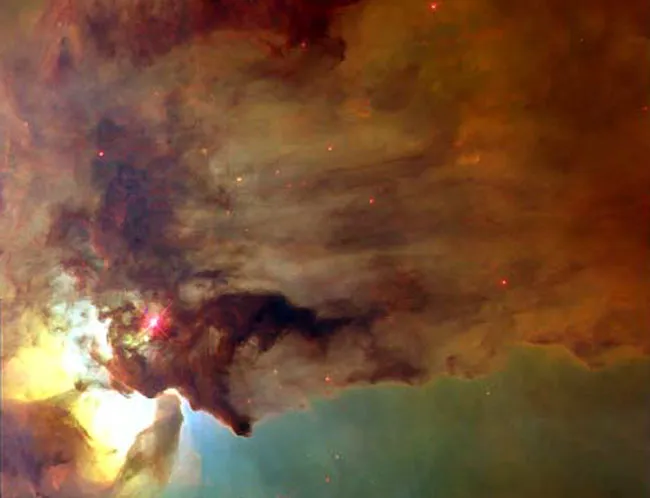
In this image, taken by Hubble, we see the center of the Lagoon Nebula (M8), 5,000 light-years away from Earth, in Sagittarius.
In the lower left, at least two long clouds formed by the strong winds and intense light of the stars can be seen. The very bright star Herschel 36 illuminates the area.
Credits: A. Caulet (ST-ECF, ESA), NASA
It was the Astronomy Picture of the Day (APOD) on March 4, 2003. In Spanish at Observatorio.
M101
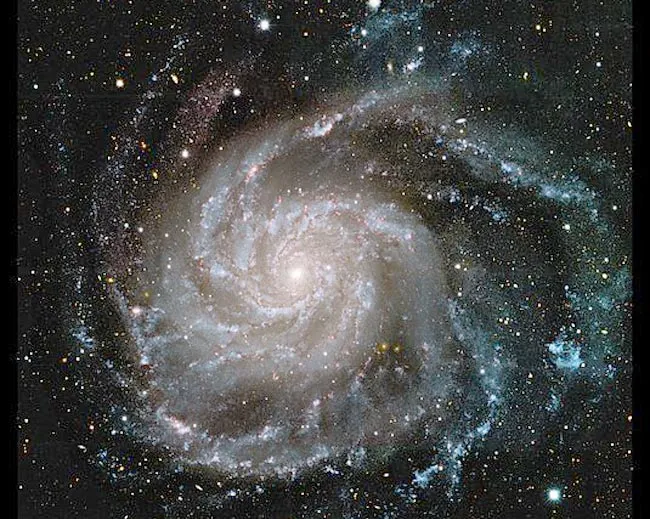
This image of the Messier 101 object corresponds to the spiral galaxy commonly called the Pinwheel Galaxy. It is a typical spiral, about 22 million light-years from Earth. Scientific evidence indicates that a close gravitational interaction with a neighboring galaxy created waves and condensed the gas that continues to orbit the galaxy's center. Those waves compress the existing gas and cause star formation, so galaxies like this one have bright stellar nurseries (called HII regions) in their arms.
Credits & Copyright: Jean-Charles Cuillandre (CFHT), Hawaiian Starlight, CFHT.
It was the Astronomy Picture of the Day (APOD) on March 10, 2003.
In Spanish at Observatorio.
Images of the Week
Venus from Saturn
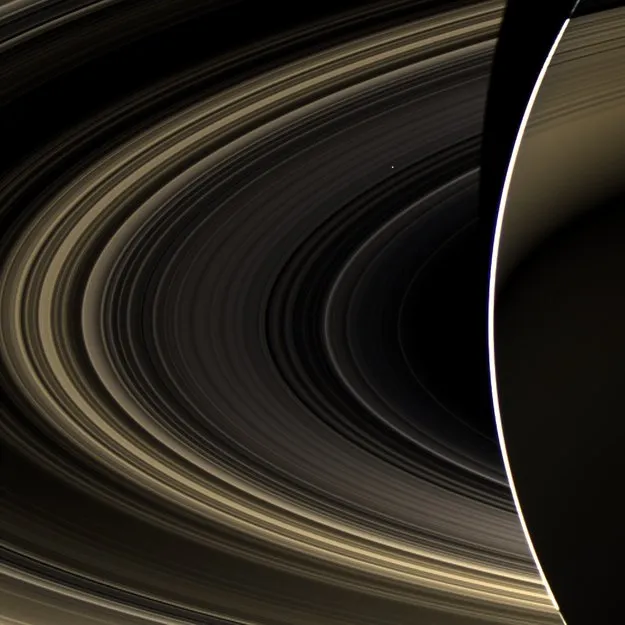
Venus shines like a beacon through Saturn's rings in this image taken by the Cassini probe on November 10, 2012, when the spacecraft was located in the shadow of the ringed planet. That allowed the spacecraft to look toward the Sun and take backlit images of the planet and its rings. This view was obtained from a distance of 802,000 km (approx.) from Saturn and looks toward the unilluminated side of the rings from about 17 degrees below the ring plane. The image scale is 44 km per pixel.
Credit & Copyright NASA/JPL-Caltech/Space Science Institute
It was the image of the day March 4, 2013 at ESA.
Abell 68 and Space Invaders
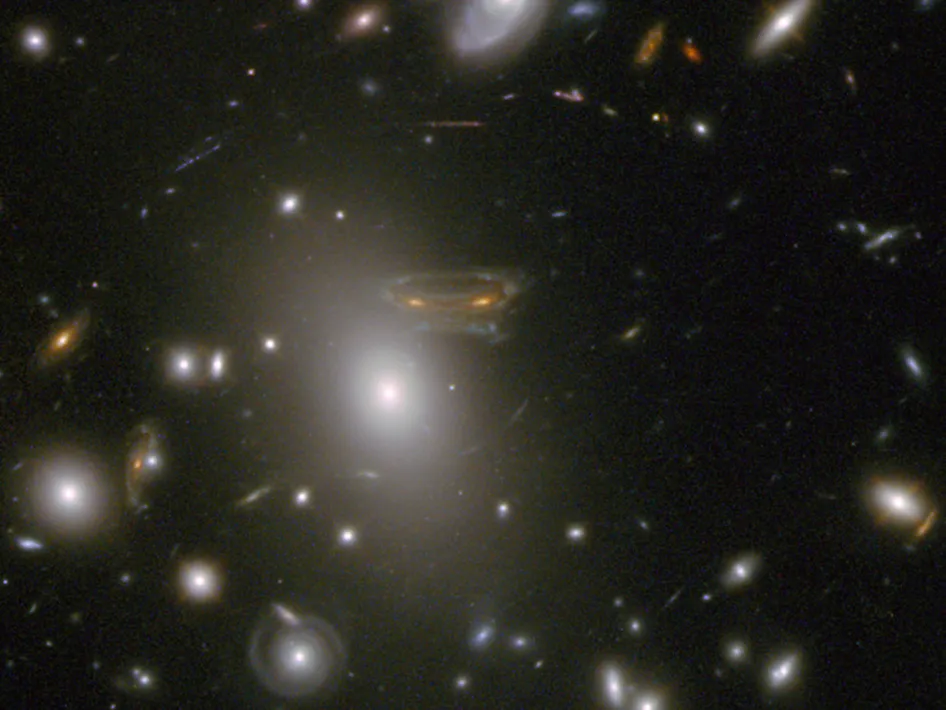
The gravitational field around the massive galaxy cluster Abell 68 acts as a natural lens in space to magnify the light coming from more distant background galaxies.
In this image, the spiral galaxy near the center has been stretched and mirrored into a shape similar to the alien form from the popular video game Space Invaders.
A second, less distorted image of the same galaxy appears to the left of the bright large elliptical galaxy.
If you don't notice it, I have created an annotated version of the image.
The photograph was taken in infrared by Hubble's WFC 3 and combined with near-infrared data from the ACS, with contributions from Nick Rose in the Hubble's Hidden Treasures competition.
It was NASA's image of the day on March 5, 2013.
Credits: NASA/ESA/N.Rose.
Space Music
Symphony of Science: Secrets of the Stars
John D. Boswell is the person behind the already popular Symphony of Science, whose goal is to bring scientific knowledge to the general public in an enjoyable and novel way: through music.
In this case, his latest creation introduces us to a mystery story: the secret of the stars. The video is subtitled in Spanish.
For more information on Boswell's production (known as MelodySheep) visit the site Symphony of Science.
Animated Science
Scientific Method - BrainPOP Español
What is the scientific method? The question has its complications. First, the "method" is not a single way of doing things. Depending on the scientific discipline, different approaches and techniques will be used.
But at least as a first approximation, this Spanish video from BrainPop can help understand what "scientific truth" is and how it is reached.
To access previous editions of this section, consult the Multimedia Selection Series. The series attempts to show that the immensity of the universe can be perceived in different ways. I choose some images from a decade ago -so they don't fall into oblivion- and from the current week that ends, as well as sounds/music and videos that are artistic forms of expression with content related to astronomy and related sciences. I am also compiling these materials in the Pinterest account