A collection of links to music, images and videos that relate art and science. Today: Images of B1957+20: Black Widow Pulsar; Jupiter and dancing moons; ESO 456-67; The comet and the laser. Music: Abstract Skylines. Video: Trailer for El Cosmonauta.

Images of the decade
B1957+20: Black Widow Pulsar
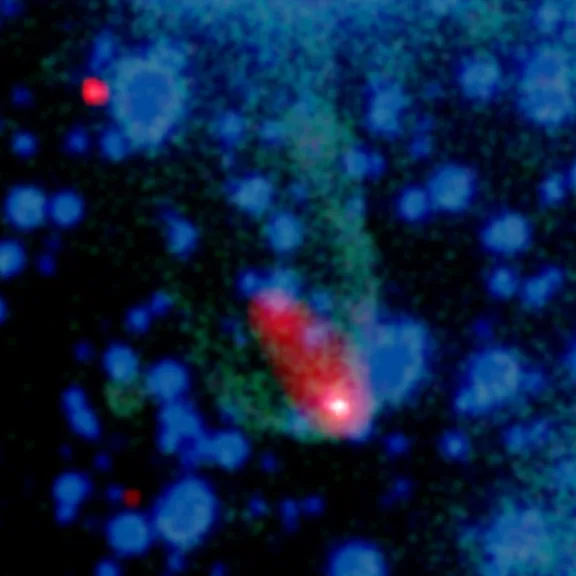
This image is composed of X-ray (red/white) and optical (green/blue) data and reveals a cloud or cocoon of high-energy particles flowing behind the rapidly rotating pulsar B1957+20 (the white point source). The pulsar, called the "Black Widow," moves through the galaxy at high speed (millions of km/h). A shock wave due to this motion is visible to optical telescopes, shown in this image as the greenish crescent shape. The pressure of the wave creates a second one that sweeps the cloud toward the pulsar to form the cocoon.
The Black Widow pulsar is emitting intense radiation that appears to be destroying a companion star. It is a millisecond pulsar, old neutron stars that acquired rapid rotation by taking material from their companions.
The pulsar is located in Sagitta, 5,000 light-years away from Earth.
The image was published on the Chandra site on February 27, 2003.
Credits: X-ray: NASA/CXC/ASTRON/B.Stappers et al.; Optical: AAO/J.Bland-Hawthorn & H.Jones
Dance of moons and shadows
This sequence of images allows us to visualize the dance of the Galilean moons around Jupiter.
Recorded on December 15, 2002, between 7:19 and 8:40 UT, over 1000 digital images were processed and combined to create this spectacular 21-frame animation of the Jovian system.
South is up and the movement of its Great Red Spot can be seen. The innermost moon, Io, emerges from the planet's shadow on the right.
Io occults (passes in front of) the edge of Ganymede with Io's shadow moving rapidly across the clouds of the gas giant, just below the Red Spot. While Callisto is out of the field of view, its long, dark shadow is visible crossing the Jovian disk at the upper left.
Credit & Copyright: Wes Higgins.
It was the Astronomy Picture of the Day (APOD) on February 27, 2003. In Spanish at Observatorio.
Images of the week
ESO 456-67
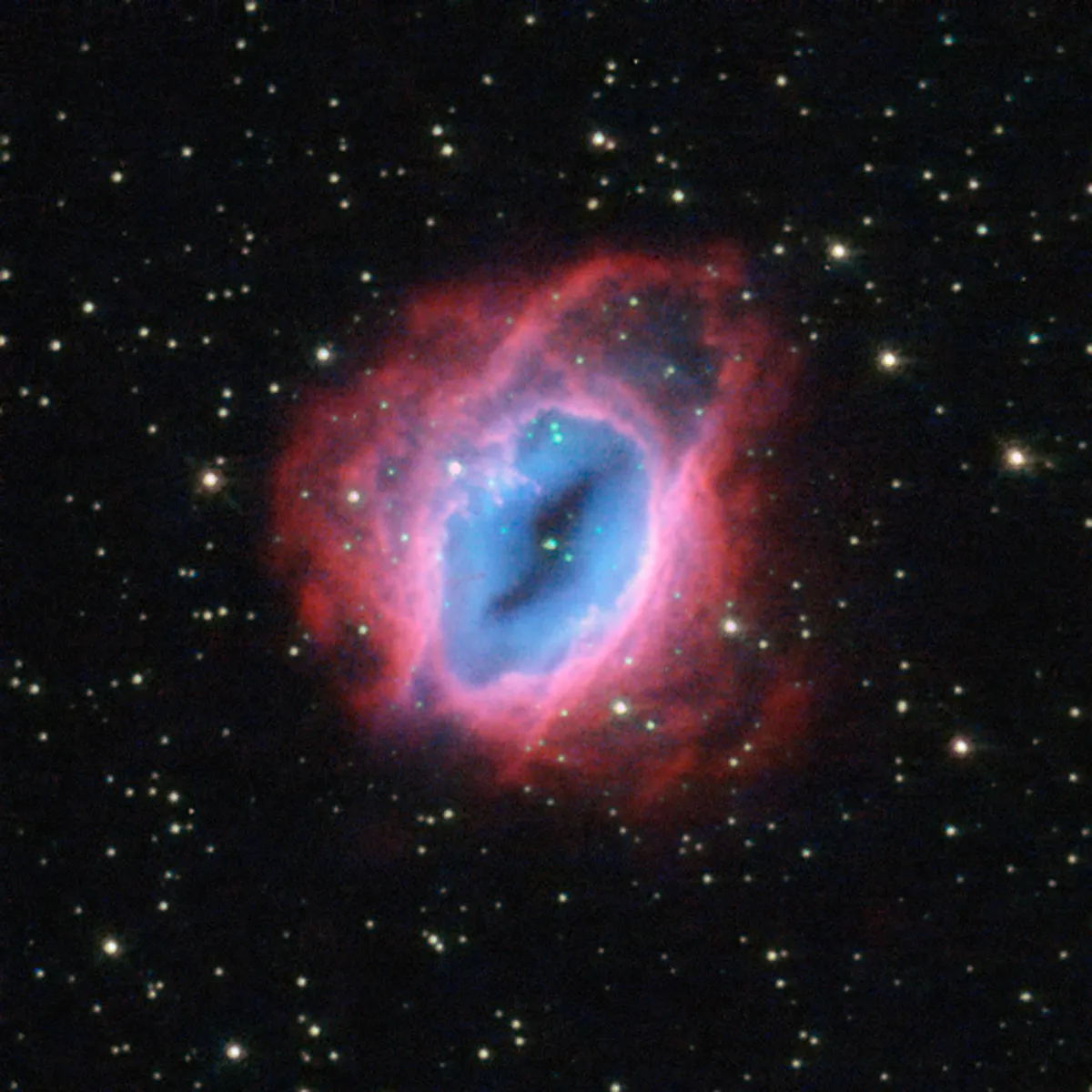
It may look like the Eye of Sauron from The Lord of the Rings, but this object is not a creation of J.R. Tolkien, but a planetary nebula known as ESO 456-67, in Sagittarius, about 10,000 light-years away.
These objects have no relation to planets, despite their name.
When a star like our Sun nears the end of its life, it expels material into space. Planetary nebulae are created this way, as gas and dust ejected by stars, a sort of cosmic burp. Cheers!
The image is color-coded to differentiate the different expelled materials, according to the wavelength of light captured with Hubble's filters.
Credit: ESA/Hubble & NASA - Acknowledgement: Jean-Christophe Lambry
It was the SpaceTelescope Image of the Week.
The comet and the laser
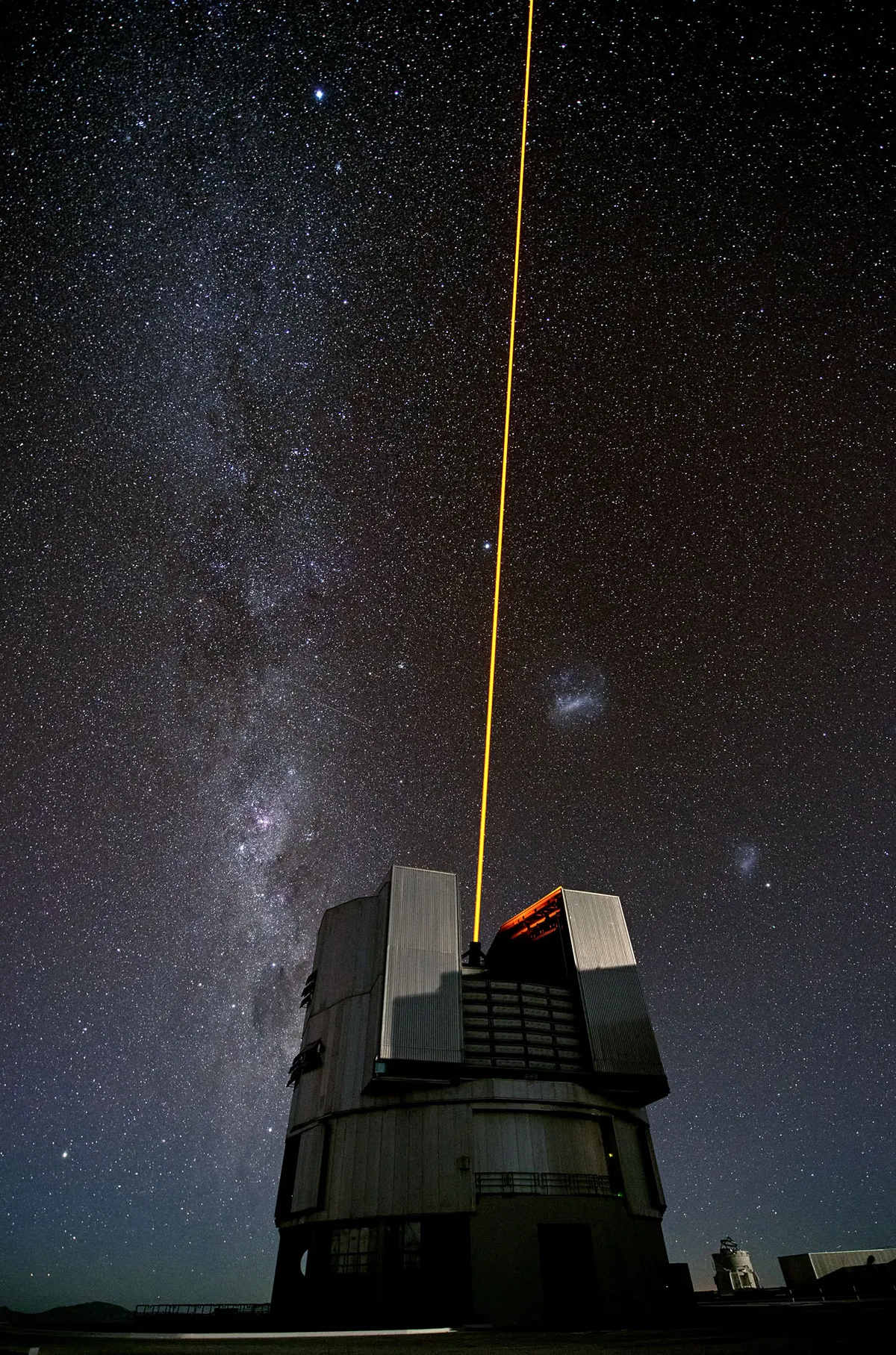
Gerhard Hüdepohl, one of ESO's Photo Ambassadors, captured this spectacular image of ESO's VLT (Very Large Telescope) during tests of a new laser for the VLT on February 14, 2013. It will be used as a vital part of the Laser Guide Star Facility (LGSF), which allows astronomers to correct most of the disturbances caused by the constant motion of the atmosphere in order to produce more precise images. However, it's hard not to think of a futuristic laser cannon aiming at some kind of distant space invader.
In addition to the impressive views of the Milky Way above the telescope, there is another protagonist that makes this image even more special. To the right of the center of the image, just below the Small Magellanic Cloud and almost hidden among the infinity of stars that populate the dark Chilean skies, there is a green dot with a faint tail stretching to its left. It is Comet Lemmon, recently discovered and brighter than expected, currently traveling across the southern hemisphere sky. Do not confuse it with what appears to be a star, as it is almost point-like, white, below the Small Cloud, since that is the cluster 47 Tuc. Below that cluster, the comet is seen.
The comet currently has a magnitude of about 9, but these days there is another comet going around, approaching Earth, heading toward the Sun, and much brighter: C/2001 L4 (PanStarrs), just above the southwestern horizon (from Argentina), shortly after sunset (Here is a capture with Stellarium for 02/14/2013, with the Small Cloud, 47 Tuc, and the two mentioned comets, for easier location).
Credit: G.Hüdepohl (atacamaphoto.com)/ESO
It was the Image of the Week of ESO.
Space Music
Abstract Skylines: Pulsar
From SoundCloud, this American artist composed a track titled Pulsar, alluding to cosmic objects like those mentioned regarding the first image of this selection.
https://soundcloud.com/abstractskylines/pulsar
Animated Science
El Cosmonauta
"El Cosmonauta" is a film by Riot Cinema Collective...and 5,000 more people!
It is the story of three characters immersed in the fifteen most exciting years of the space race: successes and failures, accidents, conspiracies, favoritism and secret missions. It is not just a movie, it is also a Transmedia project (30 webisodes, an alternative ending, a secret short film, several books and much more).
elcosmonauta.es
http://youtu.be/rlAOf5CwF-E
To access previous editions of this section, consult the Multimedia Selection Series. The series attempts to show that the immensity of the universe can be perceived in different ways. I choose some images from a decade ago -so they are not forgotten- and from the current week that ends, as well as sounds/music and videos that are artistic forms of expression with content related to astronomy and related sciences. I am also collecting these materials in the Pinterest account