For those interested in topics related to the study of the Universe, the Instituto de Astronomía y Física del Espacio offers the "Talleres de Ciencia para Jóvenes". Also, a lecture at the Asociación de Amigos.
The Instituto de Astronomía y Física del Espacio -IAFE- (CONICET-UBA)
invites you to participate in its Talleres de astronomía 2013, with the following program:
First and second meeting: Wednesday, May 15 and 22, 18 h.
"Introduction to Astronomy"
In these meetings we will take a tour through various areas of Astronomy, from the planets and other objects of the Solar System, passing through stars and nebulae, to galaxies and quasars, the most distant objects in the Universe. We will discuss the most salient aspects of the different objects of study of this science, and we will recreate the reasoning of an astronomer, discussing problems related to the investigation of said objects.
Third meeting: Thursday, May 30, 18 h
"Our Restless Sun: the different faces of a star"
Dr. Marcelo López Fuentes
It is often said that if it weren't for the magnetic field, the Sun would be a star as boring as most astronomers think it is. Among the different types of stars available in the cosmos, our Sun is indeed a fairly common star. However, there are two things that make it special for us: it is close enough that we can see phenomena that are undetectable in other stars, and its behavior has, for obvious reasons, a much more direct impact on our lives. In this talk we propose to review our current knowledge about the Sun and look at it as a laboratory of physics under extreme conditions through impressive observations obtained with state-of-the-art instruments.
More about the Sun
Dr. López Fuentes will also give a lecture on the same topic at the Asociación Argentina Amigos de la Astronomía.
It will take place next Saturday, May 18, 2013, at 19 h. at the social headquarters at Av. Patricias Argentinas 550- C.A.B.A. Admission is free.
Fourth meeting: Wednesday, June 5, 18 h
"Supernova Remnants: the traces of the explosion"
Supernova Remnants, created after the explosion of massive stars or white dwarfs in binary systems, expand for tens of thousands of years, irreversibly modifying the environment that surrounds them. Indeed, during their evolution, Supernova Remnants can create and destroy dust grains and molecules in space, they can give rise to the densest possible objects in the Universe, such as neutron stars or black holes, and they can even induce the birth of new generations of stars. In this talk, we will discuss the outstanding physical processes triggered in the temporal and spatial evolution of Supernova Remnants and in their interaction with the interstellar medium.
These science events are already listed in our agenda.
Sources and related links
- Additional information at http://www.iafe.uba.ar/docs/talleres.html
- How to get to IAFE
- Amigos de la Astronomía
About the images
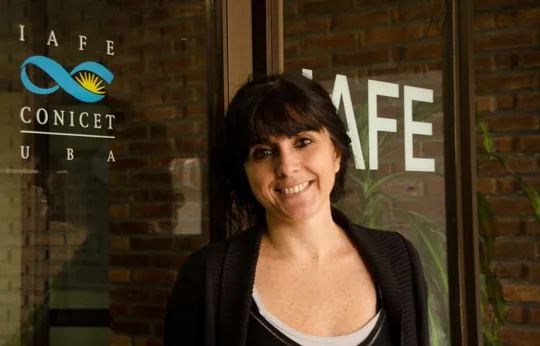
- Dr. Gabriela Castelletti. Photo: CONICET Fotografía.