A collection of links to music, images and videos relating art and science. Today: Images of Stephan's Quintet; Andromeda; EVEX. Music: Andrew Mc Cormack - Telescope. Video: Another look at photography.

Images of the decade
Stephan's Quintet
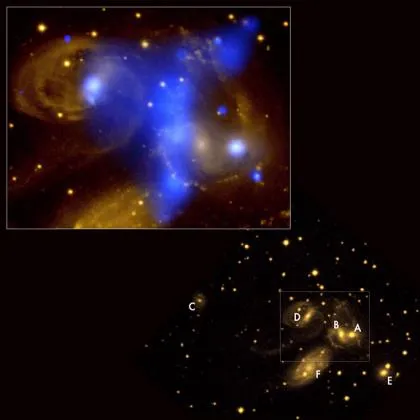
The tumultuous interactions in the compact group of galaxies known as Stephan's Quintet are shown in the upper left inset where Chandra X-ray images (blue) and DSS optical images (yellow) were superimposed.
The hot gas, visible only with an X-ray telescope, appears as a bright blue cloud oriented vertically in the middle of the image and has a temperature of 6 million degrees Celsius.
The heating is produced by the rapid motion of an intruder spiral galaxy located immediately to the right of the shock wave in the center of the image (labeled as B in the optical inset below).
Stephan's Quintet, 280 million light-years away, is an excellent example of the tumultuous dynamics of a compact group. Or, to put it another way, a group of galaxies with swing.
These images were part of a scientific study led by Ginevra Trinchieri of the Brera Observatory in Italy and others.
Credits: X-ray: NASA/CXC/INAF-Brera/G.Trinchieri et al.; Optical: Pal.Obs. DSS.
The image was published on the Chandra site on May 8, 2003.
The Halo of Andromeda
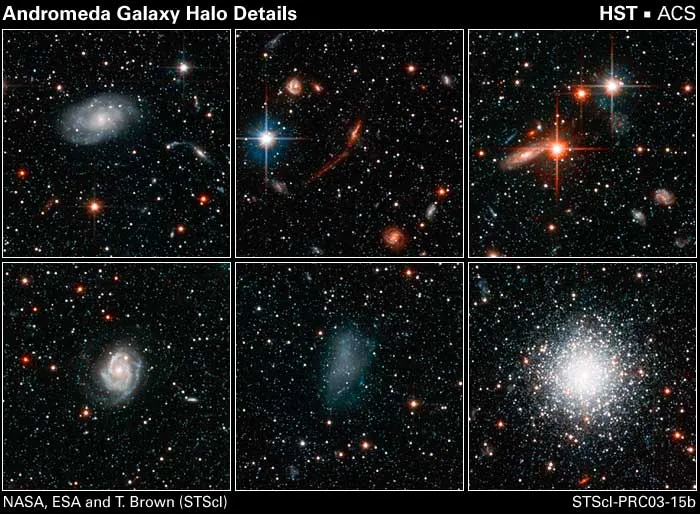
Astronomers used Hubble to measure the age of the stars that make up the spherical halo around the neighboring galaxy Andromeda (M31). To their surprise they found that approximately one third of the stars in that halo formed 6 to 8 billion years ago. That is very little compared to the 11 to 13 billion years of the stars in the Milky Way's halo.
These images, taken a decade ago, were the deepest visible observations ever taken in space at the time, made with 250 separate exposures from December 2, 2002 to January 11, 2003 with the ACS camera, but the total exposure time was 3.5 days.
Credits: NASA, ESA and T.M. Brown (STScI)
The images were published on HubbleSite on May 7, 2003.
Images of the week
EVEX

The image above can be described by pointing out elements such as a red cloud in the sky, a bright blue trail and other white ones. Oh, and palm trees.
Is it a UFO?
No, it is the result of a scientific experiment (EVEX) that used sounding rockets from the Marshall Islands. The red cloud formed from the release of lithium vapor and the white trail formed from the release of trimethyl aluminum. These clouds allowed scientists from various locations on the islands to observe the neutral winds in the ionosphere.
NASA highlighted that EVEX was successfully carried out during the early morning hours of May 7 from Roi Namur, Republic of the Marshall Islands and all scientific instruments on board the rockets worked as planned.
The image was published on the NASA site on May 7, 2013.
Space Music
Andrew Mc Cormack: Telescope
This London musician plays jazz. In this case, from SoundCloud, the track Telescope.
Jazz to see from afar, listen up close and move to a galactic rhythm.
https://soundcloud.com/andrewmccormack/telescope
Animated Science
The scientific possibilities of photography
Today it is very accessible to own a camera. The world is NOT as we perceive it with our eyes. In the first image today we came across an image created with optical data, but also X-ray data, which we cannot observe with our eyes.
With a camera we can also obtain data over time or on very small time scales that we cannot perceive without instruments.
It's nice to photograph the family and our pets.
But it is also possible to do something more with cameras than proudly show off our cats.
A video by Bill Shribman on TEDEducation, subtitled in Spanish.
To access previous editions of this section, consult the Multimedia Selection Series. The series attempts to show that the immensity of the universe can be perceived in different ways. I choose some of the images from a decade ago -so they don't fall into oblivion- and from the current week ending, as well as sounds/music and videos that are artistic forms of expression with content related to astronomy and related sciences. I am also collecting these materials in the Pinterest account