A collection of links to music, images and videos that relate art and science. Today: Images of Shapes Deforming in Carina; Earthrise. Music by Dan Cullen: Earthrise. Video: From Neurons to Networks.

Images of the decade
Shapes Deforming in Carina
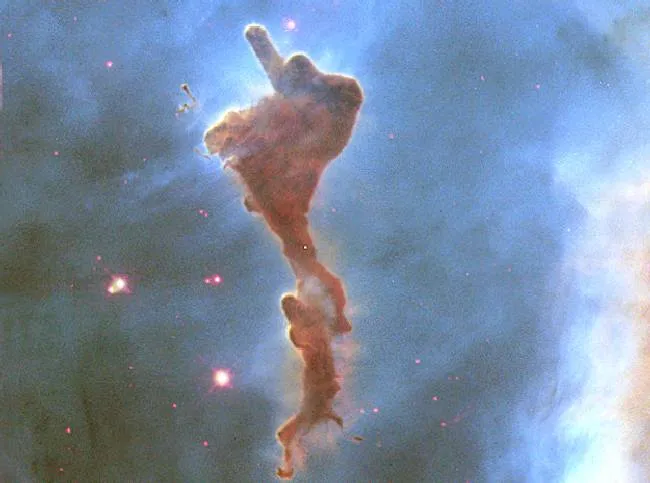
This dense cloud of gas and dust is fading.
Probably within a few million years the intense light from the bright stars will have completely evaporated it.
This cloud formed from the larger Carina Nebula, a star-forming region approximately 8,000 light-years away.
Newly formed stars are visible nearby, their images reddened by the blue light that is scattered by the dominant dust.
This unusually colored image spans approximately two light-years and was taken by the Hubble Space Telescope from its orbit in 1999.
This sub-cloud of Carina is particularly striking in part because its clear definition stimulates the human imagination (for example, it could be interpreted as a superhero flying through a cloud, with an outstretched arm, dragging a person he just saved or a large hand raising the middle finger).
The data collected with Hubble were obtained thanks to the work of the professionals on the Hubble Heritage team and three astronomers, including an Argentine: Rodolfo Barbá. On the Hubble Heritage site, his biography appears along with those of the other professionals involved in this research.
It notes that Barbá chose his career very early in his life, when he was only 7 years old. The interest was sparked by the Apollo missions to the Moon and an old astronomy book his mother gave him. However, his wife Laura has another idea: "He chose the stars as his fixed frame of reference because his family moved many times during his childhood."
That early reading created a bond, a bridge between Rodolfo and a set of ideas (discourses) that preceded him. And that contact changed the way his brain worked.
It was the Astronomy Picture of the Day (APOD) for June 30, 2003. In Spanish at Observatorio.
Credit: HubbleHeritage Team(STScI/AURA),N. Walborn (STScI) & Rodolfo Barbá (La Plata Obs.), NASA
Images of the week
Earthrise
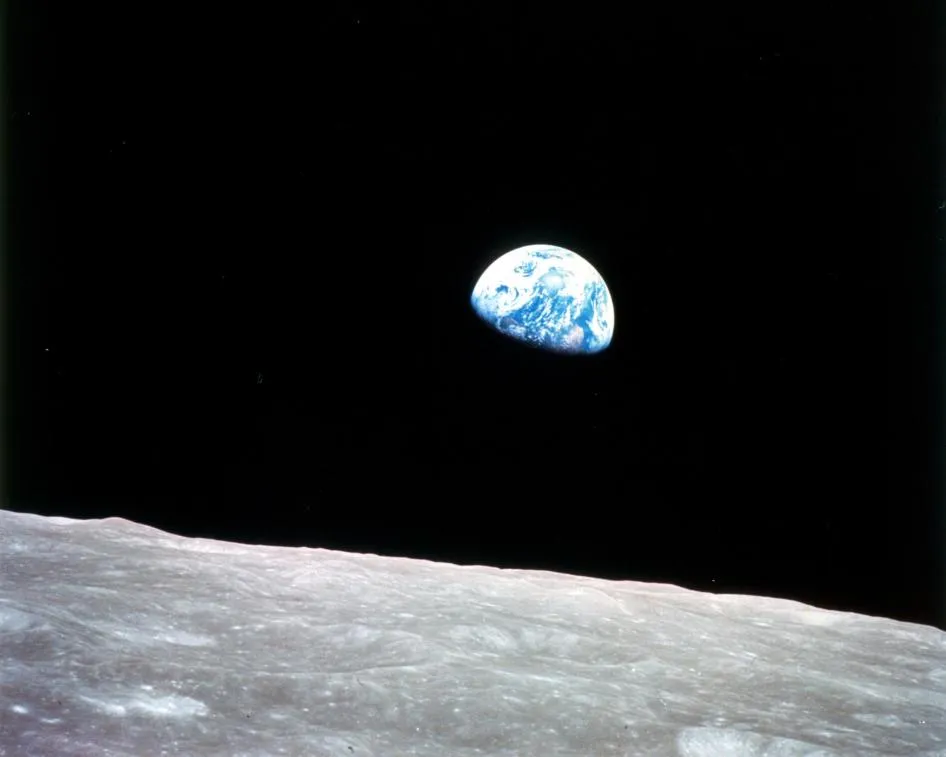
Apollo 8, the first human mission to the moon, entered lunar orbit on Christmas Eve 1968. That afternoon, astronauts Frank Borman, Jim Lovell and William Anders conducted a live broadcast from lunar orbit in which they showed images of Earth and its natural satellite as seen from the spacecraft. Lovell said: "The vast loneliness is awe-inspiring and it makes you realize what you have back on Earth." Then they read the first ten verses of Genesis (something I would have avoided) while making ten orbits around the Moon.
Neil Armstrong and Edwin Aldrin, who would later set foot on the lunar surface on Apollo 11, were the backup crew for Apollo 8 along with Fred Haise, who would fly on Apollo 13 (with Lovell).
It was NASA's Image of the Week for June 27, 2013.
Credit: NASA
Space Music
Dan Cullen: EarthRise (Earthrise)
This British artist, who with his wife Deryn forms the duo The Cello Companion, published this piece with string orchestra, children's choir and cello solo dedicated to the memory of Neil Armstrong.
http://www.dancullenmusic.com/
https://soundcloud.com/dan-cullen/earthrise
Animated Science
From Neurons to Networks
Tiffany Shlain and her team explore the parallels (metaphors) between a child's development and brain development. The Power of the Brain is a short animated film made possible by "collective filmmaking," connecting different ideas among different people, establishing a network. Like our brain.
http://youtu.be/Z4p7luxmY_s
To access previous editions of this section, see the Multimedia Selection Series. The series attempts to show that the immensity of the universe can be perceived in different ways. I choose some images from a decade ago -so they don't fall into oblivion- and from the current week that is ending, as well as sounds/music and videos that are artistic forms of expression with content related to astronomy and related sciences. I am also collecting these materials on the Pinterest account