A collection of links to music, images and videos relating art and science. Today: Images of NGC 1068; A gigantic star embryo. Music by MusikSur. Video: To the Heart of the Matter.

Images of the decade
NGC 1068 and the X-ray flashlight
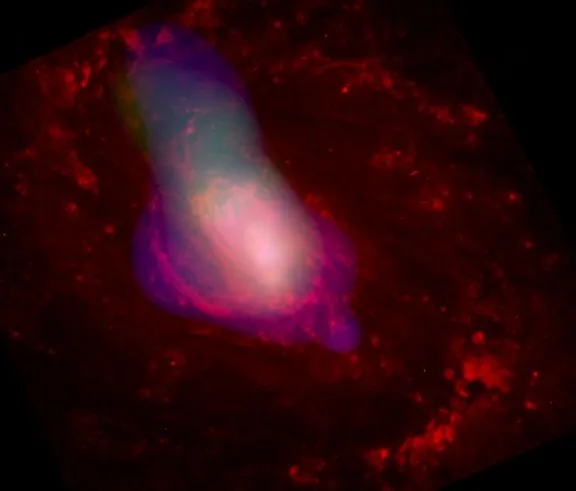
At night, if we place a flashlight under our face, we hide the flashlight's glow from the direct view of our friends. But the light still reflects off our face, giving us a terrifying appearance. The spiral galaxy NGC 1068 might be doing the same trick on a cosmic scale, hiding the powerful central source of X-rays—probably a supermassive black hole—from direct view. But the X-rays still scatter into our field of vision, in the form of a dense toroid of material surrounding the black hole. That scenario is based on X-ray data from the Chandra Observatory combined with an optical image from the Hubble Space Telescope, and we see it in this false-color composite. The optical data in red show the inner spiral structure of NGC 1068, seven thousand light-years across, with the X-ray data, in blue and green, overlaid. The wind of hot gas flowing out from the galaxy's nucleus can be seen as a broad band of X-ray emission, while the material illuminated by the hidden black hole is within the central cloud of more intense X-rays. Also known as M77, NGC 1068 is located 50 million light-years away, in the constellation Cetus, the whale.
Credit: X-ray: P. Ogle (UCSB) et al.; Optical: A.Capetti (INAF) et al.; CXO, STScI, NASA
It was the Astronomy Picture of the Day (APOD) of July 11, 2003. In Spanish at Observatorio.
Images of the week
ALMA shows us a gigantic star embryo
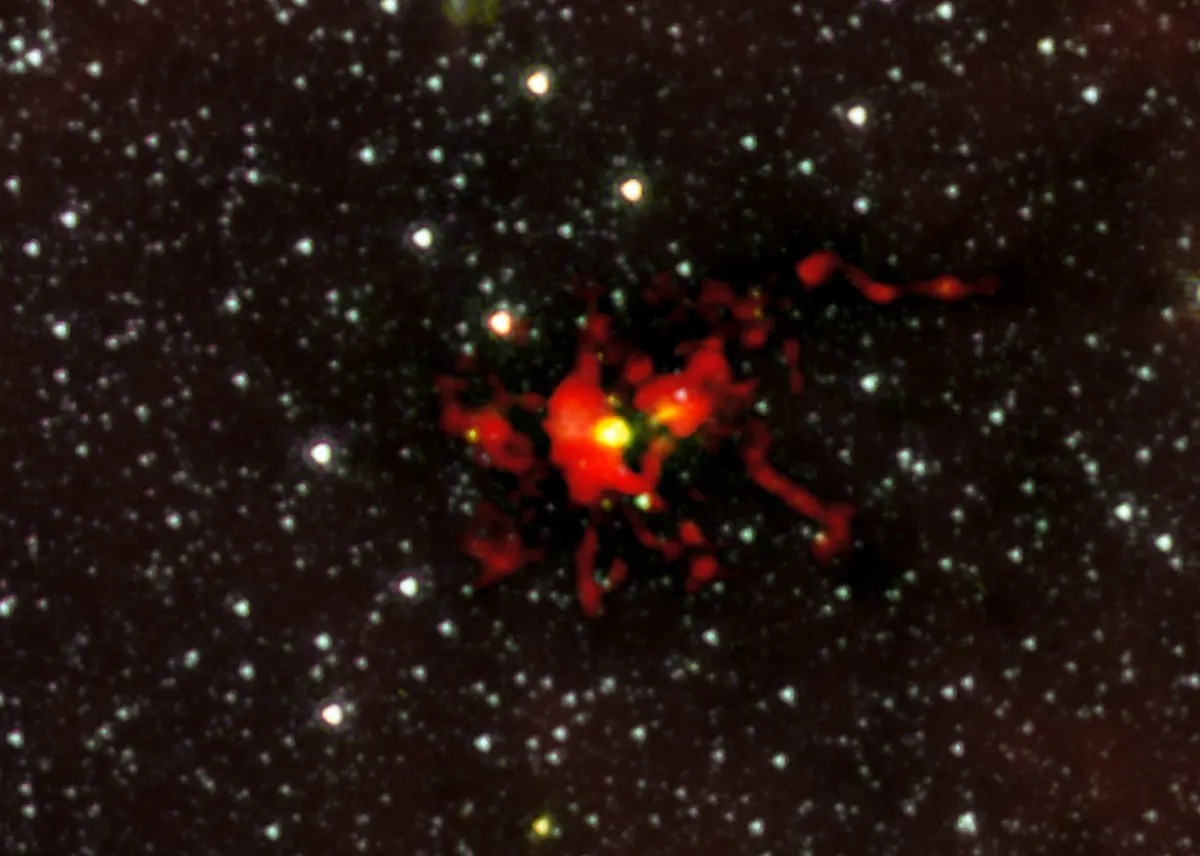
New observations carried out with the ALMA array (Atacama Large Millimeter/submillimeter Array) have provided astronomers with the best view obtained so far of a gigantic star—located about 11,000 light-years away, in a cloud known as the Spitzer Dark Cloud (SDC) 335.579-0.292—in the very process of formation inside a dark cloud. A protostellar core with more than 500 times the mass of the Sun—the largest found so far in the Milky Way—has been discovered and is still growing. The embryonic star inside the cloud is greedily devouring the material falling inward. It is believed the cloud will give birth to a very bright star with more than 100 times the mass of the Sun.
This image combines data from ALMA and NASA's Spitzer Space Telescope.
The ESO press release talks about an "ultrasound" (in relation to these observations) and a "stellar womb" (referring to the protostellar core). They are metaphors used because a resemblance is perceived between the "life" of stars and human life. Certainly there is a "resemblance," as well as abysmal differences. It makes no sense to imagine an astronomer after obtaining this "ultrasound" wondering "What sex is the protostar?"
It would be like discussing the sex of angels. For that, I prefer the metaphors of the brilliant Mario Benedetti.
Credit: ALMA (ESO/NRAJ/NRAO)/NASA/Spitzer/JPL-Caltech/GLIMPSE
More information at ESO.
Space Music
Astronomia: MusikSur
The French group MusikSur composed an album inspired by Hubble images.
Animated Science
To the Heart of the Matter
Reuben Loane, an animation student at the University of Glamorgan, created this animation in which an anxious man practices the marriage proposal he will make to his girlfriend by offering her a ring with a diamond near a "Wishing Well."
At the bottom of that well works the machine that makes the world rotate. A machine that requires coins (like the ones people throw into Wishing Wells) to function. That machine is running out of coins (because people no longer throw coins into wishing wells) and the world will stop rotating (to the misfortune of all of us on it, including the lovebirds). But when the world stops, the ring falls into the well and...
The world is not a machine, although it has been seen that way since the success of classical physics and it is still said that the Earth's core is like a dynamo. Other metaphors to explain the world to us.
To The Heart of The Matter from Reuben Loane on Vimeo.
To access previous editions of this section, consult the Multimedia Selection Series. The series attempts to show that the immensity of the universe can be perceived in different ways. I choose some images from a decade ago—so they don't fall into oblivion—and from the current week that ends, as well as sounds/music and videos that are artistic forms of expression with content related to astronomy and related sciences. I am also collecting these materials on the Pinterest account