A collection of links to music, images and videos relating art and science. Today: Images of the Chandra Deep Field South; NGC 3783; Arp 142. Music by Austin Tussing: Map of the sky. Video: Kim Taylor and her particular celestial dynamics.

Images of the decade
GOODS: Chandra does well observing the sky
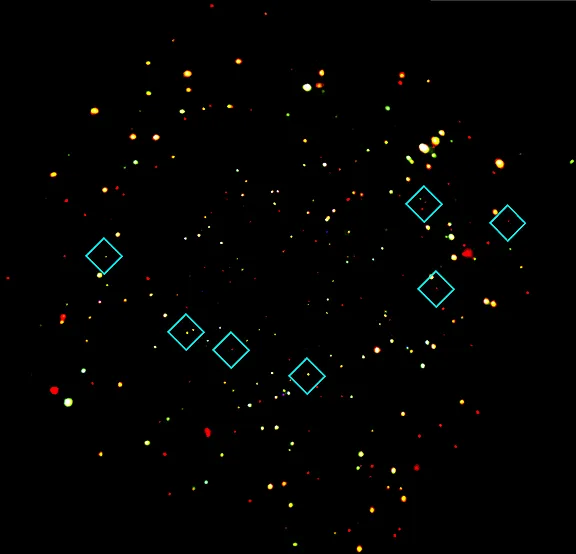
The image above is the Chandra Deep Field South made by observing an area of the sky equivalent to three-fifths of the full Moon, for 23 days.
The Chandra Deep Field was made in the northern and southern sky as part of the GOODS survey, which stands for Great Observatories Origins Deep Survey (Hubble, Chandra, Spitzer, XMM Newton).
The images obtained by Chandra are the deepest in X-rays and reveal black holes not detected in optical observations.
The blue squares in the image point to the seven X-ray sources discovered in the Chandra southern field that cannot be seen in Hubble's view. They are presumed to be extremely distant supermassive black holes or residents in galaxies too dusty to be detected.
These are observations of the Universe when it was about one billion years old. It is thought that 13.7 billion years have passed since the Big Bang, so those images are from when the universe was still very young and was forming the first galaxies.
Credits: NASA/CXC/R.Giacconi et al. and D.M.Alexander, F.E.Bauer, W.N.Brandt et al.; ID of x-ray sources: A.Koekemoer et al. [2003])
The image was published on the Chandra site on June 19, 2003. Also on HubbleSite.
Images of the week
Dusty surprise around a gigantic black hole
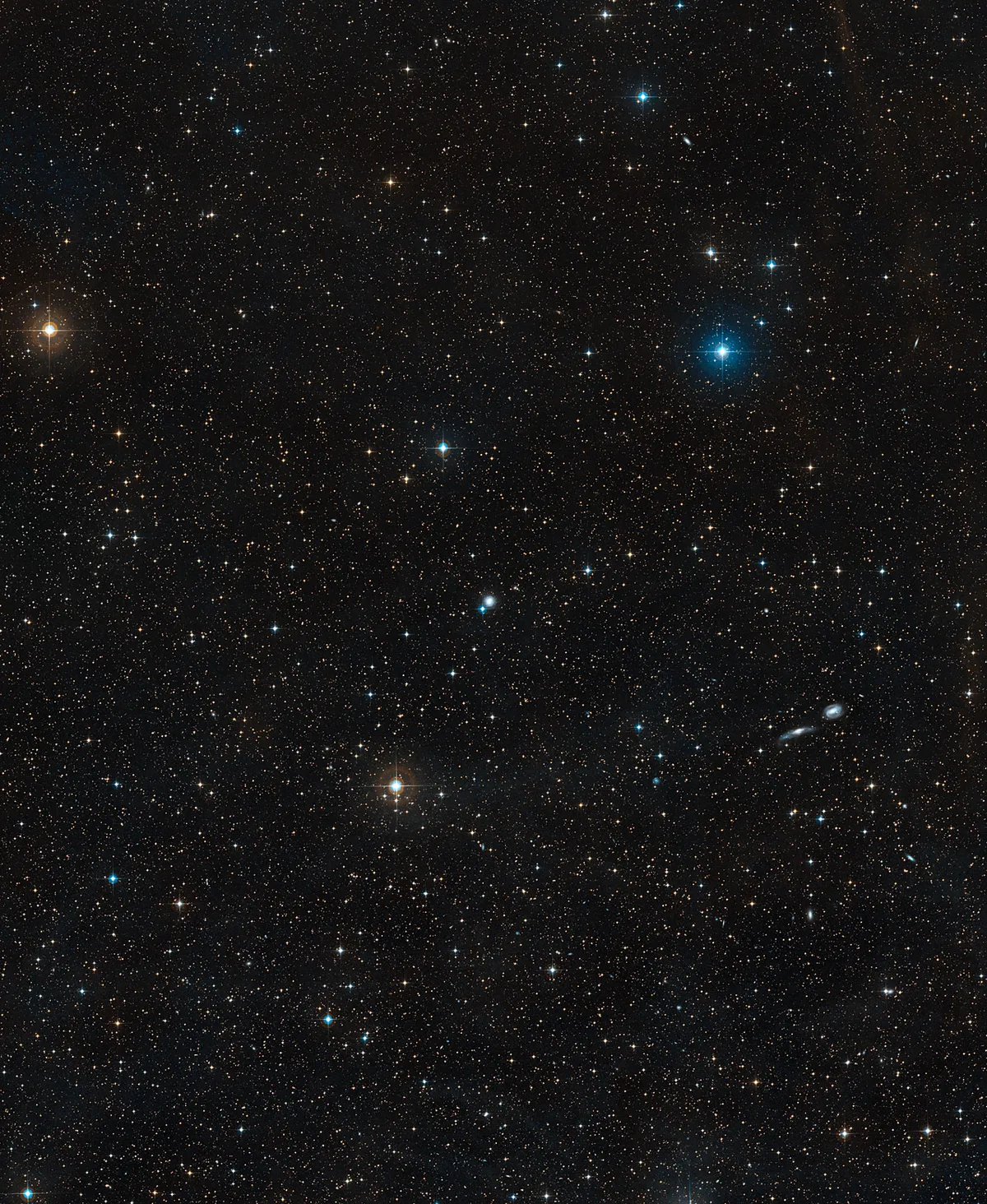
The Very Large Telescope Interferometer of ESO has carried out the most detailed observations made to date of the dust surrounding the gigantic black hole at the center of an active galaxy, through new observations of a nearby active galaxy called NGC 3783, about 130 million light-years away. Instead of finding all the bright dust surrounding the black hole in the shape of a torus (the geometric shape of a doughnut), as expected, astronomers have discovered that much of it is above and below the torus. These observations show that the dust is being pushed away from the black hole outward in the form of cold winds — a surprising discovery that challenges current theories and reveals how supermassive black holes evolve and interact with their surroundings.
This image was created from images that are part of the Digitized Sky Survey 2. It shows the region of the sky surrounding the active galaxy NGC 3783 in the southern constellation of Centaurus (The Centaur). The galaxy is the spiral figure right in the center.
Credit: ESO/Digitized Sky Survey 2. Acknowledgement: Davide De Martin.
More information at ESO.
Hubble spies two galaxies in close encounter
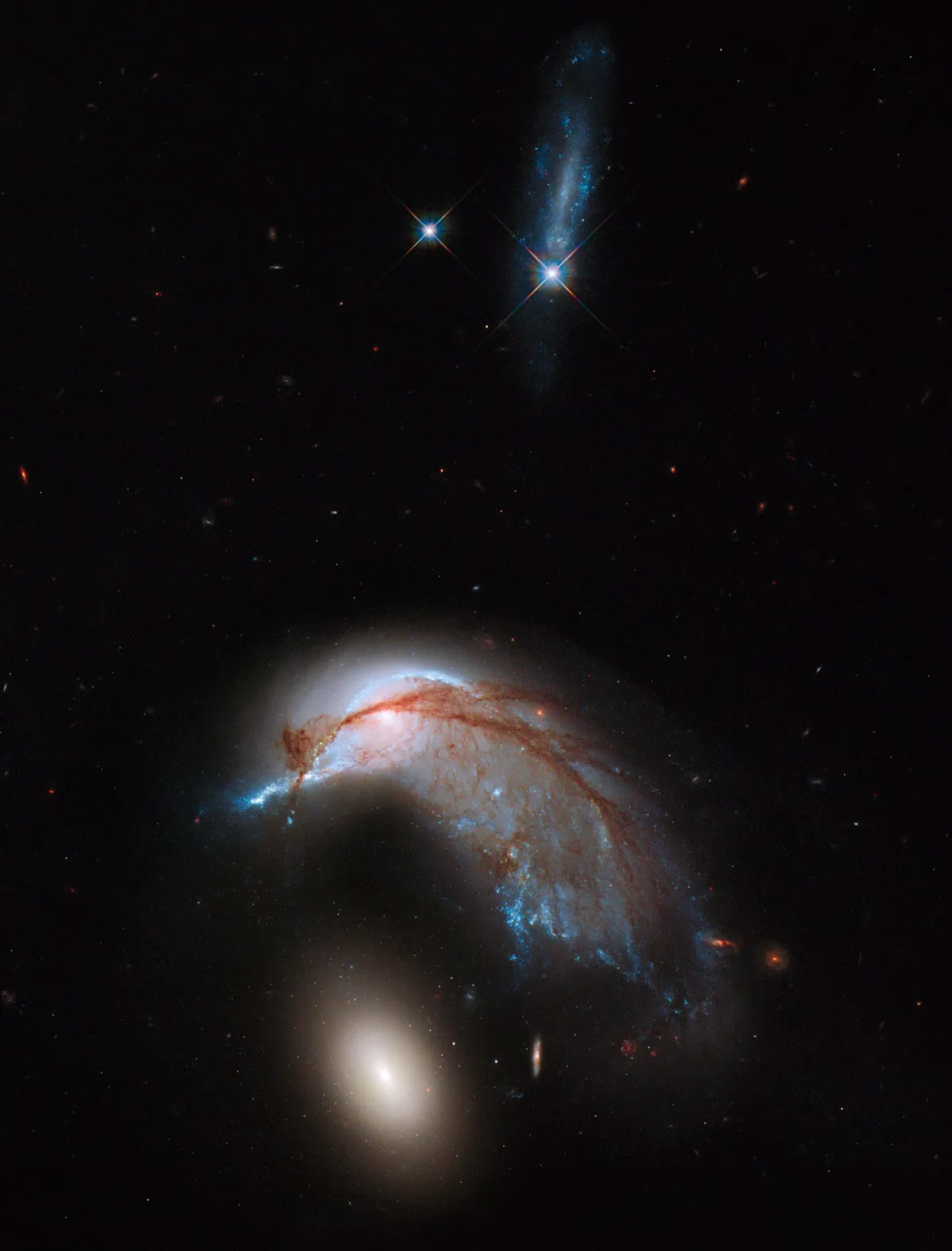
This vivid image reveals the close encounter of two galaxies seen by Hubble. The pair of galaxies is known as Arp 142. Just below the center of the image lies the bluish, twisted galaxy NGC 2936 known as "the penguin" or "the porpoise". It used to be a common spiral galaxy, but the gravity of its cosmic companion, the elliptical NGC 2937, has torn it apart.
The pair of galaxies, which lie 400 million light-years away, was cataloged by astronomer Halton Arp, creator of the Atlas of Peculiar Galaxies in 1966. This pair of galaxies is entry 142 in that catalog.
Credits: NASA, ESA and the Hubble Heritage Team (STScI/AURA)
The image was published on SpaceTelescope on June 20, 2013.
Space Music
Austin Tussing: Map of the sky
This is a small classical piece in binary form created by this American musician, available on SoundCloud, titled Map of the sky.
https://soundcloud.com/austin-tussing/map-of-the-sky
Animated Science
Kim Taylor: Celestial Dynamics
A journey through the sky and stars via ancient astronomical diagrams made by Kim Taylor, an independent designer working in London.
Kim says she dusted off some old books from her father's attic and was inspired by them for this creation. Thus, those purely scientific visual aids became unintentional works of art.
The music is "Frosti" by Björk from her album "Vespertine".
Celestial Dynamics from Kim Taylor on Vimeo.
To access previous editions of this section, consult the Multimedia Selection Series. The series attempts to show that the immensity of the universe can be perceived in different ways. I choose some images from a decade ago -so they don't fall into oblivion- and from the current week ending, as well as sounds/music and videos that are artistic forms of expression with content related to astronomy and related sciences. I am also collecting these materials on the Pinterest account