A collection of links to music, images and videos relating art and science. Today: Images of Magnetic Lights; The Big Sister. Music: Luminance Factor. Video: The beginning of the universe, for beginners.

Images of the decade
Magnetic lights
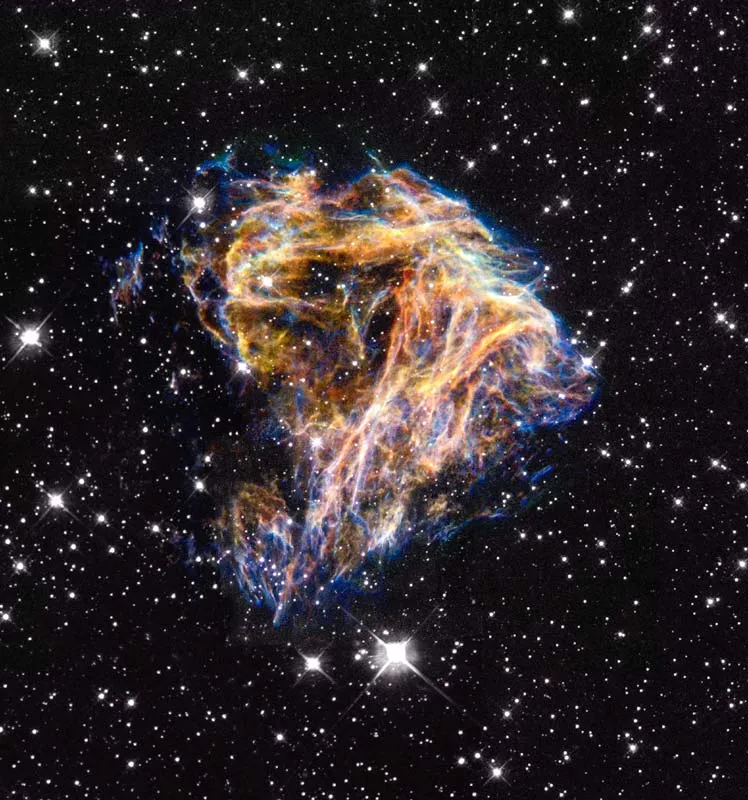
The delicate filaments that seem to form the image captured by Hubble are actually debris from a stellar explosion in a neighboring galaxy. It is the supernova remnant N49 in the Large Magellanic Cloud, 160,000 light-years away.
In the same region, a very intense gamma-ray burst was recorded on March 5, 1979. The object that caused such a record is now known as a type of exotic astronomical object: a magnetar, which is a highly magnetized, rotating neutron star, also born from the explosion that created N49.
The image was published on HubbleSite on July 3, 2003 and was the Astronomy Picture of the Day (APOD) on the following day (in Spanish at Observatorio).
Credits: NASA and The Hubble Heritage Team (STScI/AURA)
Acknowledgments: Y.-H. Chu (UIUC), S. Kulkarni (Caltech) and, R. Rothschild (UCSD)
Images of the week
The big sister
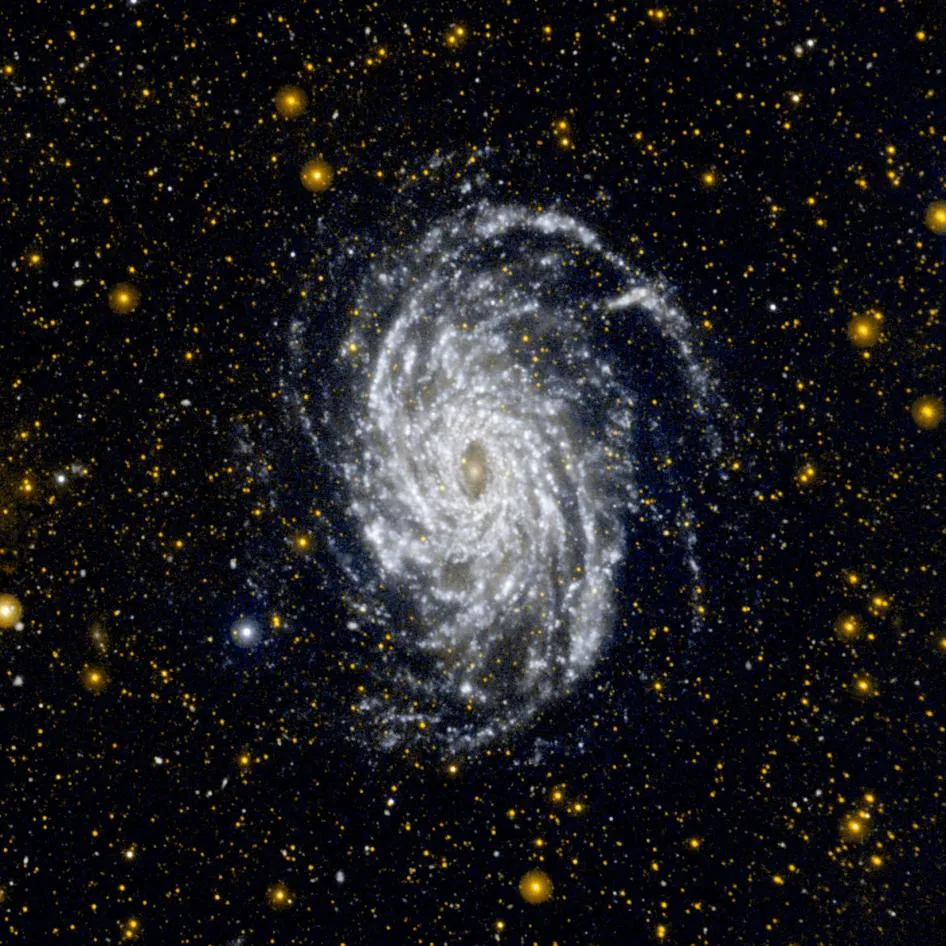
This image taken by GALEX shows NGC 6744, one of the galaxies most similar to ours in the local universe. This ultraviolet view reveals the great extent of the spiral arms and demonstrates that star formation can occur in the outer regions of galaxies.
NGC 6744 is larger than the Milky Way, with a disk extending 175 thousand light-years in diameter. A small, distorted companion is nearby and is similar to our Large Magellanic Cloud. NGC 6744A can be seen as a smudge on the outer arm of the main galaxy, top right.
On June 28 of this year, NASA shut down the Galaxy Evolution Explorer (GALEX) after a decade of operations.
The image was published on NASA's site on July 1, 2013.
Credits: NASA/JPL-Caltech
Space Music
Luminance factor: Into the Universe Part II
The artist from La Rioja never ceases to amaze with his sound. In this case, a continuation of a previous work saw the light a few days ago and features two tracks: the one that gives the work its title, composed of several minitracks, and the second: Three Thousand years After Christ.
Gonzalo González, the person behind Luminance Factor, created, arranged and produced this new material, with the collaboration of Edgardo Videla on the cover design.
Into the universe Part II is a space of sound with spatial atmospheres, ideal for astronomical observation, relaxation or documentary production.
We congratulate Gonzalo here for his new "child," which can be listened to and downloaded from the Luminance Factor and Jamendo sites.
Animated Science
The beginning of the Universe, for beginners. How did the universe begin and how does it expand? Physicist Tom Whyntie explains how cosmologists and particle physicists explore those questions. A video from TEDeducation.
To access previous editions of this section, consult the Multimedia Selection Series. The series attempts to show that the immensity of the universe can be perceived in different ways. I choose some images from a decade ago -so they don't fall into oblivion- and from the current week that is ending, as well as sounds/music and videos that are artistic forms of expression with content related to astronomy and related sciences. I am also collecting these materials on the Pinterest account