A collection of links to music, images and videos that relate art and science. Today: Images of IC 4603; S/2004 N1. Music: Starry Night. Video: Flyover of a canyon on Mars.

Images of the decade
IC 4603: an impressive reflection nebula
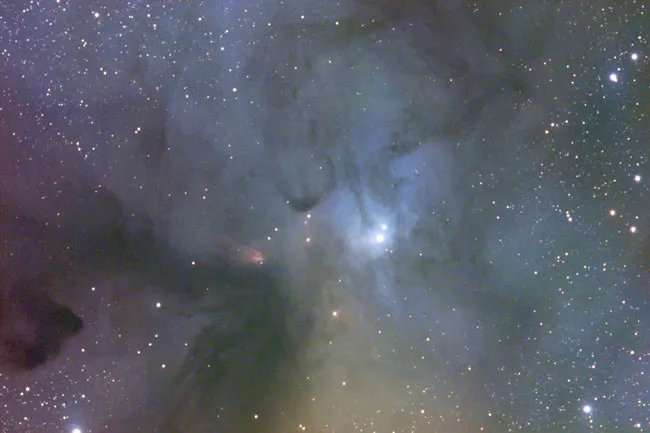
Why does this photograph of a star field recall an Impressionist painting?
The effect is not created with digital tricks, but with large amounts of interstellar dust. That dust usually comes from the outer atmosphere of large, cool young stars. The dust disperses when the star dies and grows in the interstellar medium. Dense dust clouds are opaque to visible light and can completely hide stars lying behind them. Nebular gas emissions, normally brighter in red light, can mix to form areas that seem created on an artist's canvas. The photograph above captures roughly one square degree of the nebula IC 4603, near the bright star Antares.
Impressionism was a visual, literary and musical movement. In pictorial works it attempted to capture light as a visual impression, so that the paintings suggest objects and their form becomes secondary.
An Impressionist painting is The Starry Night, by Vincent van Gogh.
Credit & Copyright: Gary Stevens.
It was the Astronomy Picture of the Day (APOD) on July 21, 2003. In Spanish at Observatorio.
Images of the week
With Hubble they discover another moon of Neptune
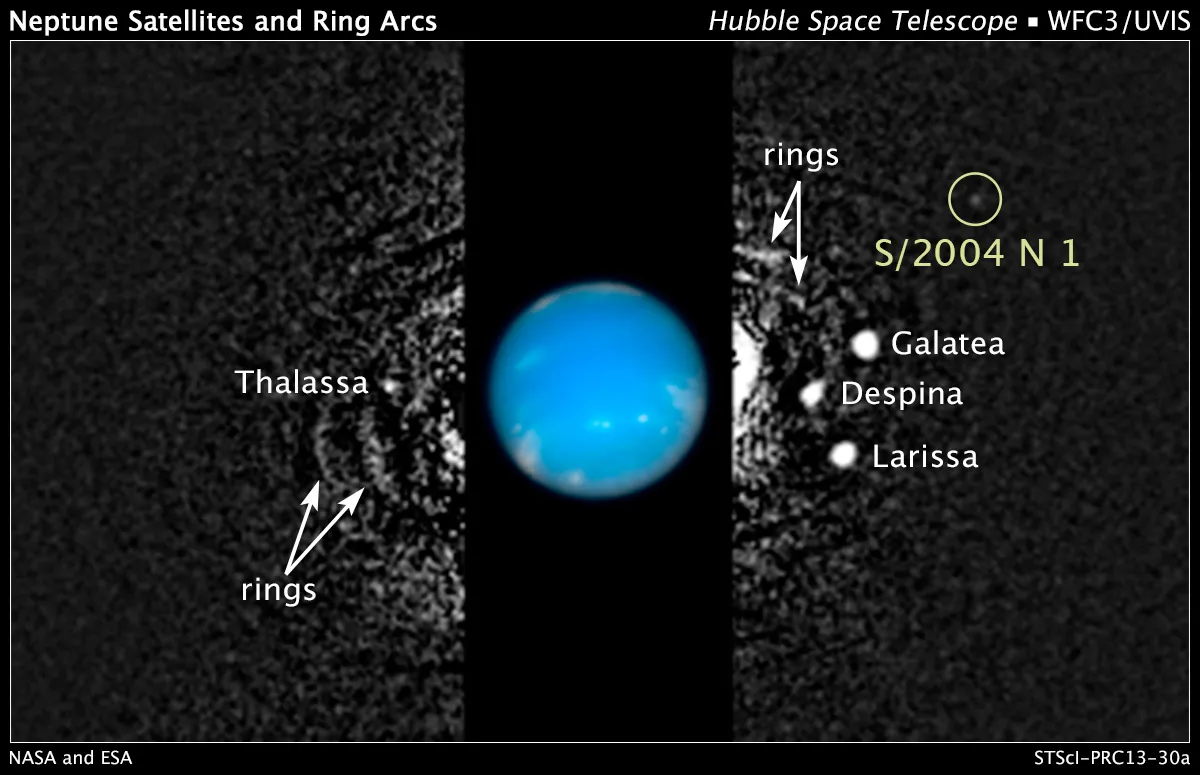
The image composite shows the location of the recently discovered moon of Neptune, designated S/2004 N1. The satellite is so small (approx. 20 km in diameter) that it was not detected by the Voyager 2 mission when it passed by in 1989.
Mark Showalter of the SETI Institute discovered this moon in July 2013 while observing the planet's rings. He then analyzed more than 150 archival photographs of the gas giant taken by Hubble between 2004 and 2009. The same small white dot appeared again and again. He then calculated an orbit for the moon, which completes one revolution around Neptune every 23 hours.
The black and white image was taken with Hubble WFC3 in visible light and the color image of the planet is from a 2009 photograph.
The shape of the natural satellite is not clearly discerned, but is "suggested" by the very little light its surface reflects from sunlight.
Other satellites of the blue planet, marked in the image, are Galatea, Despina, Larisa, Thalassa. The planet's rings are also indicated with arrows. The largest moons of the Planet that follows Uranus are Triton, Proteus and Nereid, with 14 natural satellites discovered so far...
Credits: NASA, ESA, and M. Showalter (SETI Institute)
The image was published on HubbleSite on July 15, 2013.
Space Music
Starry Night
Phil Landini is an American composer who wrote this piece for flute, clarinet and bass clarinet based on Van Gogh's work of the same name. The piece has two motifs representing bright stars and swirling winds, followed by a section that ascends the Cypress tree on the left and culminates with the Moon on the right.
https://soundcloud.com/phillandini/the-starry-night
Animated Science
Flying over a canyon on Mars
This impressive video captured by ESA's Mars Express probe brings us closer to the largest canyon on the Red Planet, Valles Marineris.
Valles Marineris is not only the largest canyon on Mars; with its more than 4,000 kilometers in length, 200 in width and 10 in depth it is the largest in the entire Solar System.
This video focuses on an 8-kilometer-deep chasm located in the northernmost part of Valles Marineris, known as Hebes Chasma.
The camera flies over the impact craters dotting the plains, descends the partially collapsed cliffs and travels across the rugged valley floor.
The European Mars Express probe has detected hydrated minerals in some regions of this valley, suggesting that at some point in its past it may have contained large amounts of water.
More at ESA Spain.
To access previous editions of this section, consult the Multimedia Selection Series. The series attempts to show that the immensity of the universe can be perceived in different ways. I choose some images from a decade ago -so they don't fall into oblivion- and from the current week that ends, as well as sounds/music and videos that are artistic forms of expression with content related to astronomy and related sciences. I am also collecting these materials in the Pinterest account