Located 250 light-years from Earth, the star HIP 102152 resembles the Sun more than any other star of its type, with the exception of being almost four billion years older. It allows us to appreciate the way the Sun will look when it ages.
The new observations provide an important and clear link between a star's age and its lithium content, and also suggest that HIP 102152 could harbor rocky terrestrial planets.
Astronomers have observed the Sun through telescopes for only 400 years (a tiny fraction of the Sun's age, which is over four billion years). It is extremely difficult to study the history and future evolution of our star, but it is possible if we look for unusual stars with the same characteristics, but at different stages of their lives. A group of astronomers has just detected a star that is essentially an identical twin of our Sun, but 4 billion years older (like a real version of the twin paradox).
Jorge Meléndez (University of São Paulo, Brazil), team leader and co-author of the new work, explains: "For decades, astronomers have tried to search for solar twins in order to better understand our Sun, which is capable of giving life. But very few have been found since the first one was discovered in 1997. Now we have obtained, through the VLT, spectra of exceptional quality, which allow us to analyze solar twins with extreme precision, to try to answer the question of how special our Sun is."
The team studied two solar twins, one that was believed to be younger than the Sun (18 Scorpii) and another that was expected to be older (HIP 102152). The UVES spectrograph, installed on ESO's Very Large Telescope (VLT) at the Paranal Observatory, was used to break down the light from these stars in order to study their chemical composition and other properties in great detail.
Stars of the same type as our sun are called "solar twins." The categories "solar analogs" or "solar-type star" are also used, but solar twins show a greater resemblance, as they have very similar masses, temperatures, and chemical abundances.
Thus they discovered that HIP 102152, in the constellation of Capricornus, is the oldest known solar twin to date. It is estimated to be about 8.2 billion years old, compared to the 4.6 billion years of our own Sun. On the other hand, it was confirmed that the star 18 Scorpii was indeed younger than our star (with about 2.9 billion years of age).
Studying the ancient solar twin HIP 102152 will allow scientists to predict what could happen to our Sun when it reaches that age; in fact, an important discovery has already been made. "One of the questions we wanted to address is related to the Sun's composition," says Meléndez. "Mainly, why is its lithium content so surprisingly low?"
Lithium, the third element of the periodic table, was created in the Big Bang along with hydrogen and helium. For years, astronomers have wondered why some stars seem to have less lithium than others. With the new observations of HIP 102152, they have taken a big step towards solving this mystery, by determining a strong correlation between the age of a Sun-like star and its content of this element.
Currently our Sun contains only 1% of the original lithium possessed by the material from which it formed. Studies of younger solar twins have shown that these younger siblings contain much larger amounts of the element, but until now scientists had not been able to demonstrate a clear correlation between age and the lithium content present in a star.[1]
TalaWanda Monroe (University of São Paulo), lead author of the new study, concludes: "We have discovered that HIP 102152 has very low levels of lithium. This clearly demonstrates, for the first time, that older solar twins indeed have less lithium than our own Sun or younger solar twins. We can now be sure that stars somehow destroy the lithium that makes them up as they age," although it is not well known how that happens.
A final twist in the story reveals that HIP 102152 has an unusual chemical composition, subtly different from that of most solar twins, but similar to the Sun's. Both show a low presence of those elements that are abundant in meteorites and on Earth. This is a strong indication that HIP 102152 could harbor rocky terrestrial planets. This is because rocky planets of this type tend to accumulate these elements throughout their formation process, which begins from a large disk surrounding the star. The idea that HIP 102152 could harbor such planets is reinforced by monitoring the star's radial velocity with ESO's HARPS spectrograph, which indicates that within its habitable zone there are no giant planets. This would allow for the existence of possible Earth-like planets around HIP 102152: in systems with giant planets close to their star, the chances of finding terrestrial planets are much lower, because these small rocky bodies suffer perturbations and variations.
The announcement of the discovery was made via videoconference at the University of São Paulo, Brazil today at 10:30 local time and subsequently the principal investigator will give a lecture there on the topic.
Brazil in ESO
Although ESO is the European Southern Observatory, meaning it is composed of European States, one exception is Brazil and the other is Chile.
ESO chose Chile in 1963 for its observatories. In this way, countries in the Northern Hemisphere could observe the southern skies with their own instruments. The United States did the same with Carnegie.
In 2010 Brazil joined ESO, which enables its astronomers to use the facilities (La Silla, Paranal, ALMA), in addition to the possibility that Brazilian companies can sign contracts with ESO. For its part, the South American country contributes 130 million euros, payable over a decade. This income will help ESO's expansion, which includes the construction of the E-ELT. The agreement is interim for now, until Brazil ratifies it.
The contributions of each member state to ESO are relative to its GDP. For example Germany (Founding Member) contributed 30M euros in 2013 (22.78% of the total), while the Czech Republic (which joined in 2007) contributed this year with 1.4M euros (1.05%). For 2013, the expected contributions total 132M euros. [2]
Brazil will contribute that amount over 10 years. The annual contribution will gradually increase, but it will only pay the full contribution in 2021.
On the other hand, it is exempt from the additional contributions that the other members agreed upon for the E-ELT. And it should be noted that such a contribution is an investment that has a concrete return in contracts with industry.
The Irish were wondering if it was worth joining ESO. Considering the issue at the beginning of 2010, the entry cost (stipulated according to different variables, including GDP) was 21.4M euros and an annual contribution of 2.2M. [3] When Finland joined the entry cost was 10M in 2005 and Australia is studying doing so considering an entry cost of 80M and 11M annually. [4]
Sources and related links
- ESO: Oldest solar twin detected
- This research was presented in a paper included in the symposium “High precision abundances of the old solar twin HIP 102152: insights on Li depletion from the oldest Sun”, held by TalaWanda Monroe and collaborators, which will appear in the scientific publication Astrophysical Journal Letters.
- [1]Previous studies have indicated that the lithium content of a star could also be affected if it hosts giant planets, although these results have been the subject of much discussion (ann1046).
- [2]ESO Member States
- [3]The Case for Irish Membership of the European Southern
Observatory. IOP. See PDF - [4]A Case for European Southern Observatory Membership. PDF
- ESO & Brazil
About the images
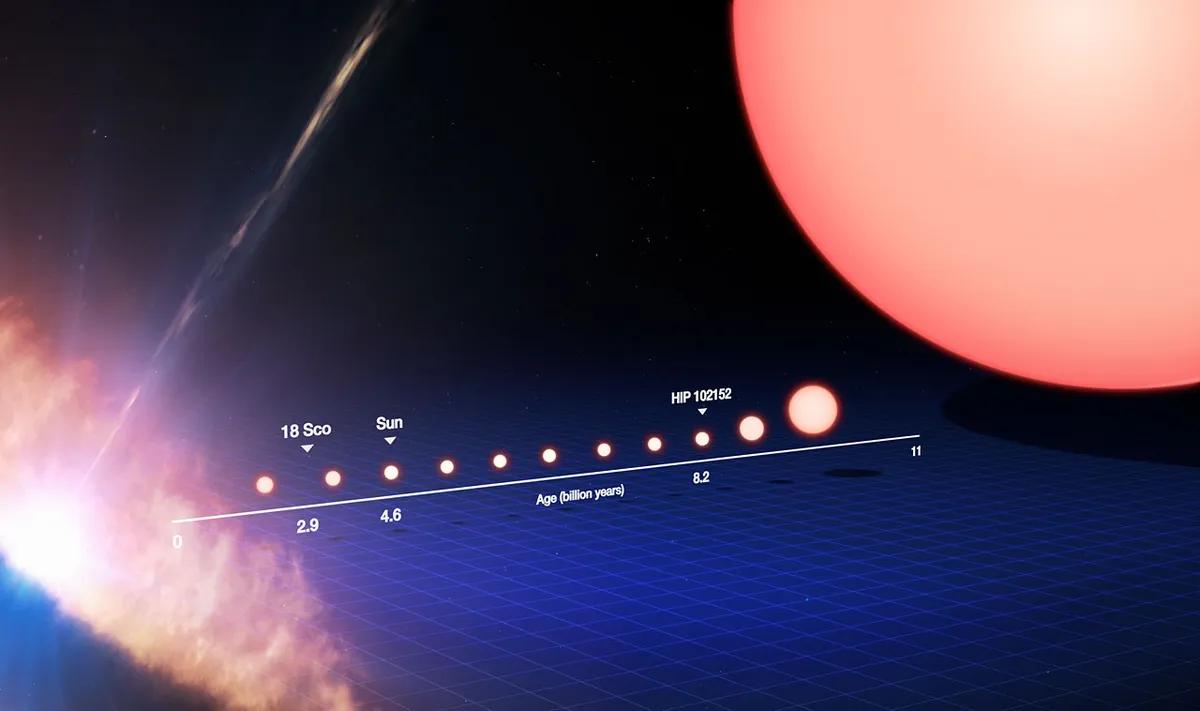
- This image traces the life of a Sun-like star, from its birth (left) to becoming a red giant (right). On the left, the star is seen as a protostar, immersed in a disk of dust and matter as it develops. Subsequently, it becomes a star like our Sun. After spending most of its life in this stage, the star begins to gradually heat up, expanding and intensifying its hue, until it transforms into a red giant.
Once this phase ends, the star expels its outer layers into the surrounding space to form an object known as a planetary nebula, while its core cools and becomes a small, dense remnant called a white dwarf.
In the lower timeline you can see the stage in which our Sun and the solar twins 18 Sco and HIP 102152 are in this life cycle. The Sun is 4,600 million years old and 18 Sco about 2,900 million years old, while the oldest solar twin is about 8,200 million years old (the oldest solar twin identified to date). By studying HIP 102152, we can get a glimpse of what the future holds for our Sun.
This graphic is for illustration only; the ages, sizes and colors are approximate (not to scale). The protostar can be about 2000 times larger than our Sun. The red giant can be about 100 times larger than our Sun.
Credit: ESO/M. Kornmesser