Is astronomy a necessity or a desire? Is it useful for anything? What is it good for? Is it correct for the State to invest money in research in this science?
Every science is good for knowing that which is not known, as well as for asking new questions. So, defined that way, science is related to the search for knowledge.
But, what is knowing good for?
A large part of knowledge is "good" for practical, instrumental, concrete matters that directly or indirectly impact people's quality of life. Knowing that the sun emits U.V. radiation and that -despite having an atmosphere that filters part of that energy- it is harmful to our health, is "good" for protecting ourselves.
In the same way we could think of other "applications" of astronomical knowledge that modify our quality of life.
But if we compare astronomy with medicine we will notice an important difference in this aspect. Astronomy has very little impact on people's "quality of life". Of course, one could define what we call "quality of life". In part it seems to be a concept related to human needs. People need many things, some of which are indispensable for living, such as food, health, housing, clothing.
In physics, research is continuously carried out that will somehow have an impact on solving problems to satisfy those needs. When that happens, the general public gives meaning to science in relation to its impact on human quality of life.
But that meaning is not always given to investment in science.
Astronomy, it occurs to me, is one of the sciences with the least "impact on quality of life", if we define those terms as I indicated above (which is not the only way to define them).
Putting a telescope in space, as NASA will do next year with the James Webb, has an economic cost. The successor to Hubble could cost about two billion dollars.
Setting up a state-of-the-art observatory on the ground, like the ones Europe has in Chile, also implies an "enormous" amount of money.
And part of the public does not understand that economic expenditure since astronomy does not solve everyday life problems. If astronomy is not good for that, then what is it good for? (In the links it is clear that I am not the only one who perceives these ideas in public discourse).
The issue is more complex than one might suppose. So I am not going to give a single answer here, although I will ask myself some questions about it and will begin to position myself in a type of answer that is not usual.
However, I write these lines to present a problem, know the public's opinion, and lay down some ideas with the aim of gathering them later along with the views of other people linked to astronomy from different places: preferably astronomers, but also teachers, philosophers, officials.
I record here an intention of an objective: to explore the topic by consulting different professionals in the field during 2014.
My approach
As I indicated before, my intention here is not to give definitive answers, but to ask myself a set of questions that pose the problem and, at the same time, position me in a type of answer.
To address the problem I will briefly develop some points, clarifying that in my view, all of them have some truth, but that -separately- they are insufficient to justify research in astronomy.
1-The statistical answer
Sometimes, faced with the question of why the State should invest in science, the answer is given with a quantitative view, pointing out that in developed countries, where the most is invested in R&D, is where the greatest human progress has been recorded. The answer, even if we take it as true, is at least insufficient. Let's think specifically about astronomy. If the above were true, does it mean that setting up an observatory in Salta will immediately bring about greater social progress? That the State invests in researching the interstellar medium, how does that impact people's quality of life?
The statistical answer does not seem to be a good answer to the specific question about astronomy.
2-Serendipity
Another type of answer that is often given is that investment in science yields unexpected fruits. This is indeed the case, since if we look for information we will see that some developments for astronomy had an impact in other areas. This is called "knowledge or technology transfer". Innovations in technological developments in one area for which they were intended can later be used in other areas, which were not the initial objective. There are concrete examples. However, does this imply that investment in science is something like a blind date with social impact? Does it imply that it is necessary to invest two billion dollars in designing, building, and putting into orbit a telescope like the James Webb just because perhaps, maybe, after some time, some application of such innovations in other areas might appear?
Does it mean that research on globular clusters is justified by the fact that when conducting such studies it is possible that some practical application in everyday life might arise?
Even if it is true, such an argument seems a weak justification for research in astronomy.
3-Critical thinking
It is said that astronomical knowledge is "useful" because it opens the doors to critical thinking. It is true, any novice will encounter the concept of apparent magnitude and absolute magnitude, which shows that the senses deceive, but that we can arrive at a more complete knowledge if we use our higher cognitive abilities, that is, if we distrust what is merely instinctive or emotional. It's true. But it is false that if an astronomer uses scientific thinking to calculate distances to an open cluster, they will also be qualified to have a critical position regarding other aspects of social life. On the contrary, there will be no shortage of astronomers who "live in a bubble" and only have a critical attitude in observatories or faculty offices, but not when reading a newspaper.
4-A place in the universe
It is thought that if research in astronomy did not exist, we would not know our "place" in the universe. Which also means that if there were no research, there would be no dissemination or education at the initial, secondary, and higher levels. It is as true as the fact that we already have that knowledge, so if the justification for astronomy lies solely in knowing our "location", we already have enough. It is clear that this cannot be an argument to justify astronomy either.
5-State and Market
One might wonder what would happen in Nation States as we know them -in the vast majority of cases they are Capitalist States- if the State did not invest money in astronomical research, would the private sector make the investment? What could the private sector's objective be in investing many dollars in astronomy? Could an economic profit be obtained from greater knowledge of variable stars or unreachable exoplanets?
6-The comparative cost
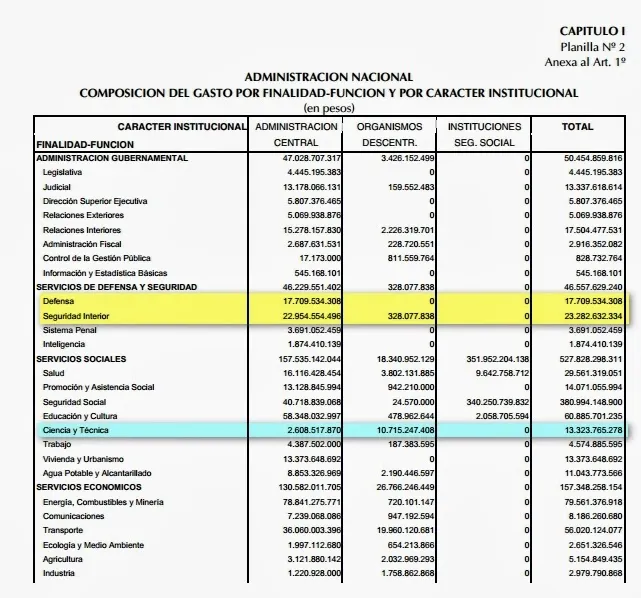
According to El Cronista, in less than five years $6,127 million were disbursed just for television rights in Fútbol para todos. It is enough to analyze the 2014 budget (project) to compare what is "spent" on Defense and on Science (Composición Del Gasto Por Finalidad-Función y Por Carácter Institucional. In Mecon.)
7-Conviction vs Convenience
If we seek to answer the question Should we do astronomy? we can answer it from two ways of thinking linked to decision-making.
7a-From a Utilitarianism or consequentialism, by which, if doing something is useful, if its consequences are useful to us, then we do that thing. It must be considered that we usually use the adjective "useful" followed by the preposition "for," which implies the idea of "means," e.g.: "Education is useful FOR obtaining a better status FOR achieving a better job FOR getting a higher salary FOR being able to buy more food FOR being alive FOR who knows what."
From utilitarianism, what is important is the result as a means to achieve an end (which is normally another means).
It is a relativist stance, since if it is convenient for me to do astronomy, I will do it, and if it is not convenient for me, I will not do it. It is a way of deciding based on convenience.
7b-A different stance is one by which something MUST be done as a matter of principle or moral value.
Unlike utilitarianism, this other way of deciding is not based on convenience, but on convictions.
If it is right to do astronomy, I must do it, regardless of its consequences, of whether it is convenient for me or not (individually or collectively).
For example, if we start from the basis that telling the truth is the right thing, as an absolute principle, then I must always tell the truth, even if by doing so it harms me or damages others. In this case, telling the truth is not a means to achieve something else, but an end in itself.
In our daily lives we make use of both ways of deciding. Can these ideas be applied to astronomy?
Is astronomy a means to solve problems of daily life or is it an end in itself?
In reality, it is difficult to think of something that is an end in itself in an absolute or literal way. But it could be said that astronomy is not a means to solve problems, but rather it is a way (or means) of acquiring knowledge and that this is an end in itself, due to our thirst for knowledge. From this point of view, knowledge would be a human need and research would be a means to satisfy that need (a satisfier).
From the other stance, research would also be a means, but not a satisfier, but a means among others in a long chain whose ultimate end would have to be clarified.
8-Human need
Does the need to know not form part of human needs, even if it is not indispensable for maintaining life? There are people who dedicate a lot of time to studying to get a better job, to earn more money, to obtain food, health, clothing, housing. Once those needs are satisfied, will we feel satisfied? Food, health, clothing and housing are needs we require to satisfy so as not to die. Is that living? Is living doing what is necessary not to die?
9-Useful art
If only what is "useful" in the pragmatic, instrumental sense is justified, then what are the works of Mozart, Picasso, Berni, Borges, etc. for?
Let the reader name a book, a film, a play that changed their life, that meant a turn in their way of thinking or interpreting reality.
Do those works seem "useful" to you? Did the author create them foreseeing that "utility" or was the artist's objective different?
10-Education and Research
When we talk about astronomy we could be referring to the visual observation of amateurs; to education in the educational system; to the popularization of science; to research (and higher education). The question is valid for all forms of astronomy, but particularly regarding research. Could there be popularization or popular education without research?
The question has been posed
Plato in his Republic (Chapter VII) made an attempt to justify astronomy. We, three thousand years later, are we in a position to do so in a solid way?
Is astronomy a "luxury science"?
Update
A simple answer to the question is found in the note:
TESS and the great problems of astronomy https://www.noticiasdelcosmos.com/2018/04/tess-y-los-grandes-problemas-de-la.html
The need for a critique of science https://www.noticiasdelcosmos.com/2015/06/la-necesidad-de-una-critica-de-la.html
From astronomy to society (Technology transfers)
https://www.noticiasdelcosmos.com/2019/05/de-la-astronomia-la-sociedad.html
I published a document (PDF, 7 pages, 260kb) that can be accessed at the following link, in which I elaborate my ideas on the same topic, in a better way:
Necessity and utility of astronomy https://drive.google.com/open?id=1vpfZ84IriR7iaqVjtqeHtGkCPmAyv0KI
Sources and related links
- Modern Ghana: Government urged to invest in astronomy
- Scidev.net: Astronomy can foster development
- Smaller questions: So Your Friend Asks: Why Spend Money On Astronomy? What'S The Use?
- The objective here is not to debate whether astronomy should receive more or less funds than now or a greater or lesser amount than other disciplines. Any money invested in astronomy is a resource that is not surplus, so regardless of the amount it is worth asking whether that expense is justified. I maintain that it is, but I want to know other opinions and arguments. By the way, the reference is in relation to the "Characteristics of scientific research" (pp 138-140) in "Estilos tecnológicos: propuestas para la selección de tecnologías bajo racionalidad socialista" by Oscar Varsavsky. (Mincyt)
About the images
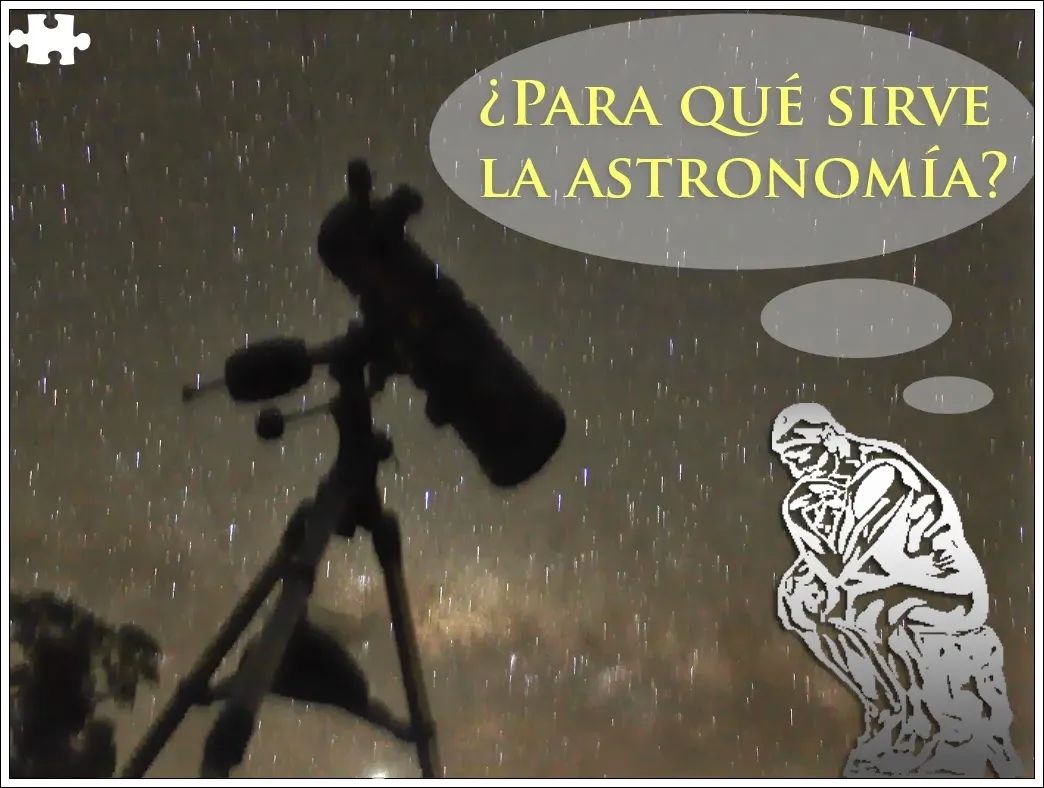
- The opening image is a combination of a photograph I took this year, with the silhouette of my telescope, together with a clip art image of Rodin's The Thinker, which I used from the Takiwall site.