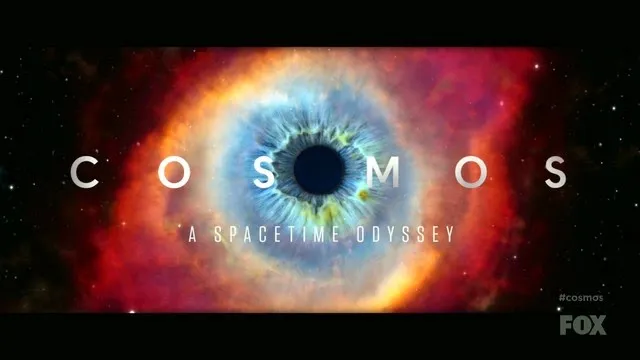
Tomorrow the new series Cosmos premieres in Latin America. What can we expect? What "void" does this series come to fill?
Since theories in communication began to be developed, the debate about the effects of media on audiences has not ceased.
For that reason and despite the existing theoretical discrepancies, it is possible to take sides with some theoretical framework.
I will not develop here the ideas I believe are closest to objective reality, but I would like to position myself within those debates.
One of the schools in communication was the one promoted by Marshall McLuhan (before him, Harold Innis): the Toronto school. Among the theorists of this current, I believe Walter Ong (#1) stands out, who conducted a significant investigation: he studied how communication and the development of thought were during "primary orality" and compared it with the later development of what for him was the first communication technology: writing.
The first period is the one characterized by the total lack of writing, in which all thought or idea was transmitted (what is transmitted are not ideas, but messages) orally. There was no way to store information outside our brains. Human memory was the only "device." That "bowl" is limited, so the information that was stored was the essential, the vital, that which was necessary to live.
With the appearance of the first forms of writing, this changes and from then on it will be possible to store information outside our memory. Therefore, it will be possible to record non-vital data, which we could call -by contrast- trivial data.
The subsequent development of new technologies (the printing press, the telegraph, etc.) will accentuate that process to the current point of generating an amount of information impossible to process.
But Ong not only described the communication process, but also indicated that communication technologies also affected our way of thinking: the possibility of making diagrams, maps, accounts, was not only a change in the way of transmitting messages, but it will be more elaborate, deeper messages that account for new cognitive processes.
Communication technologies change the way we think. That is the idea that emerges from Ong's work. And it is worrying when we begin to notice that from the telegraph to the present, that process seems to degrade more and more. Umberto Eco recently wrote an article in which he expresses concern about the "lack of memory" of young people. Some authors have noticed certain "symptoms" in current ways of communication and related them to a degradation of our thinking. The new technologies, basically audiovisual, do not allow the transmission of deep messages, so our thinking becomes increasingly "superficial," they say.
Trash TV
The notion of "trash TV" has expanded to everything audiovisual and digital, for reasons related to what was stated above. Faced with this, although it is an extensive and complex topic, I allow myself to say a few things:
1-I share some ideas, in general regarding the "symptoms," not so much regarding the causes.
2-I agree that the "perceptual material" (graphic, audiovisual) is a "variable" to consider in relation to the effects in communication.
3-It is not scientifically viable to draw conclusions about the effects considering only the perceptual material or the so-called "technological environment," since we live in a society that has certain characteristics that count as much or more than that environment and that cannot be separated because they are intrinsically linked.
That is why any television product must be understood within the social scheme in which it occurs. A background, structural variable is similar in almost any country in the world: the capitalist system.
Television is a system that is generally privately financed, through advertising linked to audience measurements. The ultimate goal of these products is economic profit. That does not mean that their creators may also have other types of objectives, but the latter are subordinated to the former.
The new series Cosmos, for example, may have pedagogical or educational intentions, but they are subordinated to "success" measured quantitatively. And that has consequences in the way television products are designed: broad, simple language, designed for a heterogeneous audience. An "impactful" content from an audiovisual standpoint to attract the public (even those who are quite uninterested in astronomy).
The effects of television as a communication medium will be different depending on the "context" and the "management of contact." Let's imagine that a teacher wants to explain the formation of the Solar System. To do this, she asks her students to watch an episode of the new series Cosmos. And she gives them a series of guiding questions that they must answer for the next class, based on the content of the program.
The students will then have to watch the "show" paying enough attention to answer the given questions.
On the other hand, a person tomorrow at 22 h in Argentina, arrives home after working 9 hours, after having traveled 1 hour by bus or train, packed like sardines, and decides to relax since they made a considerable effort during their workday. While having dinner, they turn on the TV. What level of attention and effort will that person be willing to make, with the remote control in hand?
The contrast between the first example and the second is neither the technology nor the perceptual material. If there are differences in the "effects," it will be another variable that neither McLuhan nor his disciples cared much about. "The medium is the message," is the slogan of that current. To which can be added: "Regardless of the content and the historical-social situation."
What can we expect then from the series Cosmos?
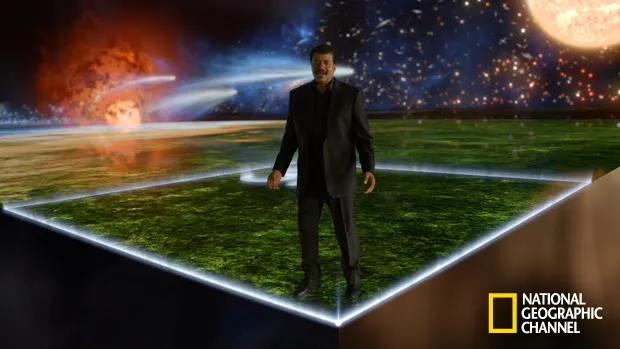
It will surely have significant visual display, as seen in advance. Its host is a charismatic astronomer, as Carl Sagan was. Neil deGrasse Tyson is known among astronomy enthusiasts.
It would be desirable that, like the original series, it at least attempts to explain the complexity of "scientific thinking," the generation of hypotheses, the experimental difficulties and how, despite those obstacles, it is possible to access objective reality. Let's not forget that we live in a "postmodern" or post-materialist world.
Science itself is not exempt from this.
First, Our Own
If the prevailing economic system is capitalism in its superior phase, also called imperialism, it is worth asking three questions:
1-The public (the publics): Are they capable, as of today March 10, of naming an astronomer who is alive?
2-The audiences: Will they be able after March 11 to name a living astronomer?
3-The viewers of Cosmos: Will they be able to name a living astronomer who has the same nationality as themselves? (For example, an Argentine astronomer in the case of a viewer from our country?)
I am tempted to venture answers, although it would be interesting to conduct an extensive opinion poll:
1-The public knows Carl Sagan, perhaps they can also name Stephen Hawking. Perhaps also Michio Kaku. I clarify that I am referring, especially, to the public that is NOT an astronomy enthusiast, the general public.
2-After Cosmos, considering the important audiovisual production that has been seen in the previews and the promotion the series is getting (see below), if as expected it is seen by a significant number of viewers, Neil deGrasse Tyson will be an astronomer's name that until today those people did not have and that they will have afterwards.
3-Those who until now do not know an astronomer from their country, will continue not knowing one.
The "fault" for that lies neither with the astrophysicist-host nor the production nor the channels that will broadcast the program. When a space is left empty, someone occupies it. There is no imperialism if the colonies revolt. When, on the contrary, we maintain a comfortable silence assuming that making a speech is taking a stand and committing ideologically, then, despite saying nothing, we are saying something (First axiom of Watzlawick)
More than what Cosmos "says," I wonder, what does the sidereal Argentine and Latin American silence say? #2
SUPERPROMOTION
According to the Prensario site: "The first episode can be seen on Tuesday the 11th at 22 h in Argentina, Chile, Uruguay and Paraguay (simultaneously on Nat Geo, Fox, Film Zone, FX and Cinecanal), Colombia (Nat Geo, Fox and FX), Venezuela (NatGeo) and Mexico (Nat Geo, Fox, Film Zone, FX, Cinecanal, Fox Sports 3, Fox/NG HD, FX HD, Cinecanal + , Film Zone HD, Moviecity Premieres and Moviecity Family)."
According to the same site, Ward Platt, CEO of National Geographic Channels International and COO of Fox International Channels said: For 125 years, National Geographic has been at the forefront of scientific research, exploration and adventure. Cosmos represents an impressive and epic journey into a new era of exploration, highlighting the fundamental and inherent values of the company.
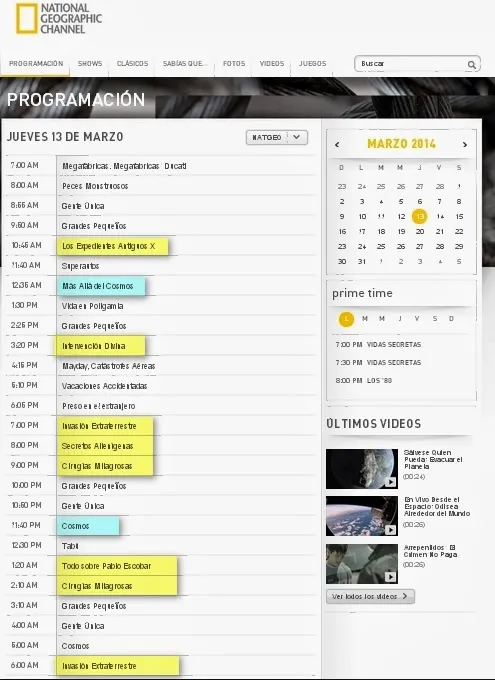
One might ask what the "fundamental values" he refers to are, considering that the same channel also broadcasts series like "Miracle Surgeries," "Divine Intervention," "Alien Invasion," and "Alien Secrets" and "All About Pablo Escobar." (see schedule for 03-13-2014)
Lecture "Discovering the universe"
It will be on 3-15-2014, 19 h, at the headquarters of the Asociación Argentina Amigos de la astronomía, given by Dr. Susana Landau (UBA-CONICET).
More information on the Association's site.
Sources and related links
- Site of the new Cosmos series on Natgeo.
- #1: ONG, Walter. Oralidad y escritura. FCE Argentina, Buenos Aires, 2006. Summary of the book at FCE: https://www.fce.com.ar/archivos/guias/Lenguayliteratura/ong.htm [Last accessed 03-10-2014]
- #2: I exclude initiatives like those of Canal Encuentro and programs like those hosted by Paenza and Golombek; the editions of popular science books, as well as the communication work of some universities (especially La Plata) and the astronomers who dedicate part of their time to general outreach.
About the images
- Image from the NatGeo/cosmos site.