The International Astronomical Union responds to a recent name-selling campaign. Background and reactions from astronomers.
In light of recent events advertising the possibility of buying the rights to name exoplanets, the International Astronomical Union (IAU) wishes to inform the public, through a press release published last week, that such plans have no relation whatsoever to the official process of naming astronomical objects.
The IAU enthusiastically welcomes the public's interest in participating or getting involved in recent discoveries, but wishes to emphasize the importance of having a unified naming procedure.
More than 800 planets outside the Solar System have been found so far, with thousands more awaiting confirmation. Detection methods in this field have increased steadily and rapidly, which implies that many more exoplanets will undoubtedly be discovered in the coming months and years.
Recently, an organization has invited the public to purchase both exoplanet nomination proposals and the rights to vote for suggested names. In return, the buyer would receive a certificate commemorating the validity and credibility of the nomination. Such certificates are misleading given that the campaign has no relation whatsoever to the naming process, so it is blatantly a scam, a fraud.
Although the IAU does not say it explicitly, it refers to the commercial initiative Uwingu.
When discovered, exoplanets and other astronomical objects, explain the IAU, receive unambiguous official designations. While exoplanets like 16 Cygni Bb or HD 41004 Ab may seem boring compared to the names of the planets in our own Solar System, the vast number of objects in the Universe - which includes galaxies, stars, planets, etc. - implies that a clear and systematic system for naming these objects is vital. Any naming system is a scientific matter that must work across different languages and cultures in order to achieve worldwide research collaboration and avoid confusion.
To make this possible, the IAU acts as an arbiter of the naming process and is advised by astronomers from different fields. As an international scientific organization, it completely dissociates itself from the commercial practice of selling names of planets, stars, or "real estate" on other planets or moons.
Such practices will not be recognized by the IAU and their alternative names will not be adopted.
However, the IAU appreciates and wishes to acknowledge the growing interest of the general public in being more involved in the discovery and understanding of our universe and its objects. As a result, in 2013, Commission 53 on Extrasolar Planets and other IAU members will be consulted on the topic of giving popular names to exoplanets, and the results will be public on the IAU website. Meanwhile, astronomers and the public are encouraged to continue using the existing nomenclature, which can be consulted on the IAU site.
About Uwingu
Alan Stern is one of the scientists behind this startup that brings together people from different fields such as educators, lawyers, marketing professionals, and astronomers. The Advisory Board is also made up of a host of professionals like journalists, artists, and entrepreneurs.
The Uwingu initiative is presented on its website as a "contest" through which names for exoplanets can be nominated. But it is not free; rather, it costs USD 5 per nomination. It is also possible to vote among those already nominated, for USD 1.
It is supposed, as they indicate on the site, that the money is to support scientific projects, although it is a for-profit organization.
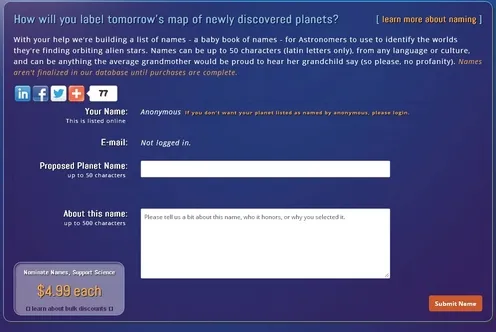
On that website, as far as I could inspect, the "official" or "formal" procedure established by the IAU is not mentioned. And, as that association reports in the statement, a "certificate" is promised for the nominations. This fact, in my view, is highlighted by the IAU based on the general notion that a certificate is a "sign" of "validity."
Background
1-The anime nebula
In February, following a new image of the Lobster Nebula obtained with ESO's VISTA telescope, I commented here that a group of people asked the researchers to change the name of that object to that of an anime character, upon finding a resemblance in the nebular shape.
In that post I pointed out that such a request is unnecessary, since nothing prevents us from colloquially calling an object whatever we want. The only problem is that if we all do the same, we will increase the disorder of the Tower of Babel in which we live and it will be impossible to communicate.
2-An astronomer proposes
The "official" naming of astronomical objects has also been questioned by astronomers like Wladimir Lyra, who proposed using names for exoplanets, instead of the cold and distant designations based on catalogs (like in HD 41004 Ab) or the combination of variables like the genitive of the constellation plus an order number plus a letter to denote objects in the same system (like in 16 Cygni Bb).
I consulted Lyra on the matter and he indicated that "I am 100% on the side of the IAU".
And he explained that "Uwingu combines two bad ideas. One is giving popular names to planets. A few years ago I advocated for a plan to name exoplanets based on world mythology. The reason is that people tend to suggest very bad names. Look at the names of asteroids: Mrspock, Jamesbond, Tomhanks, Megryan... Look at the names suggested on Uwingu: RonPaul, MittRomney and my favorite 'NoMoreTaxes' (Clarification: NoMásImpuestos, in Spanish)".
For Lyra, the second reason is that they charge for name submissions. And he indicated: "They accuse the IAU of arrogating ownership of the Universe, but they are the ones trying to sell the sky. It is not ethical".
For the Brazilian researcher, "the whole concept of funding research through private capital is a dangerous idea. For my part, I don't want to live in a world where research is funded by corporations".
Regarding the possibility of reopening the discussion for the public to participate in naming planets and consulting Commission 53, Lyra commented that "I agree. The bad elements of Uwingu are the payment and the lack of a committee to regulate the naming. But the idea of public participation is not bad. The way I would do it: free, and in addition to the name, people should offer some reason for why they chose that name. The site should make it clear that mythological names are preferred. There could be a vote later on the site, but ultimately the names should be sent to the IAU for approval. And free, I insist."
Furthermore, Lyra indicated that his previous proposal is no longer useful, because until that time exoplanet discoveries were made all over the sky and his proposal was that the names be related to the constellation in which they were located. But currently, the massive results from Kepler (referring to the NASA mission) in the same place in the sky make the scheme impractical, since the planets discovered by the mission are all in two constellations: Lyra and Cygnus.
3-Pale Blue Dot: Adopt a Star
Another precedent that can be mentioned is the Pale Blue Dot initiative, which encourages individuals to "adopt stars" to fund scientific projects.
I have contributed to such an initiative without ever thinking that I was buying a star or naming it, but simply collaborating with a science project.
I have consulted Travis Metcalfe, Ph.D. in Astronomy at the Space Science Institute, Colorado, about the Uwingu initiative and its similarity to Pale Blue Dot (PBD) which he started in 2008. According to Metcalfe, he knows some of the scientists involved in Uwingu and says their intentions are good. But he establishes that there are two differences between Uwingu and PBD:
First, PBD specifically uses the phrase "adopt a star" to make it clear to donors that they are not buying the rights to name a star and they provide a link to the IAU page on naming. "As astronomers we believe this careful choice of words is essential for the integrity of the project," Travis indicated in his email.
Uwingu is specifically about "naming" planets and does not discuss the IAU's position on its site, except for what is noted in its Faq#20, the astronomer also indicates.
"This could potentially be misinterpreted about whether the proposed names will be officially recognized," commented Metcalfe.
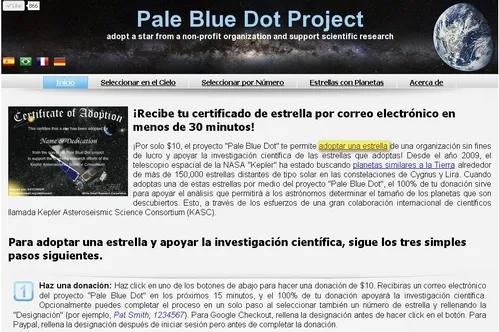
Second, PBD, according to Metcalfe, is a non-profit organization, so 100% of the funds raised support scientific research projects. Uwingu, as they themselves indicate (Faq#10) is a for-profit venture and according to the website "up to half of the funds raised will provide grants to scientists."
"The question raised by the recent IAU statement is whether Uwingu is being completely honest in how it presents itself to the public," adds Metcalfe, finishing with a wish: "I hope they make a sincere effort to address the IAU's concerns."
4-Expedición Ciencia
A recent example in our country is that of Expedición Ciencia, a non-profit civil association formed by scientists, educators and students passionate about science, education and outdoor life who run science camps. They recently started a fundraising campaign titled ¡Tomate un café con Expedición Ciencia!. The discourse of that campaign can be analyzed through the texts (written and video) they made for that purpose on their Facebook page.
On March 23, Gabriel Gellon, co-founder of Expedición Ciencia, held a hangout. As seen in that video (which was recorded on YouTube), at minute 2:30 Gellon clarifies that one of the reasons for that virtual meeting is that some people "understood" that indeed those who made a donation would "have a coffee" with its founders, in a real, tangible, concrete, sensible way. But the phrase "Tomate un café con Expedición Ciencia" is figurative, and is understood by analyzing the following phrase: "If you donate to us monthly what you would spend any day sitting in a bar, you help us a lot so that more young people from all over the country can participate in our science camps!"
How should exoplanets be named?
The reasons why part of the public can justifiably argue a complaint about the current naming systems is that they are arbitrary, complex, not very "meaningful" in the sense that they do not refer to other names used in diverse literature, and that several astronomical objects do have names like the planets of the solar system and the constellations. And those names do not "reflect" human cultural diversity in a balanced way, but have a Greco-Roman bias.
The IAU's arguments, on the other hand, are understandable. The existing naming would be difficult to change. And, given the notable number of objects being discovered incrementally, seeking "popular names" would be enormously cumbersome.
In this press release, disseminated on April 12, the IAU opens the possibility that, within Commission 53 together with other IAU members, the possibility of using names for exoplanets be evaluated. In 2009 a consultation of the same tenor was already carried out and the majority disagreed.
In Commission 53, on Extrasolar Planets, Andrea Buccino, Eduardo Fernandez-Lajus, Carlos Saffe are listed as members from Argentina and Dante Minniti (Argentine working in Chile).
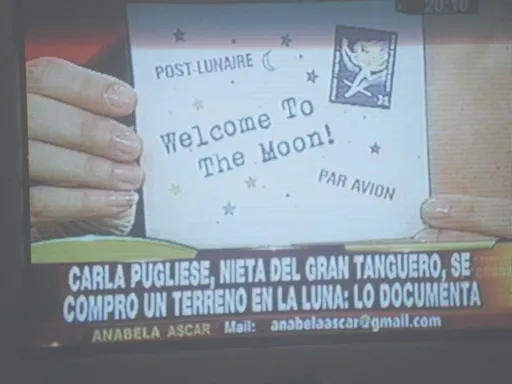
Astronomers, words, definitions
People usually believe we communicate because we emit recognizable sounds or write texts, as if they had a single possible meaning. That is an outdated idea. Everything I presented in this post can be "read" in many different ways. Among those ways, which are unique and infinite, however, there will be many coincidences. The differences in the "construction of meaning" can range from almost non-existent to very large. In communication, the only thing we have guaranteed is misunderstanding. That does not imply, of course, that we give up. What is important is to try to analyze what other "texts" are circulating (see image above) and what constructions of meaning they usually have, in order to formulate texts that can relate to those other pre-existing ones. In this way, knowing what constructions of meaning the phrase "naming a planet" (or similar) has had, it is at least strange that it is used in a way (without clarifications) where it is very likely that the construction of meaning in the public is another. There will be people who, upon accessing Uwingu, made a construction of meaning by which they understood that their proposed names would not be "official." Others will understand that, although they are not official names, if those names were used in papers, they could end up being so, generating "pressure" for the IAU to change its official naming method. And surely there are those who -like the IAU- understand that it is potentially a very ambiguous discourse that deserves at least some clarifications.
Sources and related links
- IAU: Can One Buy the Right to Name a Planet?
- Wladimir Lyra: Naming exoplants
About the images
- Screenshots from Uwingu and Pale Blue Dot. The credit belongs to their creators.
- Screenshot from the program hosted by Anabela Ascar on Crónica TV, aired on 01-26-2013, 20:10. The broadcast credited that the process of "buying land on the Moon" was real and official, because the person who had done it -the naive granddaughter of Pugliese- had received a "Certificate."
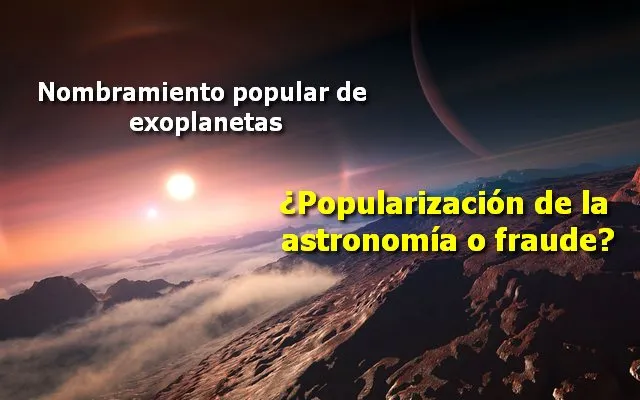
- Initial illustration: IAU/L. Calçada