On August 31, DES, the Dark Energy Survey, officially began operations. The scientists forming the research team will systematically map one-eighth of the sky (5000 square degrees) with unprecedented detail. The start of the survey is the culmination of a ten-year effort of planning, construction, and fine-tuning by scientists from 25 institutions in 6 countries.
The goal of the survey is to find the reason why the expansion of the universe is accelerating, instead of slowing down due to the force of gravity, and to explore the mystery of dark energy, the force thought to be the cause of that acceleration.
"With the start of this project, the work of more than 200 collaborators begins to bear fruit," says DES director, Professor Josh Frieman of Fermilab. "It's an exciting time in cosmology, when we can use observations of the distant universe to learn about the fundamental nature of matter, energy, space, and time."
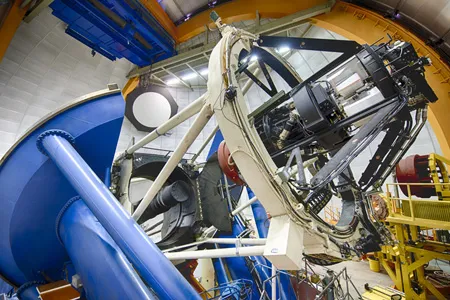
The project's fundamental tool is DECam, the Dark Energy Camera. A 570-megapixel digital camera built at Fermilab and installed on the Víctor M. Blanco telescope. This is a telescope with a 4-meter diameter mirror located at the Cerro Tololo Inter-American Observatory (CTIO) in the Chilean Andes, which belongs to the United States National Science Foundation. The camera is equipped with 5 lenses, polished with extremely high precision, the largest of which has a diameter of almost one meter, and which together provide sharp images across the entire field of view.
DECam is the most powerful instrument ever built for a survey of this kind. With each snapshot, it will be able to see the light from more than 100,000 galaxies located at distances of up to 8,000 million light-years.
The construction of this camera is the result of an international collaboration, in which CIEMAT, with the contribution of UAM in Madrid, and ICE (CSIC/IEEC) and IFAE in Barcelona, have had a prominent participation. The collaboration includes researchers from the United States, Spain, Brazil, England, Germany, and Switzerland.
Scientists in the DES collaboration will carry out the largest galaxy survey ever proposed, and will analyze this data to perform four tests on dark energy, studying galaxy clusters, supernovae, the large-scale distribution of galaxies, and the weak gravitational lensing effect on those galaxies. This will be the first time these four methods are used simultaneously in a single experiment.
"It is exciting to see some dreams come true and we can finally investigate the nature of that dark energy responsible for the accelerated expansion of the universe," comments Juan García-Bellido of the Universidad Autónoma de Madrid.
For 5 years, the DES project will obtain color images of 300 million galaxies and 100,000 galaxy clusters. Furthermore, it is expected to discover 4000 new supernovae, many of which occurred when the universe was half its current size. The data obtained will be processed at the NCSA (National Center for Supercomputing Applications) at the University of Illinois at Urbana, and made available to scientists in the collaboration, and the general public, later.
DES observations will not see dark energy directly. However, by studying the expansion of the universe and the growth of its large-scale structure over time, the survey will provide scientists with the most precise measurements of the properties of dark energy obtained to date.
The DES survey will use four methods to study dark energy:
Counting galaxy clusters. While the force of gravity causes matter to attract and form galaxies, dark energy causes it to repel. DECam will observe light from 100,000 galaxy clusters, located billions of light-years away. Counting the number of galaxy clusters that existed at different times in the history of the universe will shed light on this cosmic competition between gravity and dark energy.
Measuring supernovae. A supernova is a star that explodes and can become as bright as a galaxy, which contains billions of stars. If we are able to determine how bright supernovae appear from Earth, we can know how far away they are. With these measurements, scientists can determine the speed at which the universe is expanding. DES will discover 4000 of these supernovae, which exploded billions of years ago, in galaxies located billions of light-years away.
Studying the distortion of light. When light from distant galaxies encounters dark matter in space, its path curves around that matter, causing the image of those distant galaxies to appear distorted in the images taken by the telescope. DES will measure the shape of 200 million galaxies, which will reveal the cosmic tension between gravity and dark energy that has formed clumps of dark matter distributed in space.
Using sound waves to create a large-scale map of the expansion of the universe over time. When the universe was less than 400,000 years old, the interaction between matter and light created a series of sound waves traveling at a speed close to two-thirds the speed of light. Those waves left their imprint on the distribution of galaxies in space. DES will measure the positions of 300 million galaxies to find that imprint and use it to deduce the history of cosmic expansion.
"Dark energy is one of the greatest mysteries of current science, and only by using several techniques can we advance in the study of its properties. The DES project will allow a huge advance, which could bring us fascinating discoveries," states Eusebio Sánchez, of CIEMAT.
Interactive DECam
The interactive DECam shows us a composition of a part of the constellation Fornax, taken in 2012 with DECam, showing the entire field of view in color. The camera captures light on 62 CCDs. On this page you can click on each CCD to see what is observed. Clicking opens a window with information.
The Data Management System
In addition to the camera and telescope, a data management system is needed. Each image taken by DECam is one gigabyte in size. DES will take 400 of these images per night: quite a challenge when it comes to handling such a quantity of bits. The data is sent via link to La Serena and from there, by optical fiber to NCSA in Illinois for storage and reduction. The latter consists of standardized corrections of the information in the CCDs to remove imperfections due to the instrument and to combine them into images of 0.5 square degrees. Then the stars and galaxies are identified and cataloged, their properties are measured, and they are stored.
Sources and related links
About the images
- The Dark Energy Camera, mounted on the Blanco telescope at Cerro Tololo Inter-American Observatory in Chile. Credit: Reidar Hahn/Fermilab.
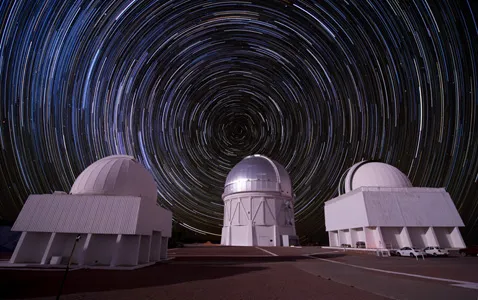
- Star trail, shot of stars over Cerro Tololo. Credit: Reidar Hahn/Fermilab.