The NSF decided to change the name of the LSST and it will be the first national observatory in the USA to have a woman's name.
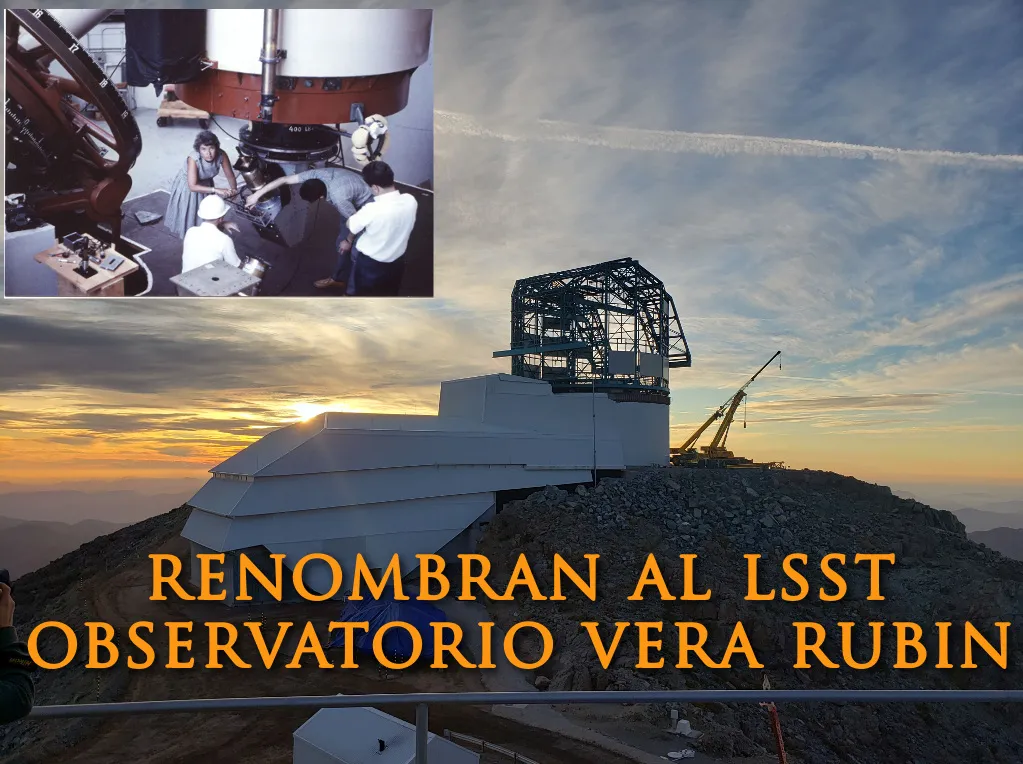
The LSST (The Large Synoptic Survey Telescope) will now be called the Vera Rubin Observatory, as announced at the January meeting of the American Astronomical Society.
"Named for an astronomer who provided important evidence for the existence of dark matter, the NSF Vera Rubin Observatory is destined to make history in science with its extraordinary capabilities that will take place in the coming years", said France Córdova, director of the National Science Foundation (NSF) of the United States. "Congress helped turn this inspiring commemoration into a reality. The Rubin Observatory is expected to enable significant advances in what we know about dark matter and dark energy, so the name Rubin will be another way to inspire women and men eager to research", she added.
The initiative to rename the observatory began in June 2019 by Eddie Bernice Johnson (Chair of the Science, Space, and Technology committee) and Congresswoman Jenniffer González-Colón and the law was enacted on December 20.
Scientific operations at the Rubin Observatory, located on Cerro Pachón, Chile, will begin in 2022. The observatory consists of an integrated system containing a wide-field telescope with an 8.4-meter mirror, a 3200-megapixel camera, an automatic data processing system, and an online platform.
During its first 10 years, the system will conduct an optical survey of the visible sky, which will have four objectives: to study dark energy and dark matter, to take an inventory of the solar system, to explore transient phenomena, and to map the Milky Way.
"We are deeply honored to have the Observatory named in tribute to Vera Rubin", commented Steve Kahn, director of the Observatory. "Through the discovery of dark matter, Vera made one of the most important contributions to science in the last century".
However, the telescope of the Vera Rubin Observatory will have a man's name: it will be called the Simonyi Survey Telescope after Charles Simonyi, a software engineer who made a significant donation used for the construction of the primary mirror.
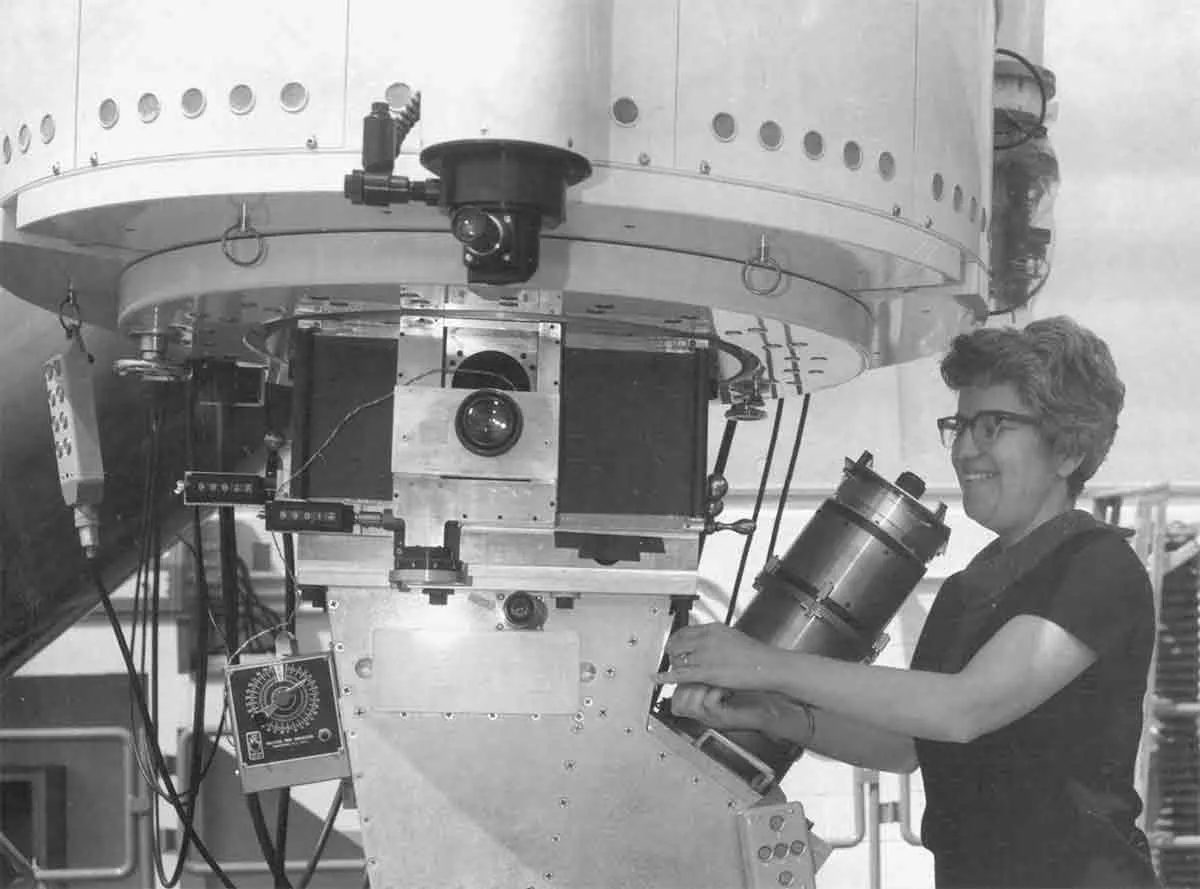
In a biographical note on the US National Museum of Natural History website, a quote from Rubin is cited:
"In a spiral galaxy, the dark matter-light ratio is about a factor of 10. That is probably a good number for the ratio of our ignorance-knowledge. We have left kindergarten, but we are in third grade."
Rubin studied at Vassar University (women-only at that time) in 1948. She wanted to go to Princeton, but that institution did not accept women until 1975. She applied to Cornell, where she studied physics with professors of the caliber of Richard Feynman and Hans Bethe. She then earned her doctorate at Georgetown in 1954 (under George Gamow).
After teaching there for a few years, she took a research position at the Carnegie Institution in Washington where she teamed up with Kent Ford who had developed a spectrometer. With the device they studied galaxies by making Doppler effect measurements to calculate stellar velocities.
Thus they discovered that stars in the outer parts of galaxies (halo) were moving faster than expected, according to Newton's laws.
Earlier, in 1933, astronomer Fritz Zwicky had found something similar in galaxy clusters.
She was elected to the National Academy of Sciences and in 1993 received the National Medal of Science. However, she did not seek acclaim, but the personal satisfaction of scientific discovery:
"We have peered into a new world and have seen that it is more mysterious and more complex than we had imagined. Still more mysteries of the universe remain hidden. Their discovery awaits the adventurous scientists of the future. I like it that way."
Vera Rubin passed away on December 26, 2016.
THE FIRST, BUT NOT THE ONLY ONE
Dennis Overbye, a journalist for the NYTimes, published a note in which he recounts that the Vera Rubin will be the first National (US) observatory to have a woman's name, but not the only one.
The Maria Mitchell Observatories, in Nantucket, Massachusetts, are named in honor of the first American woman to discover a comet.
The Swope telescope, at the Las Campanas Observatory in Chile, is named after Henrietta Swope, who worked at the Harvard Observatory in the early 20th century and used a relationship between luminosities and periodicity of variable stars to measure galactic distances.
And the Annie Maunder astrographic telescope at the Royal Observatory Greenwich, on the outskirts of London, is named for the woman who -together with her husband Walter- made pioneering observations of the solar cycle in the late 19th century.
Sources and related links
- Vera Rubin Gets a Telescope of Her Own
https://www.nytimes.com/2020/01/11/science/vera-rubin-telescope-astronomy.html - NSF-supported observatory renamed for astronomer Vera C. Rubin
https://www.nsf.gov/news/news_summ.jsp?cntn_id=299739 - AMNH: Vera Rubin and Dark Matter
https://www.amnh.org/learn-teach/curriculum-collections/cosmic-horizons-book/vera-rubin-dark-matter
About the images
Image 1: Vera Rubin Observatory at sunset.
Credit: Rubin Observatory/AURA/NSF
Vera Rubin at Lowell Observatory, 1965.
Credit: Carnegie Institution https://carnegiescience.edu/news/vera-rubin-who-confirmed-%E2%80%9Cdark-matter%E2%80%9D-dies
Image 2: Credit: NOAO/AURA/NSF