A collection of links to music, images and videos relating art and science. Today: Images of M20; M74. Music: What Surrounds, by Reefer Sutherland. Video: Ibercivis - We are science.

Images of the decade
A beautiful Trifid
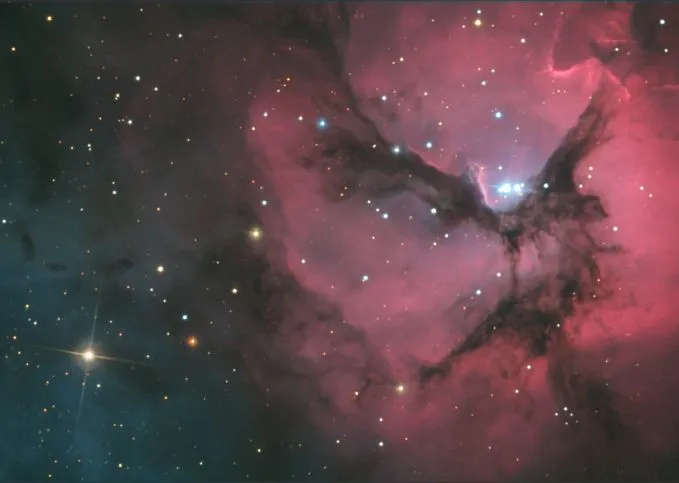
The beautiful Trifid Nebula (also known as M20) lies about 5,000 light-years away toward the nebula-rich constellation of Sagittarius.
A star-forming region in the plane of our galaxy, the Trifid itself illustrates three basic types of astronomical nebulae: red emission nebulae, dominated by light from hydrogen atoms; blue reflection nebulae produced by dust reflecting starlight; and dark absorption nebulae where dense dust clouds appear in silhouette.
The bright emission nebula on the right, separated into three parts by obscuring dust lanes, gives the nebula its popular name.
Many details are visible in this gorgeous high-resolution image of the Trifid.
For example, the large pillars sculpted by newly formed stars (visible in the upper right corner of the emission nebula) that appear in close-up images of the area, taken by the Hubble Space Telescope.
Credit and Copyright: Jim and Janet Castano, Adam Block, NOAO, AURA, NSF.
It was the Astronomy Picture of the Day (APOD) for September 1, 2003.
In Spanish at Observatorio.
Images of the week
PESSTO captures a supernova in Messier 74
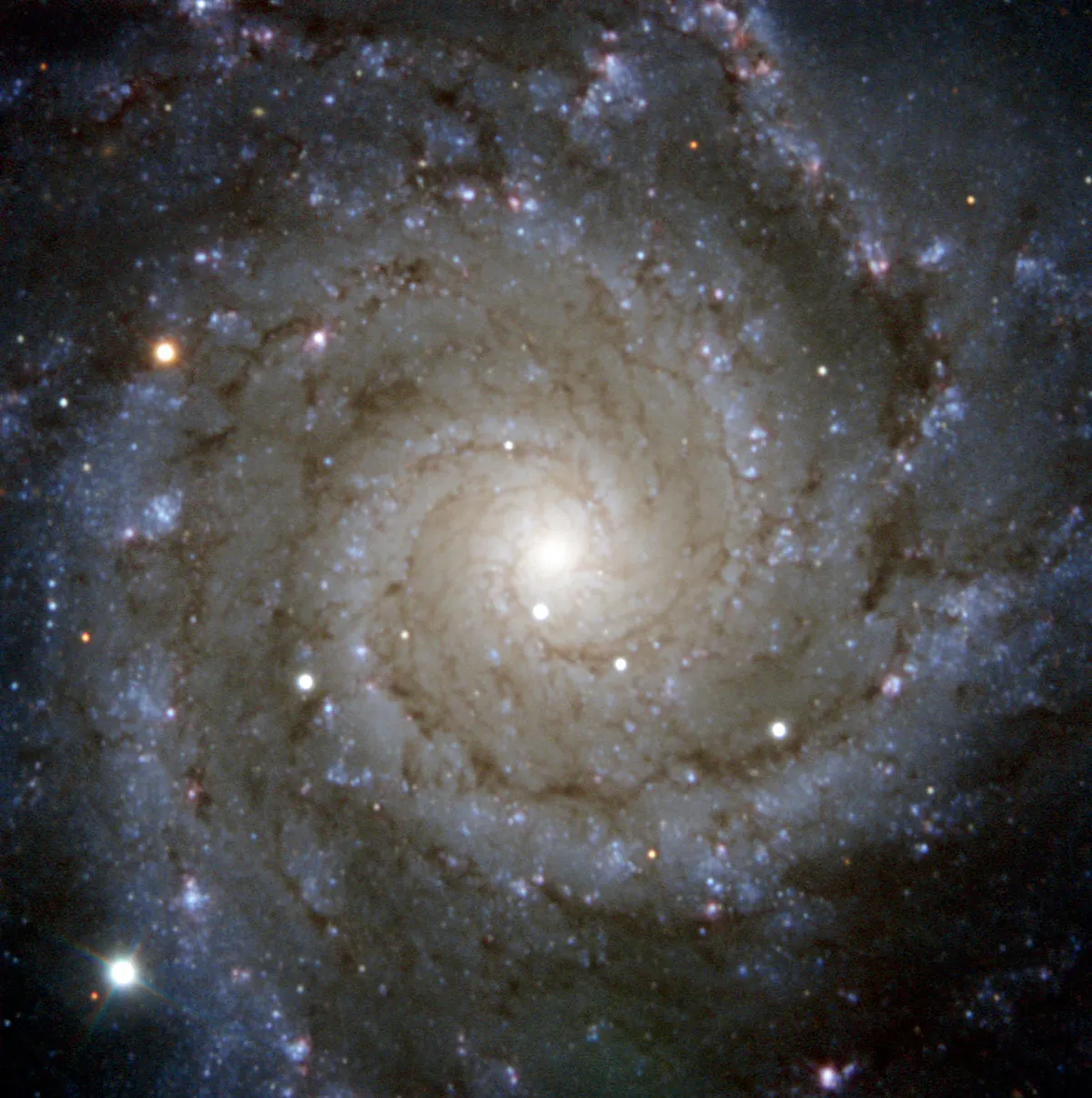
ESO's PESSTO survey has captured this image of Messier 74, a stunning spiral galaxy with very well-defined swirling arms. However, the real protagonist of this image is the new bright spot added to the galaxy in late July 2013: a Type II supernova named SN2013ej, which we can see as a very bright object in the upper left corner of the image.
This type of phenomenon occurs when the core of a massive star collapses under its own gravity at the end of its life. As a result of the collapse, a massive explosion takes place that ejects material into space, reaching great distances. The resulting detonation can be brighter than the light emitted by the entire host galaxy and can be detectable to observers for weeks or even months.
The PESSTO survey (Public ESO Spectroscopic Survey for Transient Objects) is designed to study objects that briefly appear in the night sky, such as supernovae. It does so using a suite of instruments installed on the NTT (New Technology Telescope), located at ESO's La Silla Observatory in Chile. This new image of SN2013ej was obtained with the NTT during this survey. This very week, another very interesting study, conducted with the same instrument, was announced.
SN2013ej is the third supernova observed in Messier 74 since the millennium began, the other two being SN 2002ap and SN 2003gd. On July 25, 2013, the team at the KAIT telescope in California reported its presence for the first time, and the first precovery image was obtained by amateur astronomer Christina Feliciano, who used the public access camera SLOOH Space Camera to observe the region in the days and hours preceding the explosion.
Messier 74, in the constellation of Pisces (The Fish), is one of the most difficult Messier objects for amateur astronomers to detect due to its low surface brightness, but the most meticulous amateur astronomers will be able to observe SN2013ej in the coming weeks as a faint, fading star.
Credit: ESO/PESSTO/S. Smartt
It was the ESO Picture of the Week.
Space Music
What Surrounds, by Reefer Sutherland
In this album, containing 12 tracks named in reference to astronomical objects, we find a supernova (track 2) and the Trifid Nebula (last track).
It can be downloaded from BandCamp and from 420.se.
http://reefersutherland.bandcamp.com/album/what-surrounds
Animated Science
Ibercivis: We are science
Ibercivis is a citizen science initiative composed of a volunteer computing platform and a series of experiments that allow the scientific community to harness two of the most powerful tools that exist today: the capacity of the computer and the human brain.
Ibercivis is constituted as an open window to science-society interaction, facilitating resources for citizen participation in scientific research.
This initiative helps researchers and allows citizens to contribute in different ways.
To bring out the scientist within us, there are only four steps: visit www.ibercivis.es and choose the experiment you want to collaborate with.
Follow the instructions on the website to access the tool.
Register and enter your profile information.
Contribute from anywhere with an internet connection.
Ibercivis corporative video from Ibercivis on Vimeo.
The video presents those who make Ibercivis possible, but the powerful thing is that they say they ARE science. Not because that's all they are. But it is very obvious and repeated to say that WE ARE passion, impulses, emotions, feelings. And it's true. But the human being also IS science. The curiosity to understand nature (with no other objective), as well as to solve problems, lies inextricably within us.
Furthermore, it is impossible to understand ourselves individually, as we are part of a social whole in which our actions (and inactions) have consequences. That is why "being science" is also understanding that true freedom and happiness cannot be achieved individually, but collectively. That is, paying attention to what surrounds us.
To access previous editions of this section, consult the Multimedia Selection Series. The series attempts to show that the immensity of the universe can be perceived in different ways. I choose some images from a decade ago -so they are not forgotten- and from the current week that ends, as well as sounds/music and videos that are artistic forms of expression with content related to astronomy and related sciences. I am also collecting these materials in the Pinterest account