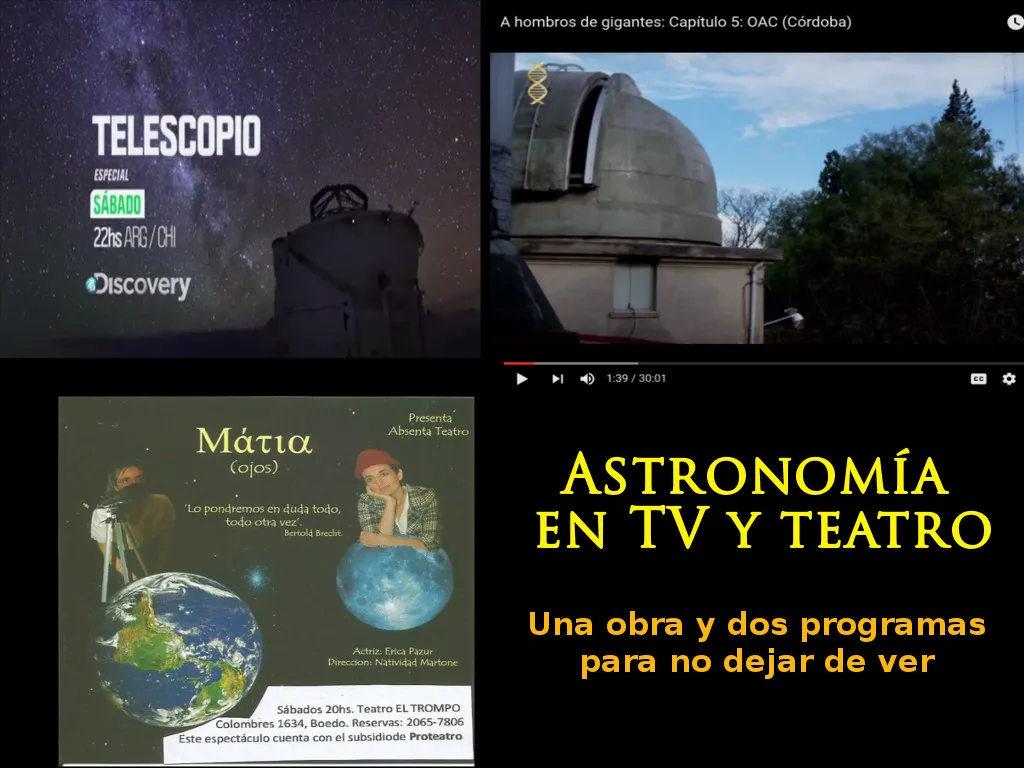
About the program "De lunas y estrellas" aired by TN. What can be said about the program broadcast on Sunday starting at 22 hours on the cable channel TN?
Some preliminary observations
There are those who consider TV a "minor genre" in contrast to literature and cinema and even go so far as to claim that all television is "trash." My ideas on the matter are more complex. Among other things, because some of those who think this way assume that television is "in itself" trash because its "technical" characteristics would not allow for "complex discourse." It is on this point that I disagree, but certainly there is television that could be classified as contingent, which tirelessly seeks spectacle and mere amusement.
People need our leisure spaces, but on TV it seems everything is amusement, exaggeration, scandal.
There are also those who consider that scientific-academic discourse begins and ends in academia, in the educational system and particularly in universities. Perhaps that's why we have the mass media we have. That is, since "complex discourse" had a "sacred" place from which it should not be removed, the communication media of modernity chose to inform and entertain.
Removing such discourse from academia would imply its "banalization." While some of that happens, such a stance is elitist. I am in favor of scientific outreach, knowing that it can be done well or poorly.
Finally, that astronomy is a SCIENCE and therefore has a certain rigor does not mean it must be communicated in a boring way. One might wonder if amusing is the same as entertaining.
De lunas y estrellas
In this context, the cable channel TN recently did a live broadcast of a meteor shower and had previously also done live coverage of a lunar eclipse. During the meteor shower broadcast, it was indicated that extra material had been produced that would later be edited into a special broadcast. That's what this Sunday's broadcast was about, that is, extra material, recorded, with images and brief interviews.
Since I have only been able to see a few fragments of those live broadcasts when they were done in due time, I did not make any comments here. And this one I am making now, also for that reason, is limited.
But I can say the following:
-The initiative to disseminate astronomy, sometimes called "popularization," seems good to me.
-Good intentions alone are not enough. Competence is also necessary. But it is essential to have clear intentions. One is not born with knowledge and it is possible to acquire it.
-We generally expect mass media to offer reliable, fact-checked, responsibly produced information and that, therefore, it is not suitable for "improvisers." But that does not mean that those who make a TV program about astronomy must have a doctorate in that science.
In particular:
-The person who appears to be the main host of these broadcasts, José Bianco, is a meteorologist. As part of his training he must have had some approach to scientific knowledge, though not so much to astronomy. I think I recall hearing him say on some occasion that his interest in specifically astronomical matters was recent. I do not consider this an impediment, at most it will be a limitation, as we all have. I notice, subjectively, that he seems to have serious or responsible intentions, reflected in a certain caution when addressing topics that he himself says he does not know in depth.
On some previous occasions he has had contact with the Asociación Amigos de la Astronomía or the Planetarium.
If there is indeed a "serious" intention, knowledge is acquired. Furthermore, as a journalist, he will know to consult those who know more.
But:
-Alongside this young man, there are others, including the sports journalist known as "Rifle" Varela, whom I heard explicitly say on at least two occasions that he is a "student" of astrology. And this is already mixing apples and oranges. Perhaps I was mistaken and he meant something else? Hmm...no:
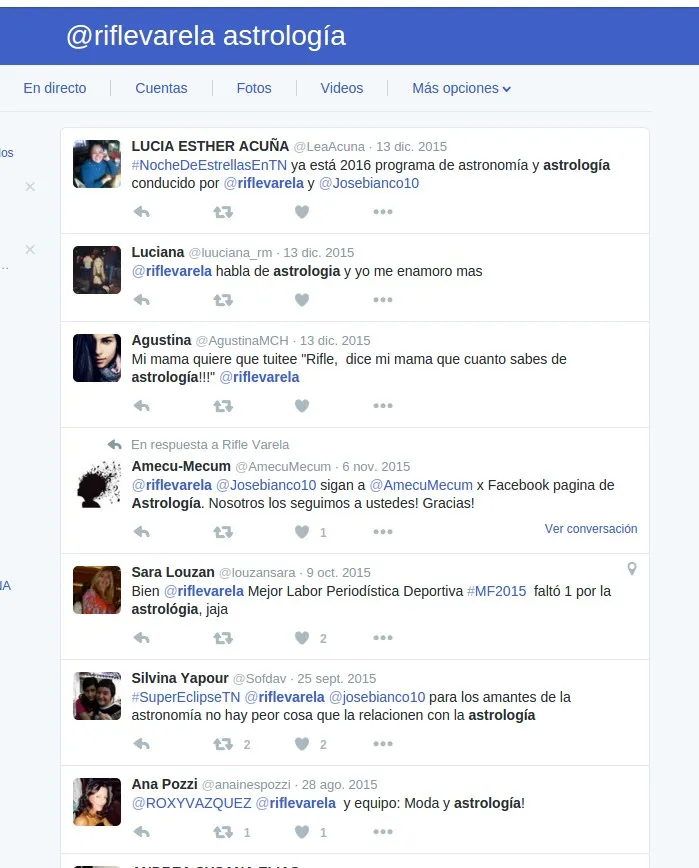
One thing is to inform and entertain, another thing is to directly lie, confuse, deceive. Eclipses, meteor showers, or any other astronomical phenomenon cannot be confused with anything related to astrology. That in astronomy we speak of constellations whose origin is mythical should not be confused with the discourse of neo-hipster hucksters who believe their lives are subject to the apparent movements of the "heavenly bodies" and cannot distinguish between planets, moons, stars, asteroids, and dwarf planets. The worst, really, is that they speak using names that most people associate with planets, but they are not talking about the influence of the objects, but about the GODS associated with those planets. For astrology, those who influence human life are gods (Mars, Jupiter, etc.) of which the planets are symbols. That is, a polytheistic religion that, precisely for that reason, was persecuted by the Catholic Church. Disagreeing with those bonfires does not mean agreeing with astrologers.
TV AS AN INCENTIVE
Visual astronomy involves observing. In principle observing astronomical objects, but also, at least at the beginning, observing other people, because that is a way to learn.
In some specific cases, when a phenomenon occurs and we are not in a position to observe with instruments directly, virtualization-mediation can be useful. It can also be part of a practice, since currently professional astronomers access instruments remotely or indirectly.
The media do very well in explaining and encouraging amateur astronomical practice. But it is possible that, to some extent, the live broadcast of these events generates the opposite: why make the effort to acquire an instrument, go to a place with dark skies, have the patience that astronomy demands, if I can watch it on TV?
With this I do not mean that such broadcasts should not be made. It is very good that they are made and that such spaces are used to encourage people who until then had never engaged in those practices to dare to do so. For that, it is necessary to be clear: observational or photographic astronomy as a hobby does not require great knowledge, but it does require patience, along with interest or motivation in the necessary amounts to make certain efforts. Indirect observation (via TV or internet) does not replace direct observation, although it can complement it.
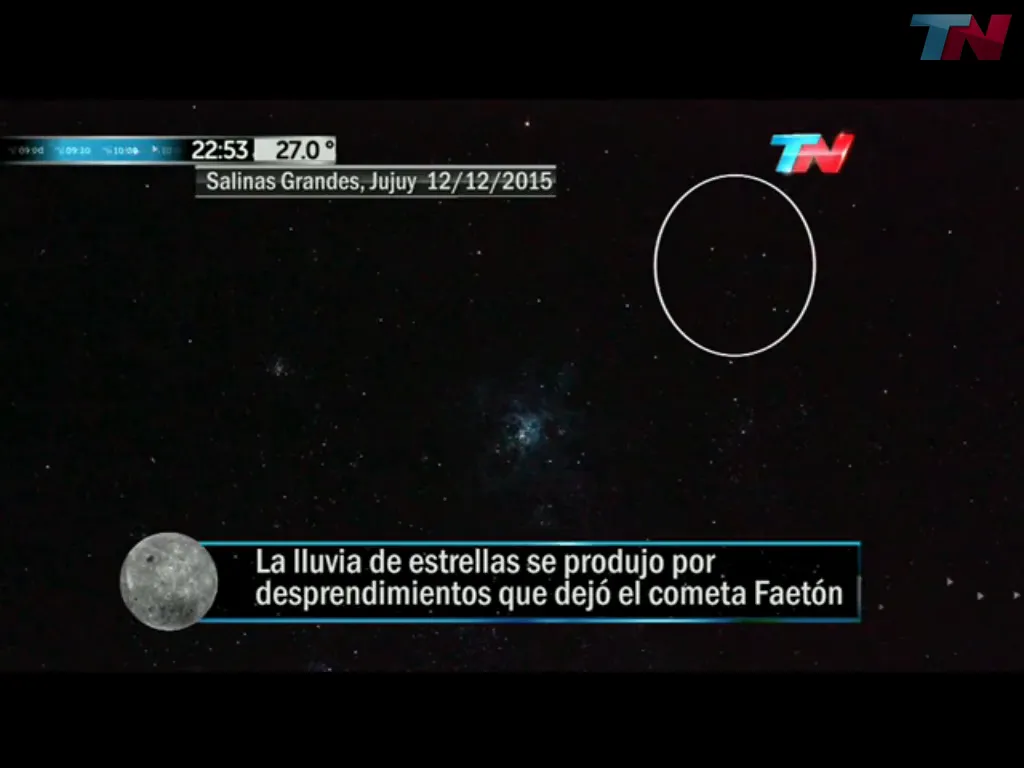
If it is said that a meteor shower will generate a maximum rate of 150 streaks per hour and then the person expects that, goes out for five minutes and barely notices one or two, they will be disappointed. Similarly, if the observer expects to see in the eyepiece of an amateur telescope (no more than 30 cm) the same as is perceived in photos taken by 2-meter telescopes in orbit (like Hubble), they will also be disappointed. For the same reason, what is observed with certain special cameras in a unique sky (like the Salinas Grandes of Jujuy from where the Geminids broadcast was made) will not be what the public will observe with the naked eye.
In the live broadcast of the last meteor shower I noticed some of this. With this Sunday's broadcast, I can say something else, since interviews were conducted with the amateur observers who went that night with their equipment to Jujuy and gave an account of what observing entails. Likewise, some typical deep-sky objects were indicated for their magnitude and location, namely: the Tarantula (NGC 2070), the Orion Nebula (M42), 47 Tucanae (NGC 104).
There is also no need to scare anyone, as it is not quantum mechanics. Nor is it necessary to be an amateur astronomer. Bringing astronomy closer to the public is at least explaining what the objects are about, differentiating myths from scientific truths (there are no shooting stars, it does not bring good luck to make a wish), informing what types of objects they are and, in any case, making amateur telescopes available so that the public can, perhaps for the first time, look through an eyepiece. In this sense, this type of broadcast could be a way to stimulate interest, awaken curiosity. Unfortunately, as such programs are made on rare special occasions, that potential fades away.
CONCLUSIONS
For the reasons stated, this type of live broadcast and recorded programs is auspicious, but some corrections would have to be made, in particular, not mixing apples and oranges, as I believe I perceived in the live broadcast of the Geminids (the time I was able to watch the broadcast). This was not the case in the recorded material aired this Sunday.
Television programs (like other products that are marketed) need a market that is sometimes created as products are offered. There was no tablet market until they started being offered.
Just as television used to offer late-night music programs ("Ese amigo del alma"), the nighttime slot could be a good place for astronomy. It would be almost a new "television genre," not documentary anymore, but a weekly series and could include:
-Observation through online telescopes (for example from San Luis/San Juan).
-Interviews with Argentine professionals who tell what it is to do professional astronomy, how, where, etc.
-Sections with advice for amateurs or courses/tutorials on how to photograph, how to choose a telescope, etc.
-Videos made by amateurs or professionals that can be found on sites like YouTube or Vimeo and are of very good quality, for example, time-lapses.
-Display of amateur photographs (from Argentina and the world) indicating where, when and how they were taken.
-Specials could be made from time to time and send a reporter to large observatories in Argentina and Chile.
In astronomy, as in almost any other field, there are often misgivings towards the new, towards novices. I, on the other hand, promote initiatives to the extent that I consider them genuine and responsible. I have my reservations, however, that what is indicated above could ever be realized in a "serious" way due to the limitations pointed out at the beginning. But still, I place some bets in favor, as long as journalists are called who -beyond how they dress- have a real interest in astronomy and the sciences, instead of pseudoscientific confusionism, even if it seems nice and cool.
Sources and related links
About the images
Screenshots from tn.com.ar