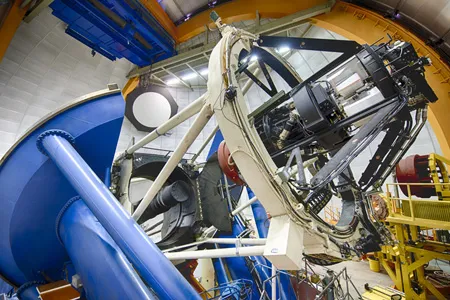
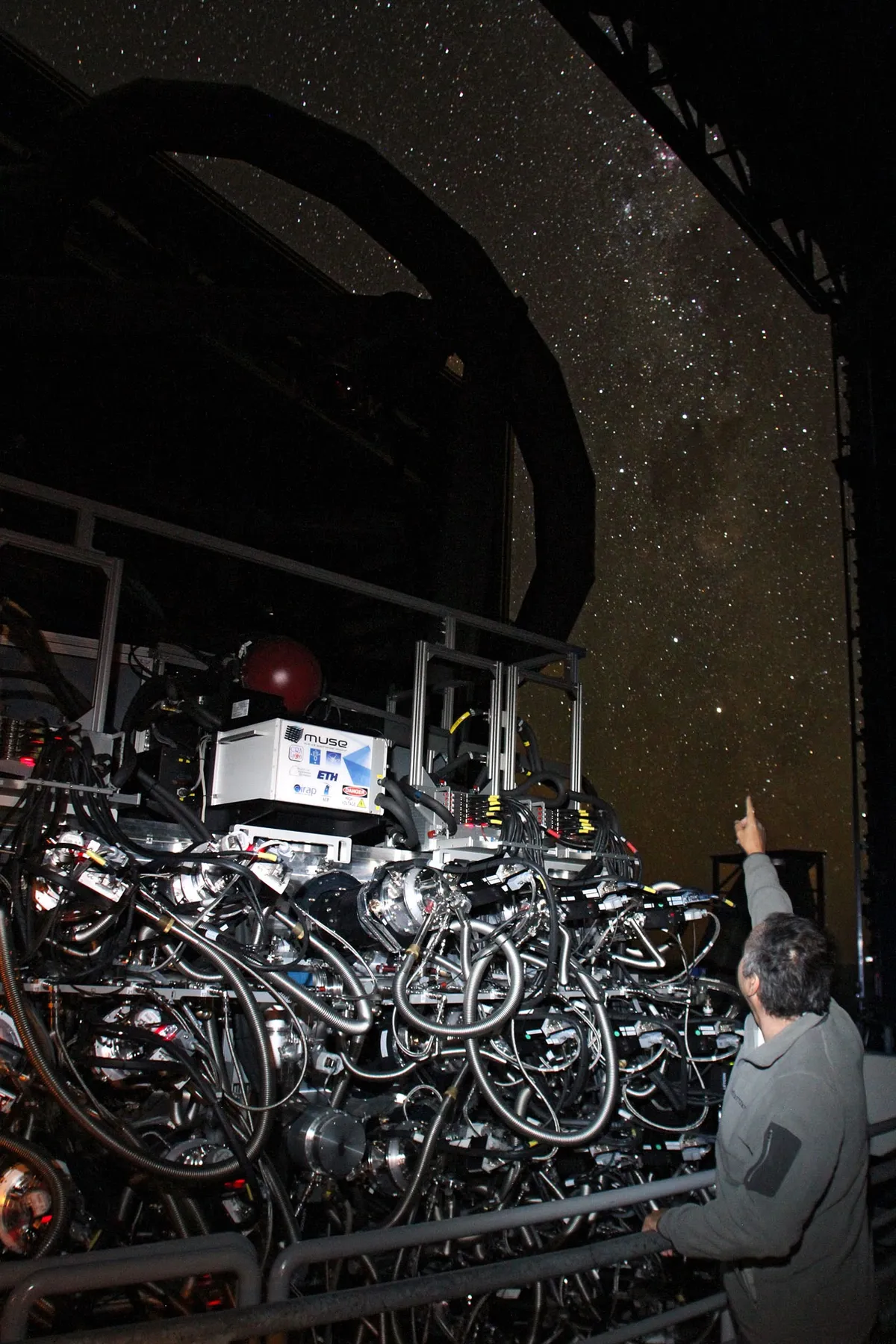
A new and innovative instrument called MUSE (Multi Unit Spectroscopic Explorer) has been successfully installed on ESO's VLT (Very Large Telescope) at the Paranal Observatory in northern Chile.
During the first observing period, MUSE observed distant galaxies, bright stars and other objects in order to carry out the tests, which have been a complete success.
After the testing phase and its preliminary acceptance in Europe in September 2013, MUSE was shipped to ESO's Paranal Observatory in Chile. It was reassembled at the base camp before being carefully transported to its new home on the VLT, where it is installed on Unit Telescope 4. MUSE is the latest of the second-generation instruments for the VLT (the first two were X-shooter and KMOS and the next one, SPHERE, will follow shortly).
The team leader and principal investigator of the instrument, Roland Bacon (Centre de Recherche Astrophysique de Lyon, France), expressed his feelings thus: "It has taken a lot of work by many people over many years, but we have done it! It's strange that this seven-ton assembly of optics, mechanics and electronics is now a fantastic time machine for studying the early universe. We are very proud to have achieved it: MUSE will be a unique instrument for many years to come."
The scientific objectives of MUSE include delving into the early epochs of the universe in order to better understand the mechanisms of galaxy formation and to study both the motion of matter and the chemical properties of nearby galaxies. It will have many other applications, from the study of planets and satellites in the Solar System, through the properties of star-forming regions in the Milky Way, to the study of the distant universe.
Integral field spectroscopy
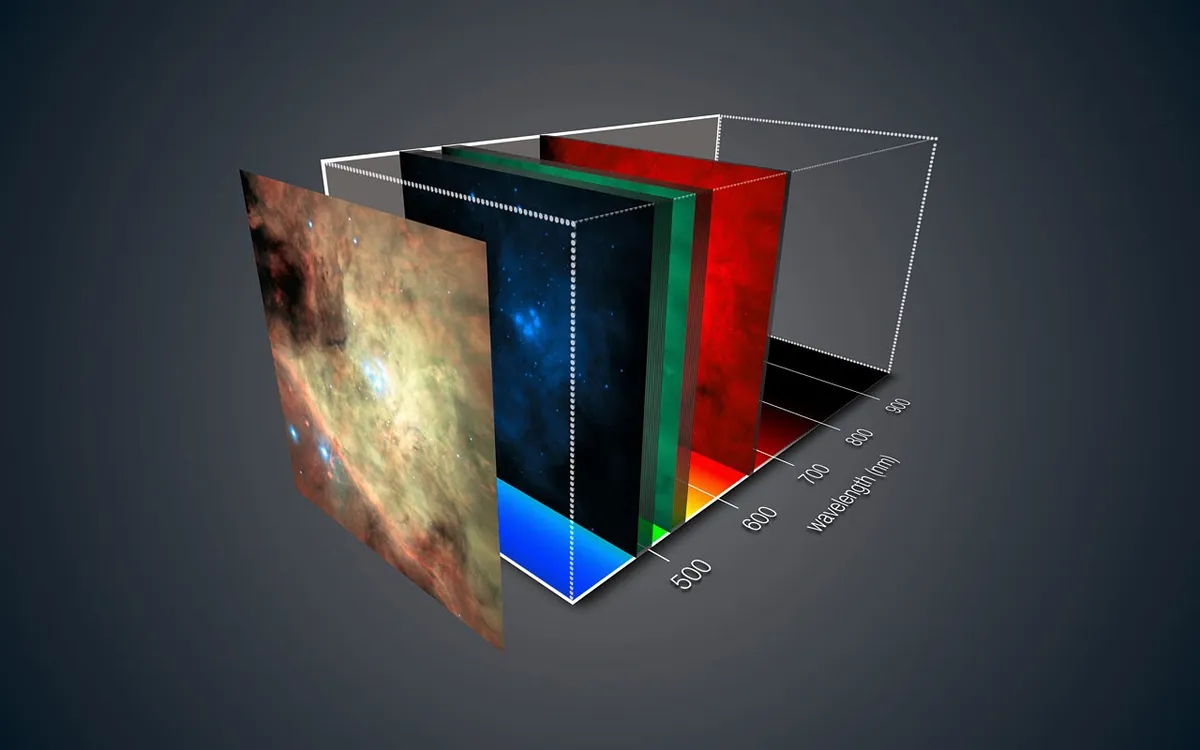
MUSE is a unique and very powerful discovery tool. It uses 24 spectrographs to separate light into its different component colors in order to create both images and spectra of selected regions of the sky. It creates 3D views of the universe that have a spectrum for each pixel as the third dimension.
This technique, known as integral field spectroscopy, allows astronomers to simultaneously study the properties of different parts of an object such as a galaxy to see how they rotate and measure their masses. It also allows determining the chemical composition and other physical properties in different parts of the object. This technique has been used for many years, but now with MUSE it has taken a great leap in sensitivity, efficiency and resolution. One way to describe it: MUSE simultaneously combines high-resolution imaging with spectroscopy. During subsequent analysis, astronomers can move through the data and study different views of the object at different wavelengths, just as if we were tuning to different channels on a television at different frequencies.
MUSE combines the discovery capability of an imaging instrument with the measurement capabilities of a spectrograph, while at the same time taking advantage of the great imaging precision of much higher quality thanks to the application of adaptive optics. The instrument is installed on Unit Telescope 4 of the VLT telescope, which is currently being fine-tuned in order to become a fully adaptive telescope.
MUSE is the result of ten years of design and development by the MUSE consortium — led by the Centre de Recherches en Astrophysique de Lyon, France and consisting of the partner institutions Leibniz-Institut für Astrophysik Potsdam (AIP, Germany), Institut für Astrophysik Göttingen (IAG, Germany), ETH Zurich Institute for Astronomy (Switzerland), Institut de Recherche en Astrophysique et Planétologie (IRAP, France), Nederlandse Onderzoekschool voor de Astronomie (NOVA, Netherlands) and ESO.
Since early 2014, Bacon and the rest of the MUSE integration and commissioning team in Paranal have been recording MUSE's history in a series of blog posts that can be followed here. The team will present the first results from MUSE at the upcoming ESO 3D2014 Workshop to be held in Garching (Munich, Germany).
"The muses are inspiring beings. Certainly, MUSE has inspired us for many years and will continue to do so," says Bacon in a blog post about first light. "We have no doubt: MUSE will have the same enchanting effect on many astronomers around the world." We'll have to see what Matt Bellamy says...
Sources and related links
- ESO: First Light for MUSE
- MUSE pages at the Lyon Observatory
About the images
- In this image we can see how the new MUSE instrument, installed on ESO's VLT (Very Large Telescope), provides a three-dimensional representation of the Orion Nebula. For each part of this spectacular star-forming region the light has been separated into its different component colors, revealing in detail the chemical and physical properties of each pixel.
Credit: ESO/MUSE consortium/R. Bacon/L. Calçada - This impressive nighttime image shows the MUSE instrument in the dome of VLT's Unit Telescope 4. The telescope tube appears at the top of the image and in the foreground the reflection of MUSE can be seen. Through the open dome shutters the bright Milky Way can be seen.
Credit: ESO/Ghaouti Hansali/Fernando Selman