A team of astronomers led by a Brazilian found that the asteroid Chariklo has two rings. It is the first time rings have been found on an asteroid. The team included several Argentine and Uruguayan astronomers.
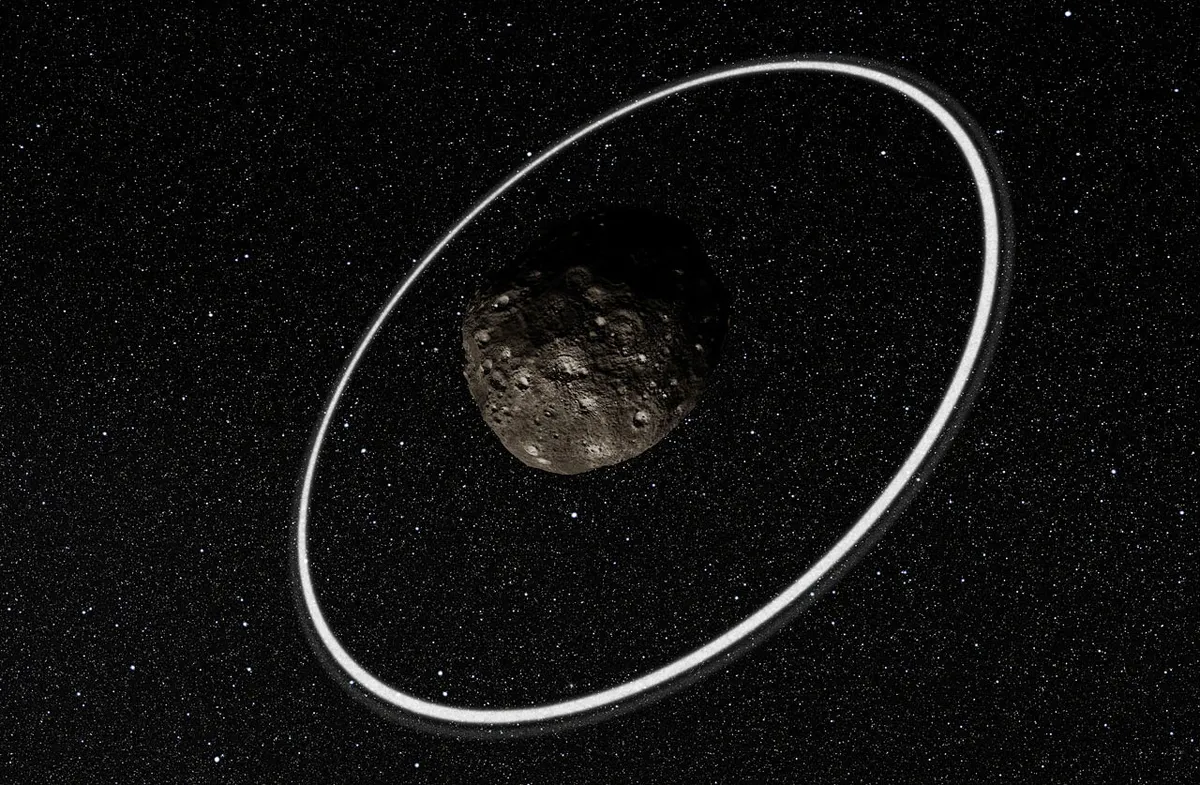
Observations carried out from numerous points in southern America (*) have discovered something surprising: the remote asteroid Chariklo (at almost 16 Astronomical Units from the Sun. Jupiter is at 5 AU, Saturn at 10 AU) is surrounded by two dense and narrow rings. It is the smallest object found so far that has this type of rings and the fifth object orbiting the Sun in the Solar System with this characteristic (after the planets Jupiter, Saturn, Uranus and Neptune, which surpass it in size). The origin of these rings is still a mystery, but they may be the result of a collision that, subsequently, generated a debris disk. The new results have been published online in the journal Nature on March 26, 2014.
Now, observations of the distant minor planet (10199) Chariklo carried out while it passed in front of a star have shown that this object is also surrounded by two thin rings.
"We weren't looking for a ring and we didn't believe that small bodies like Chariklo had them, so the discovery – and the impressive amount of detail we saw in the system – has been a complete surprise!" says Felipe Braga-Ribas (Observatório Nacional/MCTI, Rio de Janeiro, Brazil) lead author of the new paper and responsible for planning the observation campaign.
Chariklo is the largest member of a type of objects known as centaurs and its orbit lies between that of Saturn and Uranus, on the periphery of the Solar System. Predictions showed that it would pass in front of the star UCAC4 248-108672 on June 3, 2013, as seen from southern America. See occultation data on the researcher's page and page translated into Spanish by Gonzalo Tancredi (Uruguay).
Using seven telescopes, including the Danish 1.54-meter telescope and the TRAPPIST telescope, both at ESO's La Silla Observatory in Chile, the astronomers were able to see that, apparently, the star disappeared for a few seconds as Chariklo passed in front of it, thus witnessing an occultation.
But they found much more than they expected. A few seconds before and a few seconds after the main occultation, there were two more, very short, dips in the apparent brightness of the star. Something around Chariklo was blocking the light! By comparing what was seen from the different locations, the team was able to reconstruct not only the shape and size of the object itself, but also determine the shape, width, orientation and other properties of the newly discovered rings.
Glossary
Asteroids and planets
Currently, the IAU (International Astronomical Union) defines all objects orbiting the Sun that are very small (not massive enough) for their own gravity to give them an almost spherical shape, as small Solar System bodies. In fact, this classification includes most asteroids in the Solar System, near-Earth objects, Trojan asteroids of Mars and Jupiter, most centaurs, trans-Neptunian objects (TNOs), and comets. In informal language, the words asteroid and minor planet are used to refer to the same type of object.
Centaurs
Centaurs are small bodies with unstable orbits found in the outermost zones of the Solar System that cross the orbits of giant planets. Since their orbits suffer frequent perturbations, they are expected to remain in those orbits for only a few million years. Centaurs are distinct from the much more numerous main-belt asteroids, which are found between the orbits of Mars and Jupiter and may originate from the Kuiper Belt region. They have that name because, like the mythical centaurs — they share the characteristics of two different "species," in this case comets and asteroids. Chariklo itself seems more like an asteroid and does not appear to have cometary activity. (10199) Chariklo was discovered by James V. Scotti on February 15, 1997. Its definitive name comes from the nymph Chariklo who, according to Greek mythology, was the wife of Chiron and daughter of Apollo.
Occultation
It is called an occultation when a celestial object is hidden or covered by another celestial object that passes between the first and the observer. It is similar to eclipses and transits, although in the latter the closer object is perceived as smaller than the farther object. In all three cases they are conjunctions, which is when two objects are at the same celestial longitude, as seen from Earth. When the longitude separating those objects is 180º it is called opposition.
The team discovered that the ring system is made up of two very well-defined rings only three and seven kilometers wide, separated by a clear gap of nine kilometers — around a small object 250 kilometers in diameter that orbits beyond Saturn.
Although many questions remain unanswered, astronomers believe that this type of ring seems to form from debris generated after a collision. The debris remains confined in the two narrow rings by the presence of putative small satellites.
"Therefore, just like the rings, it is very likely that Chariklo has, at least, a small moon waiting to be discovered," adds Felipe Braga Ribas.
The rings may be a phenomenon that, in turn, leads to the formation of a small moon. A sequence of events like this, on a much larger scale, could explain the birth of our own Moon in the early Solar System, as well as the origin of many other satellites around planets and asteroids.
The project leaders provisionally call these rings by the nicknames Oiapoque and Chuí, two rivers near the northern and southern extremes of Brazil. These names are for informal use, the official names will be assigned by the IAU, following pre-established rules.
(*) In addition to the Danish 1.54-meter telescope and the TRAPPIST telescope installed at ESO's La Silla Observatory, observations of the event were carried out at many observatories, including the Astronomical Observatory, Bosque Alegre Astrophysical Station, National University of Córdoba. That is why the research team includes the Argentine scientists: (Ministry of Education of the Province of Córdoba; Astronomical Observatory); J. Spagnotto (El Catalejo Observatory, Santa Rosa, La Pampa); R. Gil-Hutton (El Leoncito Astronomical Complex (CASLEO) - UNSJ, San Juan); E. M. Schneiter, R. Melia and D. G. Lambas (Astronomical Observatory). Several Uruguayan astronomers from the Los Molinos Astronomical Observatory also participated. The South also exists.
Sources and related links
- ESO1410es: First ring system discovered around an asteroid
- “A ring system detected around the Centaur (10199) Chariklo”, by F. Braga-Ribas et al., appearing online in the journal Nature on March 26, 2014.
About the images
- Artist's impression of the rings surrounding the minor planet Chariklo. Credit: ESO/L. Calçada/M. Kornmesser/Nick Risinger (skysurvey.org)