About comet Elenin and asteroid impacts as parts of a false apocalyptic saga.
From 2003 to the present, every August the false case of Mars's approach reappears. The resurgence of apocalyptic theories associated with comets is also periodic, although at this point in modern science, it seems implausible. As if that weren't enough, the most serious studies on asteroid impacts can be interpreted in different ways. Let's see.
THE ELENIN CASE
What follows is based on data from different sources, but in particular on the contribution of Ian Musgrave.
C/2010 X1, more popularly known as Elenin, was detected in 2010 by Leonid Elenin, an observer from Russia who detected the comet from an observatory in New Mexico. This year, on October 16, it will reach its closest approach to Earth and will be 35 million kilometers (0.23 AU) away. The Moon is at an average distance of 384,000 km.
To know this, you can consult the IAU Minor Planet Center.
In the text box we indicate "C/2010 X1". If we do nothing else, it will provide the ephemerides for that object for the next 20 days. However, below the text box we can indicate from when to get the ephemerides and the number of days from the previous date. For example, we can indicate the current date (like 2011/08/01 for August 1st) and 100 days (for the next three months and a bit more).
In the results, we must look at the parameter "delta", the distance to the observer in Astronomical Units. The parameter "r" is the object's distance from the Sun, also in astronomical units.
As we see in this image, between 02/08/2011 and 11/09, the parameter d approaches zero until October 16, which is 0.234 until the 18th. Then, from the 19th, it moves away from zero again.
There are those who claim that if this or another object were to hit Earth, THE GOVERNMENT would keep it quiet.
Which government? The U.S., England, Italy, Argentina, Paraguay? Would all amateur astronomers also keep quiet?
It is said that the comet will cause earthquakes or incredibly high tides or other disasters. Is that so?
No. Elenin is between 3 and 5 kilometers in diameter at its nucleus, a billionth of the tidal force of the Moon at its closest approach. We have been closer to other comets, without any anomaly. In 2006 comet 73P/Schwassmann-Wachmann was 12 million km from home, about 0.08 AU.
But it's not that small. It's bigger than Jupiter!
No, that's the comet's tail, the thin tail of gas and dust that surrounds the nucleus. That tail is indeed extensive, about 50,000 km. Other comets have had much more extensive tails and of course larger nuclei, like Halley's. The Great Comet of 1811 had a nucleus of 30 km! We survived all of them and we will survive Elenin without problems. Comet tails are mainly water and dust. Nothing to really fear.
But, can an earthquake occur when Elenin passes?
It can. These days there was a significant earthquake in Japan. But there are earthquakes every day. Some are more powerful than others and appear in the press. But there is no relationship between comets and earthquakes. Of course, if a very large comet or asteroid impacted our planet, telluric movements would occur.
Is it possible that something could make it go off course and collide with Earth?
There is nothing large enough that could make it change course naturally.
But it's seen in Google Sky and it's huge.
No. Just as with the supposed planet Nibiru, a certain image is erroneously attributed to a different object. In Google Maps or in Google Earth Sky, with the coordinates 09:47:27, 13:16:27. It is CW Leonis.
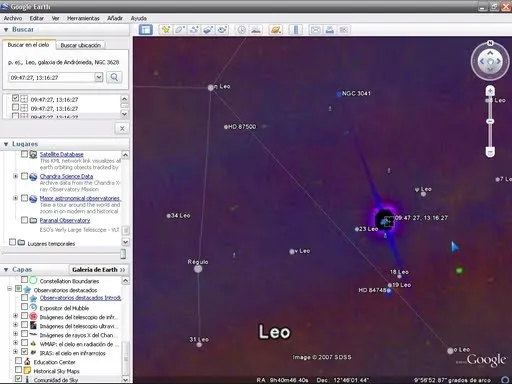
We can also obtain the orbital elements of the object.
They say Elenin is not a comet but a brown dwarf or a moon of a brown dwarf.
Brown dwarfs are stars somewhat larger and more massive than Jupiter, but not large enough to begin hydrogen fusion. But although they produce very little visible light, they reflect light perfectly. In the same way that we can see Jupiter, even though it is not a star, because it reflects sunlight.
If an object like that were at Elenin's current distance, it would have a magnitude of -6.5, that is, brighter than Venus. But also, if we replaced Elenin with a brown dwarf with a mass of 0.05 solar masses, the changes would be dramatic and would have begun to perturb Saturn's orbit three years ago. Elenin's own discoverer performed a simulation of this type.
Why doesn't NASA say anything about Elenin?
In principle, NASA is not obligated to say everything about every object in the cosmos. Surely it reports on objects that its spacecraft fly by or on studies conducted by its researchers or by other scientists using its facilities. But it is not the arbiter of all astronomical matters.
However, if we go to Nasa.gov and search for Elenin, we will get information about the comet.
On a NASA page, they have been asked about Elenin and Apophis, for example.
On the other hand, from the JPL Small-Body Database Browser you can get a diagram of Elenin's orbit. The last line shows the date of closest approach.
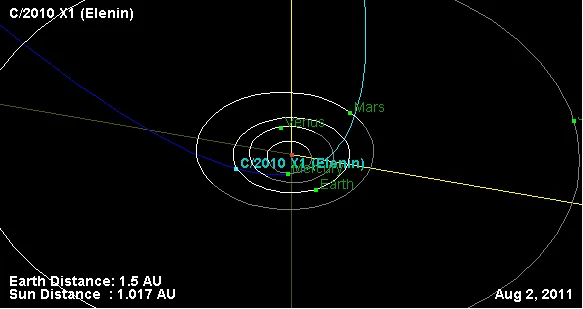
For example, on August 3, Elenin is 1.5 AU from Earth.
Beyond the stupidities said in different places about the end of the world, earthquakes, effects of alignments, changes of era and even that behind the comet comes a spaceship (yes, there are people for everything), beyond that, I say, Elenin will be a good target for pointing telescopes and binoculars.
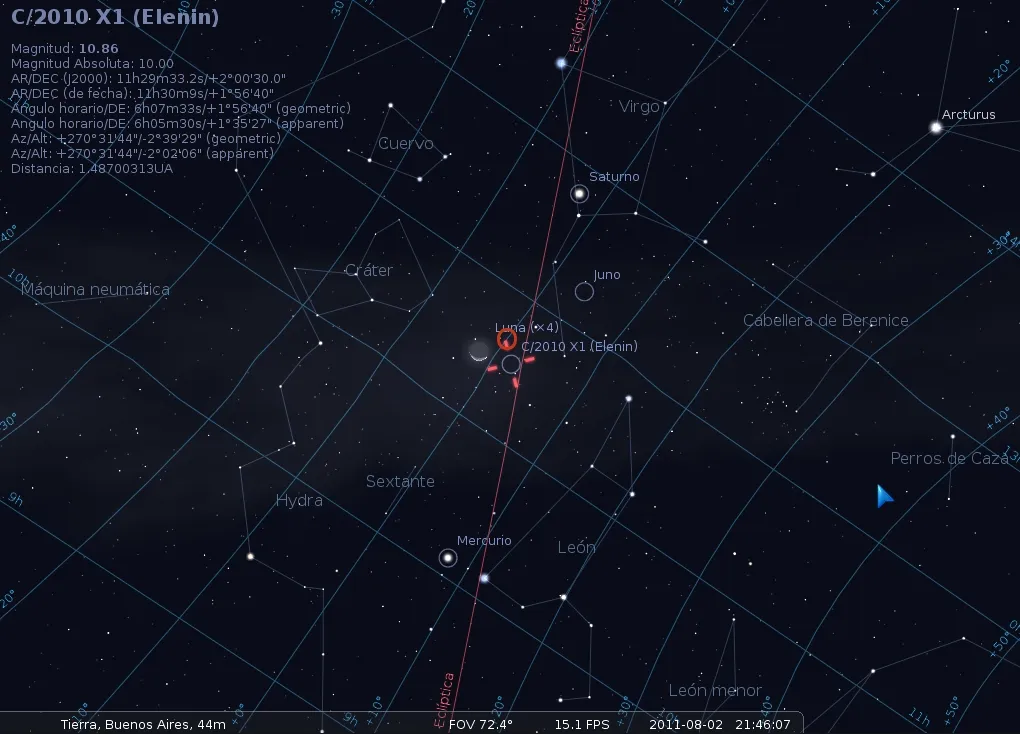
It already is today, although its magnitude is 10.7, but with a telescope we could locate it from Buenos Aires, between 19 and 21 h towards the West, in Leo. We can take the opportunity to see Mercury, near the horizon, Regulus and the Moon these days. The star and the planet are about 4/5 degrees apart. At 19 h Buenos Aires time, towards the West, about 30º from the horizon, we could try to locate Elenin. The Moon, higher up, we will see accompanied by Saturn and above them Spica. Between Elenin and the Moon, moreover, Juno will be roaming.
By October the comet will be brighter, although it will probably not be perceptible or only minimally so to the naked eye in very dark skies. In the previous image, the parameter m1 is the magnitude. It is assumed that objects down to magnitude 6 are visible to the naked eye, but it depends on the quality of the night sky, affected by light pollution. According to those ephemerides, the comet would reach 5.8 on September 16.
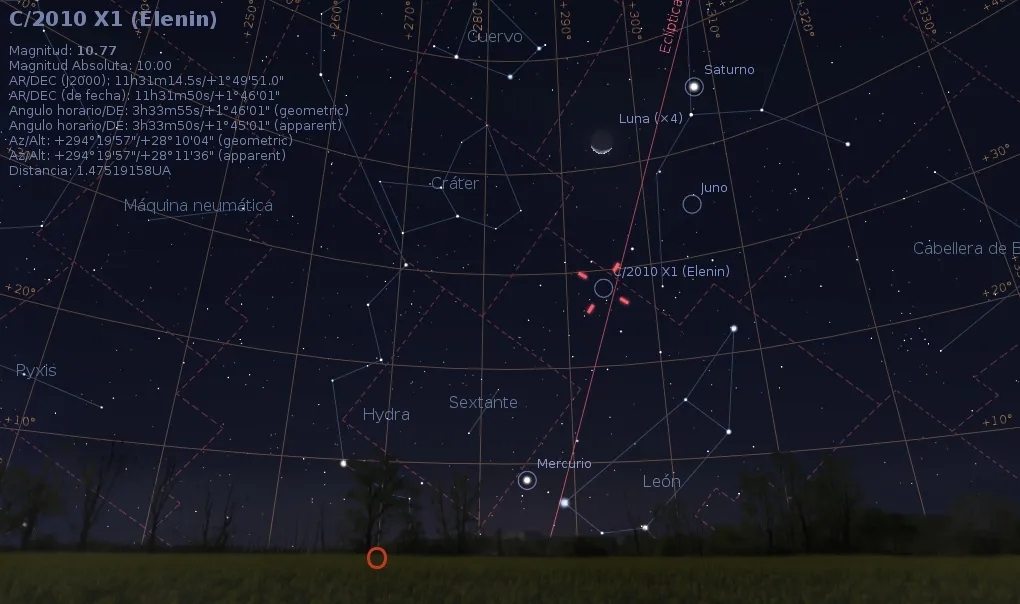
Let's observe the comet without fear of cataclysms. And, in any case, let's do the exercise of noting down who says what and then see if the statements corresponded to the facts. It is the best way to discard the new "false prophets" who, with pseudo-scientific language, try to sell us a pig in a poke.
How to know where Elenin is?
A simple way is by using a simulator with the comet's orbital data.
For that we can use the latest version of Stellarium. We go to Configuration (F2) and choose the Solar System Editor option. There we check Load at startup.
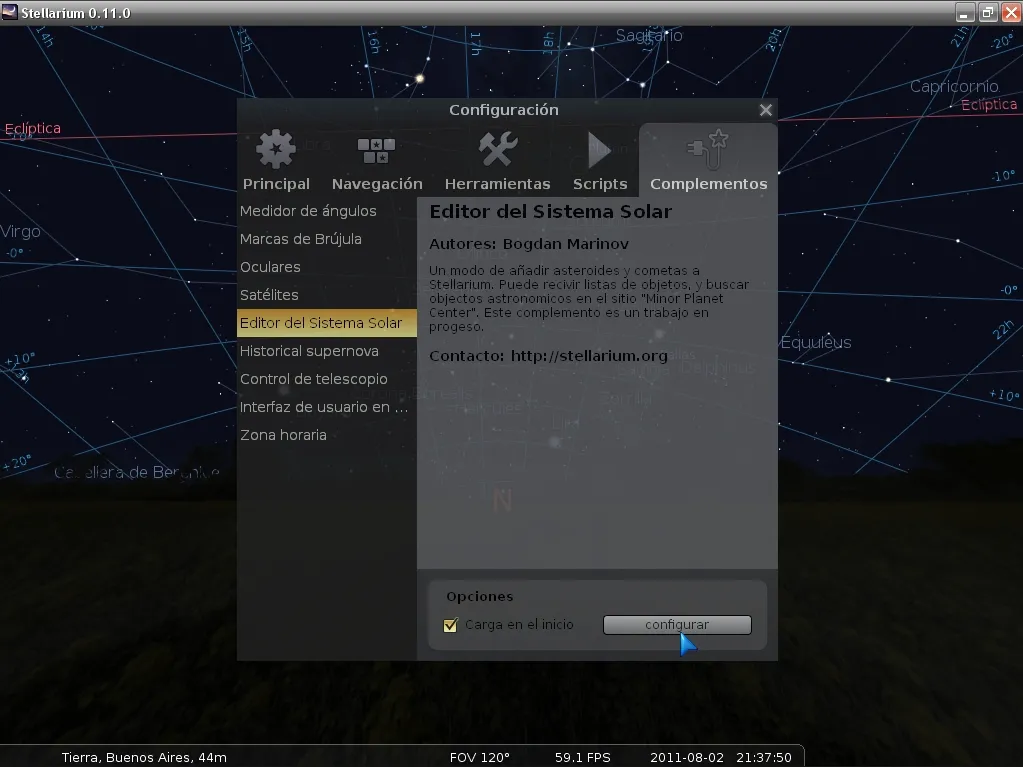
We restart and upon returning to that tab we will see that the Configure button can be pressed. We do so and we will first see that it indicates where the configuration file is stored. We can make a copy of that file, as a backup.
In the Solar System tab we will see at the bottom the option Import Orbital Elements in MPC Format. We press it.
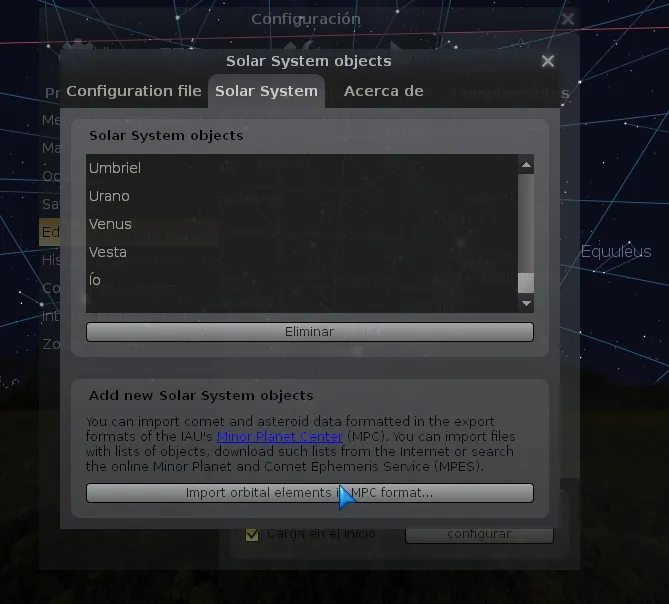
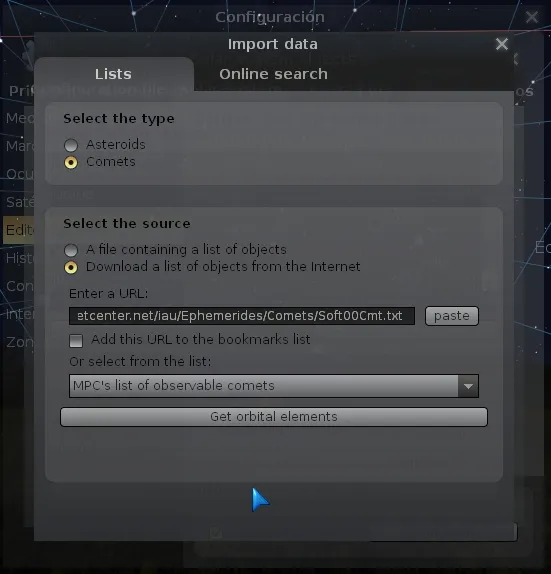
We choose Comets, and Download a list of objects from the internet. Where it says Select bookmark we choose the only option which is MPC's list of observable comets.
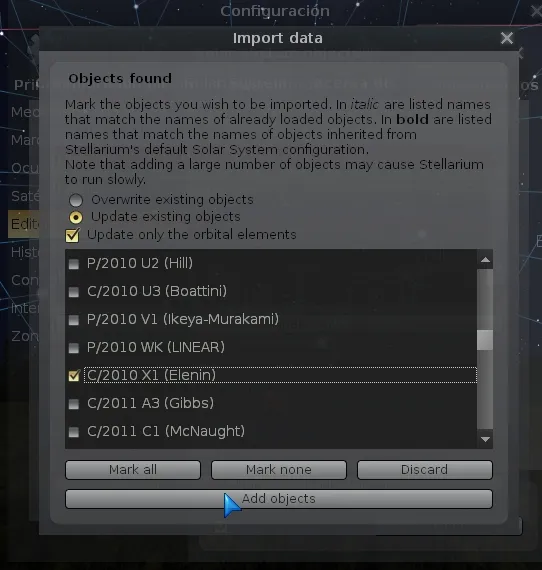
We press Get Orbital Elements and a window with a bunch of objects will appear. We choose C/2010 X1 (Elenin) and add it by pressing Add Objects.
We exit the configuration and without restarting we search (F3) for C/2010 X1 and press enter. If it is below the horizon we can remove it to see where the comet is located.
DOES THE POSSIBILITY OF COLLIDING WITH AN ASTEROID INCREASE?
The popular newspaper Clarín reports, via La Vanguardia, despite having its own very good science journalists, reports on a study by the Max Planck Institute on catastrophic events, with the headline: "They warn that the chance of an asteroid hitting Earth increases day by day".
The study was conducted by Coryn Bailer-Jones based on Bayesian statistics.
The MPIA press release says:
"Since the mid-1980s, a number of authors have claimed to have identified periodic variations in the impact rate. Using crater data, notably the estimated ages for different craters seem to derive a regular pattern, where every so many million years (values ranging between 13 and 50 million years), an era of fewer impacts is followed by an era with an increase in impact activity and so on".
It then continues saying:
"One of the mechanisms proposed for these variations is the periodic motion of the Solar System relative to the plane of the Milky Way. That could lead to differences in the influence that nearby stars exert on objects in the Oort Cloud, a giant repository of comets that form a bubble around the solar system, leading to episodes in which more comets than usual leave the cloud to approach our system and, potentially, towards collisions with Earth. A more spectacular proposal is the existence of an as-yet-undetected companion of the Sun, called 'Nemesis'."
It then points out:
"For researcher Bailer-Jones these results are evidence, not of mysterious cosmic phenomena, but of subtle pitfalls of traditional and frequent statistical reasoning. 'There is a tendency to find patterns in nature where none exist. Unfortunately, in certain situations, traditional statistics reinforces that particular weakness'."
Therefore, for her analysis, Bailer-Jones chose an alternative way to evaluate possibilities: Bayesian statistics, which avoids those supposed statistical pitfalls.
I say that Bayesian statistics, like all other statistics, depends on its interpretations. It is not exempt, either, from the pitfalls of human interpretation, much less.
Bailer-Jones found that periodic variations do not occur, but that the number of craters of different ages, from 250 million years ago to the present, has increased regularly.
Hence La Vanguardia and Clarín extrapolate the headline, which is not blameworthy because it is a statement made by the researcher. What the Argentine newspaper does NOT point out is what follows in the press release:
"There are two possible explanations for that trend. That smaller craters erode more quickly and the older ones have had more time to erode. The trend could simply reflect the fact that larger and younger craters are easier for us to find than smaller and older ones". And the researcher indicates: "If we look only at craters larger than 35 km and younger than 400 million years, which are less affected by erosion and infill, we do not find that trend".
But, on the other hand, at least a part of the increase in the impact rate could be real. In fact, there are analyses of impact craters on the Moon where there are no natural geological processes leading to erosion and infill, which point towards that trend.
The last two paragraphs seem more than necessary when reporting the news. Otherwise, it leaves the impression that scientists proved that the impact rate increases and that's it, an incomplete conclusion if the full article is read.
This is not a criticism of Clarín or La Vanguardia in particular. It is common in other newspapers as well. In fact, the news has been treated in the same way in other newspapers, but in Argentina, Clarín is the most widely circulated newspaper.
The famous astroblogger Phil Plait, with a similar headline, does not fail to mention and highlight in bold that "there is no solid evidence that we are at more risk now than in the past" in his article New study finds giant impacts aren’t periodic.
Bayesian Statistics
The press release explains what that type of statistics implies:
The inference Bayesiana (by Bayes' Theorem) is an alternative approach to hypothesis testing that is done this way: To begin, you need different hypotheses. In this case, Bailer-Jones chose: constant probability, simple periodic (sinusoidal) variations of the impact rate, the case where those periodic variations govern only a part of the impact probability, a background trend, a background trend plus periodic variations.
Before looking at the data, you assume you cannot decide which hypothesis is more likely: you assign equal prior probability to all of them. Bayesian inference allows using the data—in this case the approximate data or date ranges for different impact craters—to adjust the probabilities. In particular, it tells you how likely each hypothesis is, given the measured data. By comparing those probabilities, you can decide which of your initial hypotheses is more likely and how likely the others are.
Bayesian inference is not a cure for all statistical problems. It has its own subtleties, notably concerning the correct choice of prior probabilities. For this particular task, that is, the analysis of time series with different uncertainties (and, in some cases, upper age limits for a crater), it is a very suitable tool that allows well-founded statements about the different hypotheses in question. Periodic variations in cratering rates are strongly disfavored in the datasets and there is no evidence for a periodicity added to a general background trend. This result is found to be robust for specific assumptions about the hypotheses.
How to know who is telling the truth?
We usually have more information about the things that interest us. There are exceptions and variants, but it tends to be that way. When something doesn't interest us much, we don't have much information about it. In the face of those things we are more "vulnerable." Not knowing, we must turn to the supposed "experts." But how to know who is telling the truth about something we don't know?
It's a great question, applicable to scientific claims and many other kinds. The crux of the matter is information. We will obtain varied information if we do some searching, but we will have nothing if we don't search. To do so, of course, you need to want to. To desire to know something. If there is no interest, we will stick with the first thing we hear.
Now, if we are going to do this last thing, at least, as a matter of common sense, let's take that information with a grain of salt. "Someone says such a thing. I have no idea. It doesn't matter much to me. Honestly, I don't know," would be an honest thought.
Giving significant weight to extraordinary claims, with little information, on a topic that interests us little, does not seem to make sense.
If we are interested and obtain varied information, we will be able to contrast one with another. In this particular case, let the reader evaluate what is said out there, what predictions are made, what it implies to BELIEVE what they are told. And if interested, take note and have a memory. Some claims will stand. Others will not.
What is important is not to believe blindly what others say, no matter how expert they claim to be, but what one manages to discern oneself. Along the way we will stumble upon errors, as happens to everyone, but they will be our own ideas and not those of others. And the logic of that path demands good sense, but above all humility.
In short, Nullius in verba.
Sources and related links
- Worried About Comet Elenin? FAQs from Ian Musgrave
- Will C/2010 X1 Elenin, the Comet of Doom, Evaporate?
- Avoiding Nemesis: Does the impact rate for asteroids and comets vary periodically with time?
- Bayesian time series analysis of terrestrial impact cratering
C.A.L. Bailer-Jones
DOI: 10.1111/j.1365-2966.2011.19112.x
arXiv:1105.4100v2 [astro-ph.EP] - Toscano and his pseudo comet
About the images
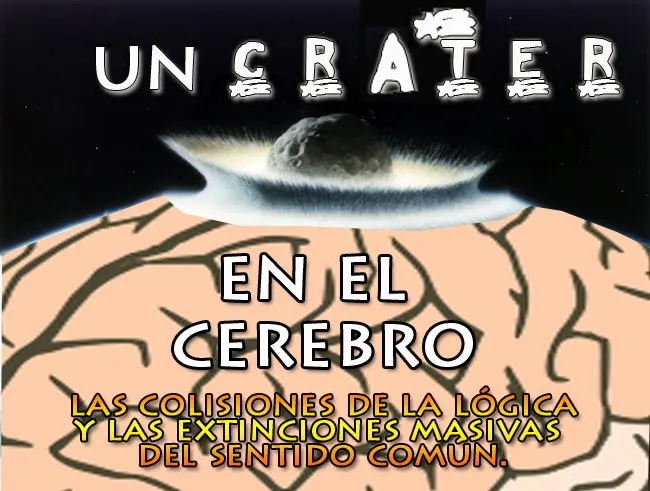
- Initial image: Composition with illustration by Don Davis, NASA and brain illustration from OpenClipArt.
- Screenshots from Stellarium and Google Earth.