Galaxy Zoo is a "citizen science" project to classify galaxies. Until now the site was only available in English, but now there is a version in our language created by Argentine and Chilean astronomers.
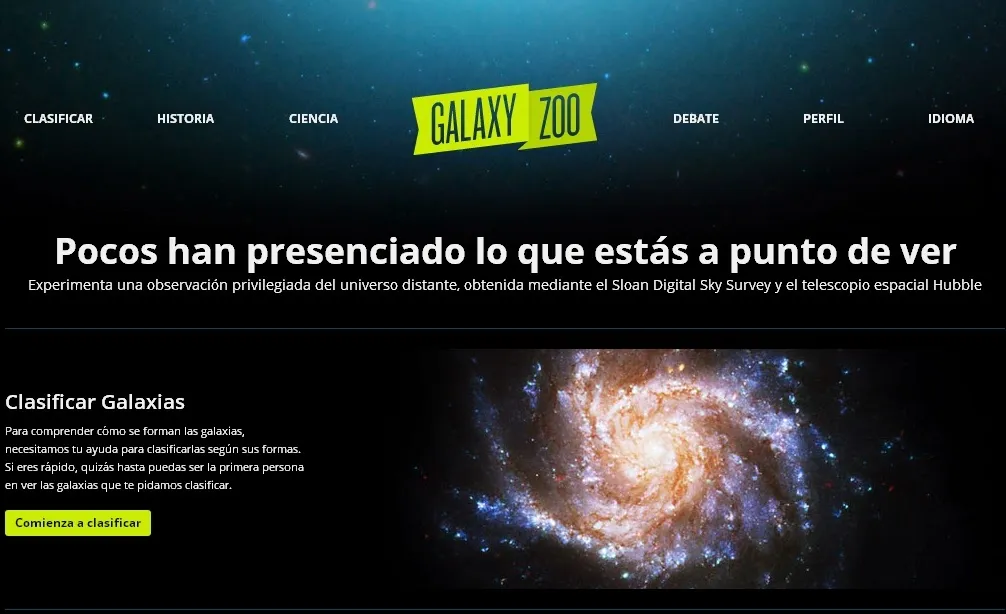
We have talked in this space about the citizen astronomy projects of Galaxy Zoo. On several of those occasions what I did was a small "tutorial", useful especially for those who do not handle English.
With the intention of solving this limitation, Dr. Ezequiel Treister of the University of Concepción and collaborators from Chile, made the Spanish version of Galaxy Zoo available at http://www.galaxyzoo.cl
Let's see how it is:
Upon entering, a user must be created. Since I was a user of the project, in English, I tested if my username and password were validated. They were. The first thing I thought was to look for a "tutorial". Not finding one, I went directly to classify.
The classification screen is divided into two parts. On our left, an image that comes from some astronomical surveys (SDSS, UKIDSS, Hubble). On our right we have:
Top: survey indication, favorite icon, invert option.
Followed by Help and Restart.
Below the options, which will change during the classification process.
Initially they are: smooth, features or disk, star or artifact.
The survey icon indicates where the image comes from. The favorite icon allows adding that image to a favorites list. The invert option is particularly useful for certain images. It means inverting the color of them, which is normally a dark background with objects in white.
The Help is a modal window that does not include all aspects in that single window, it is not a single, extensive file, but rather it "adapts" to each instance of the classification process.
For example, I am going to classify and I come across this screen:
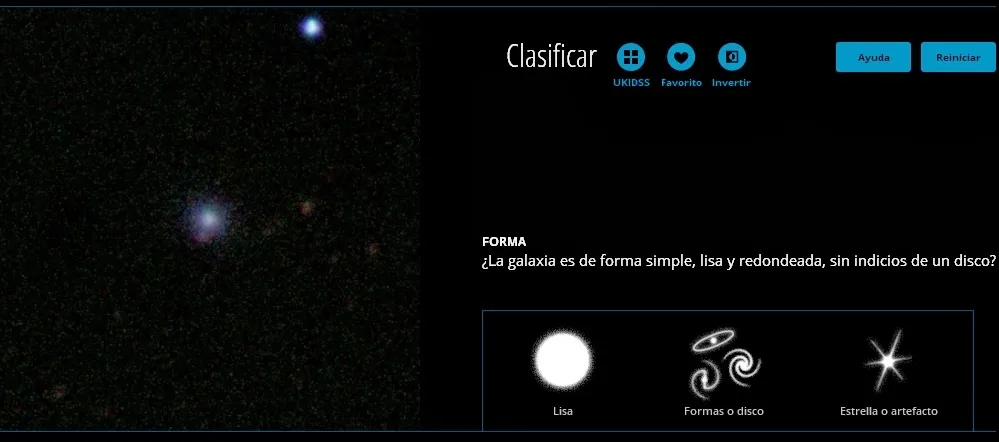
Here I must decide if it is a smooth galaxy, features or disk, or an artifact.
Let's go to the help. A window opens that helps us decide, showing us images of each case.
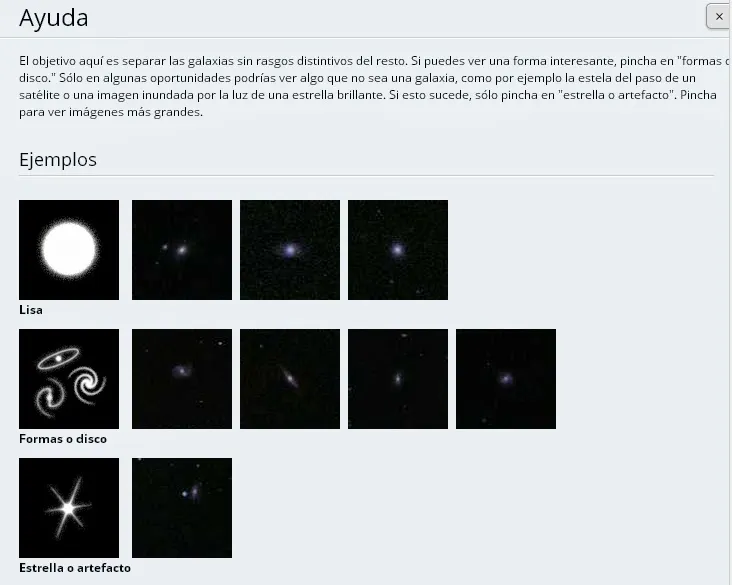
Let's say then that it is a "smooth" galaxy. The bottom part of the right section will change the options and will ask us: How round is it?
Completely, intermediate, or cigar-shaped.
Let's go to the help.
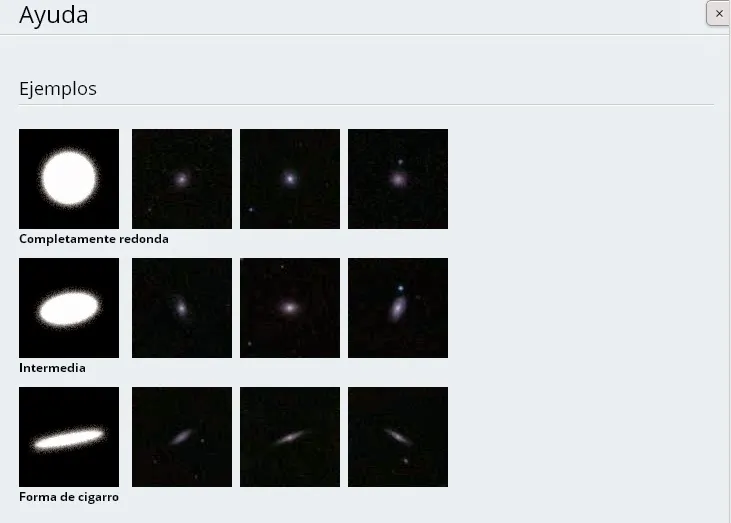
As we already noticed, the help is a window that has information pertinent to that classification instance, instead of being a single tutorial-type file with the entire process described. Interesting.
Let's say then that the object to classify (it is always the central object) is completely round. There is, however, some "artifact" at the top right, but it is not of interest.
Then we are asked if there is anything odd. The help will provide us with images that will allow us to decide. In this case there is nothing, but let's go to that option just to know what other options would be displayed:
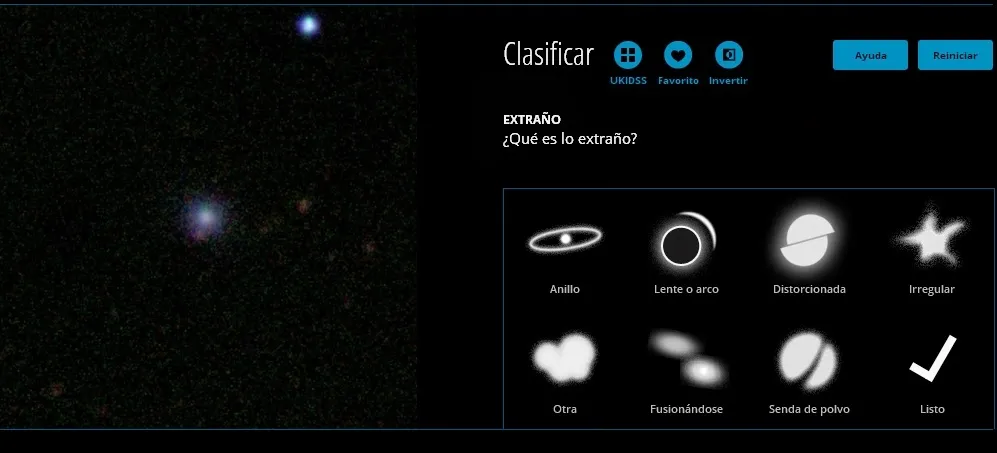
If we were to go to the help again we would see images of each case.
If at any point in the process we realize we chose wrong, then we go to Restart, an option always present at the top right.
Let's go there. We restart and return to the beginning. Let's now choose the option Features or disk.
It asks us if it could be a disk seen edge-on. Suppose yes, then they ask us about the central bulge:
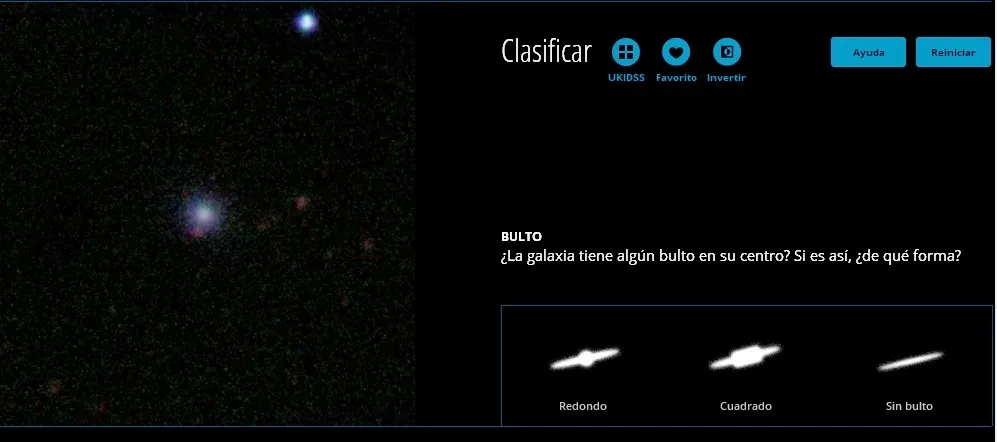
Since that is not the case, I restart again, I go back to choose Features or disk, but this time I indicate that it is not an edge-on disk. Then we are asked if there is any bar resembling prohibition signs in the center of the galaxy. What? Prohibition signs?
If on a first reading I don't understand it, it's surely because it is a "language" or metaphorical figure suitable for a not very specialized audience. But then I understand. A "prohibition sign" what is it like? Well, like the No Parking sign, right?
What is being asked, to put it another way, is if it is a barred spiral, like the Milky Way.
Let's go to the help: Some galaxies have a prominent straight "bar" crossing them through the center, and that is what we are looking for here.
Then we will be asked if there are spiral shapes. If there are, we will choose between
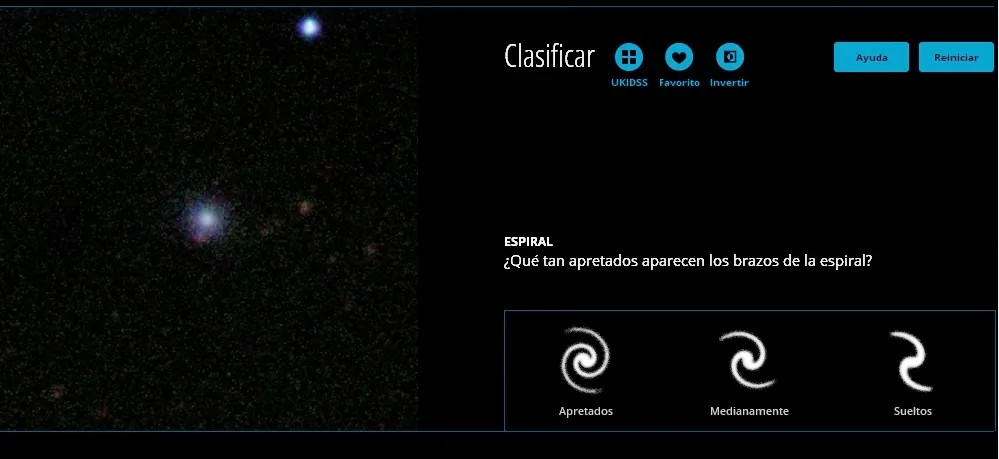
And then between:
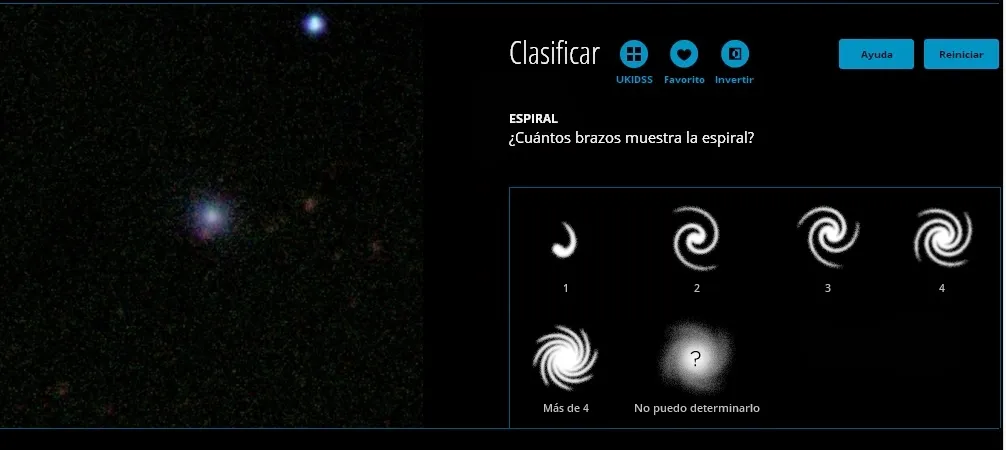
Then they ask us about the bulge. I prefer the term "bulge" for reasons of language idiosyncrasy, but it is similar. We choose:
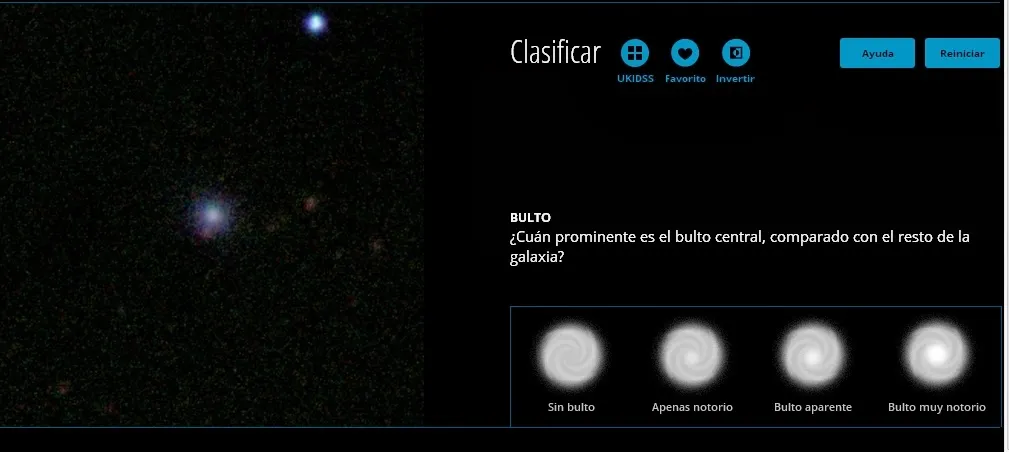
Again we will be asked if there is anything odd, an option we already saw. Then, in all cases, we will be asked if we would like to discuss this object. Usually we will say no, unless we notice something sufficiently odd for the community to pay attention to it.
In the name of science
The name of the project, in English, always displeased me a little. It's that "Zoo" means "animal". I understand that in a zoo we are in contact with varieties of animals. In that sense, zoo has a nuance of synonymy with variety, diversity and therefore, with the exotic.
Zoo, fauna and circus have nuances of synonymy. The word zoo has been used metaphorically, for example in Zoo Station and Zooropa, songs by U2 (metaphors of modern life), as in The Glass Menagerie by Tennessee Williams (metaphor of escapism).
None of this relates to galaxy classification projects, except for the distant idea that such objects have different shapes.
I would prefer something like Galaxiarium. The Latin suffix arium is used to associate with a specific function, place or thing. Dictionary or solarium, cupboard, wardrobe, recipe book, centenary. It indicates collection, set, series.
I can't think of any better option. Galaxiario or in Latin Galaxiarium. If it were in Latin it could be used both for the English project and for the Chilean project in Spanish.
I would have expected that when translating the project into Spanish a translated form would be used: Zoo de Galaxias, Zoo Galáctico or the combined form ZooGalaxias. But it was chosen to preserve...
Galaxy Zoo in school
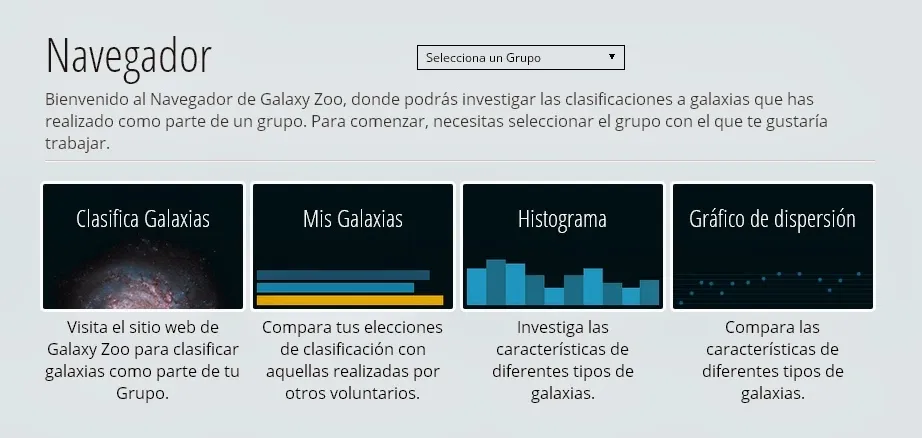
A particularly interesting option is Zoo Teach and the other is The Navigator.
The Navigator is a tool that can be used in class. As I understand it, it aims to be a way to work in groups. A group is created, which for example the teacher will do. Then the students classify and then it will be possible to compare the group's classifications.
What's missing
Zoo teach is in English. If something is most interesting, it is those two tools, even though the second one is still in a foreign language. That is something to work on.
There are multiple options to do it. One is to create pdf, ppt files on galaxy evolution. Since the Galaxy Zoo user will already know something about classification, the topic can be deepened (the famous Hubble fork) and then move towards theories of galaxy "evolution." Those files can be an aid for teachers, relying on Galaxy Zoo as student material.
What I think is missing on the site is an explanation or text about why an ordinary citizen should classify galaxies. Why is it NECESSARY? Is it?
What does the user "get" in return? Should they get something in return?
In any case, it is necessary to give meaning to citizen science projects, not only from the astronomer's perspective.
The professional will say there is a lot of data, so much that it is difficult to process and that despite advances in computing and automatic classification methods, there are things that only we humans can do (because we have a brain). And that, although we can make mistakes, those errors are "cleaned up" statistically.
Great. That explains why it is necessary FOR ASTRONOMERS to have the help of volunteers. But what is the meaning for citizens?
We live in a capitalist society where everything is evaluated by give and take, supply/demand, cost/benefit.
Could this project not be understood as a means for professionals to get free "labor"?
My opinion is that knowledge and its search are human needs. I have been writing a series on this. In the next installment (already written, not published) I will make a simplified taxonomy of needs. Astronomy can "serve" FOR other things, but ultimately it is a means to answer questions we have always asked ourselves and that are an end in themselves. We want to know. That is the non-monetary "benefit."
In a capitalist society this may be hard to swallow, but we cannot ignore how society works and what people who might approach projects of this type think.
However, if the solidarity of citizens towards astronomers is appealed to, what is the solidarity of professionals towards the rest of the public?
Research papers are published in a technical language that the public does not understand, in English, and in Journals that are generally paid. The product of science is like any other product, like a piece of meat or an appliance. It is sold.
Something will have to REALLY change to move towards a solidarity interaction between astronomy professionals and the amateur public.
This type of project is something. It is valuable. But we must go for more, unless we settle. Settling is conserving.
Project presentation in Spanish
On Thursday, April 3, at 18:00, this project will be launched in Argentina at the Instituto de Astronomía y Física del Espacio dependent on CONICET and UBA, through the Grupo de Astrofísica Numérica, who will be the local representative of the project.
"For the presentation of Galaxy Zoo, Dr. Ezequiel Treister from the Universidad de Concepción will visit us and will give a talk about galaxy classification and its importance in astronomy, will also talk about the history of Galaxy Zoo and a brief demonstration of its use will be made. We will also have the presence of Dr. Patricia Tissera, one of the main promoters of the project," they inform from IAFE. Here we have commented on part of Dr. Treister's work in The mAGNificent Universe.
Sources and related links
- IAFE
- Galaxy Zoo in Spanish
About the images
- Screenshots of www.galaxyzoo.cl from Google Chrome.