At Samsay Huasi. With a telescope manufactured at UNLP, visitors will be able to enjoy astronomy.
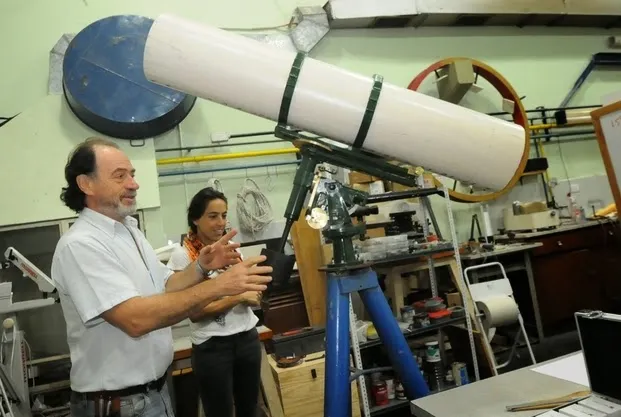
The National University of La Plata will install at its Samay Huasi Rest House, located in the province of La Rioja, a new Telescope that will allow all visitors to enjoy astronomical observation in an unparalleled natural setting. The new instrument will be used for educational and recreational purposes for schools in the area and the community in general. The initiative marks the beginning of a much more ambitious project that includes the future construction of an automated weather station.
The brand new instrument was entirely designed and built by the Optics Laboratory of the Faculty of Astronomical and Geophysical Sciences, and is already ready, waiting to be transported in the coming days to the estate that UNLP has in the city of Chilecito, La Rioja. Its installation coincides with a series of activities within the celebrations of the 300th anniversary of the town's founding.
The Vice Dean of the Faculty and one of the authors of this initiative, Luis Martorelli, explained that: "the idea of building the Telescope arose from a concern of the Board of Directors of the Association of Workers of the University of La Plata (ATULP), which proposed that we fix and repair the old refractor instrument that we had installed in Samay Huasi more than two decades ago."
Thus, those in charge of the Optics, Calibration and Testing Laboratory (LOCE) of UNLP took on the challenge of returning to the estate's visitors the pleasure of observing the night sky. "When the old Telescope arrived from La Rioja to our city, we noticed that the degree of deterioration of the instrument, added to its age and the time it would take to obtain the supplies to repair it, would make its repair impossible. It was then that, with the support of the presidency of UNLP and ATULP, we made the decision to build a new one," Martorelli detailed.
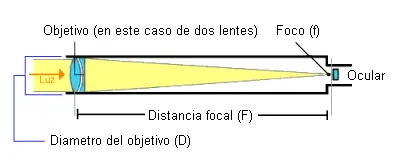
Unlike the previous model, the new Telescope will not be a refractor, but a reflector. The original instrument consisted of an optical lens system comprising two very high quality optical glass lenses, built over 70 years ago in France. This system is known as the Galileo Telescope (1610) in its Fraunhofer version (1700). Figure 1:
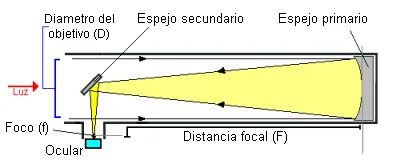
As one of those lenses was completely destroyed and it was very expensive to make a new one, the complete construction of a Reflector system was undertaken, that is, a Telescope that uses as its main objective a mirror ground on the first surface. This system is known as the Newton Telescope (1660). Figure 2:
The optics were entirely made at LOCE, with national materials, as well as its mechanical parts, mirror support cells, exterior and interior paint of the tube and the aluminizing of the reflective surfaces.
Furthermore, the old original mechanical mount of the system – with its tracking clockwork – was recovered, which showed deformations from use and mistreatment. Martorelli highlighted the importance of this work since "a historical and very useful part of the old telescope was preserved." The current instrument has a 210 mm diameter and a 1,200 mm focal length.
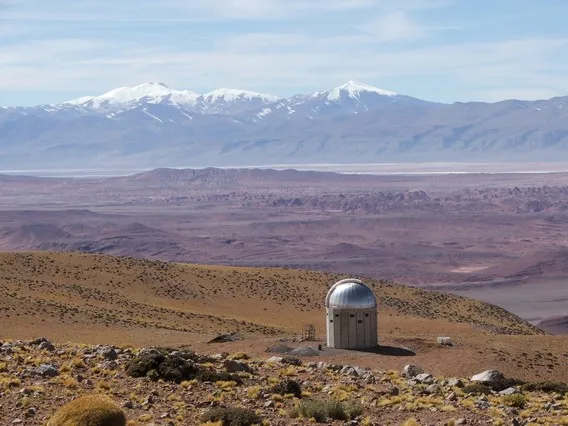
Once at Samay Huasi, the Telescope will be installed in the old wooden shed with a sliding opening, where the old telescope used to operate for years. This space was recently restored by local non-teaching staff.
THE BEGINNING OF A GREAT PROJECT
The construction and installation of the Telescope is only the beginning of a much more ambitious project that aims to launch a series of transfer and extension activities that UNLP has specially planned for Samay Huasi.
To learn more, see the UNLP press release (link below).
Sources and related links
- UNLP: Samay Huasi sees the stars again
- El Día: They will take a new telescope to Samay Huasi
- Faculty of Astronomical and Geophysical Sciences, UNLP
About the images
- Telescope diagrams from Diploma in science teaching. (http://132.248.239.10/cursos_diplomados/diplomados/anteriores/basico/colima07/portafolios/portafolios.html)
- The Vice Dean of the Faculty of Astronomy, Luis Martorelli, with the new telescope that will travel to La Rioja. Credit: UNLP.