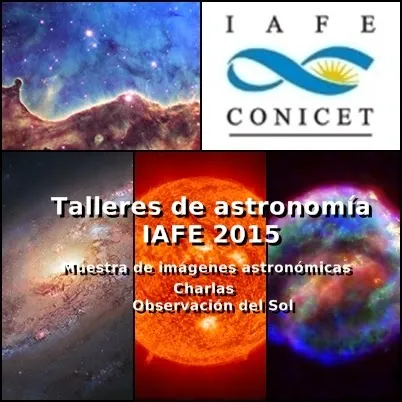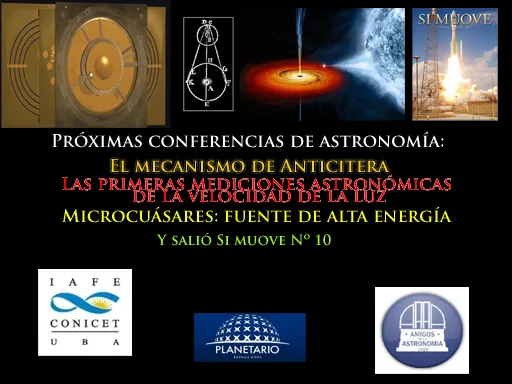
The Instituto de Astronomía y Física del Espacio -IAFE- (CONICET-UBA) invites all those interested in topics related to the study of the Universe to participate in its Workshops.
-First meeting: "Observing black holes"
Wednesday, October 8, 18 h.
Dr. Leonardo Pellizza
One of the most fascinating areas of modern Astrophysics is the study of black holes. In this meeting we will discuss how to detect these objects and investigate their properties. We will describe various types of radiation sources associated with black holes, and we will analyze one of the most powerful energy sources in the Universe: the accretion of matter onto a compact object.
-Second meeting: "Our restless Sun: the different faces of a star"
Wednesday, October 15, 18 h.
Dr. Marcelo López Fuentes
It is often said that if it weren't for the magnetic field, the Sun would be as boring a star as most astronomers think it is. Among the different types of stars available in the cosmos, our Sun is indeed a fairly common star. However, there are two things that make it special for us: it is close enough for us to see phenomena that are undetectable in other stars, and its behavior has, for obvious reasons, a much more direct impact on our lives. In this talk, we propose to review our current knowledge about the Sun and look at it as a laboratory for physics under extreme conditions through impressive observations obtained with state-of-the-art instruments.
-Third meeting: Telescope observations of the Sun, date to be determined during the solar physics talk.
-Fourth meeting: "Galaxy Formation and Dark Matter"
Wednesday, October 22, 18 h.
Dr. Susana Pedrosa
What is the possible nature of dark matter. Its role in the formation of galaxies. The most recent models. How the formation and evolution of galaxies is studied through numerical simulations.
-Fifth meeting: "The fascinating life of Galaxies"
Wednesday, October 29, 18 h.
Dr. María Emilia De Rossi
The study of galaxies is one of the most fascinating branches of
Astronomy and can contribute to unveiling secrets about the origin and evolution of our Universe. However, investigating galaxies is not an easy task since within them coexist the most varied astrophysical systems, ranging from planets like ours, millions of stars like our Sun, and even gigantic black holes. On the other hand, galaxies do not spend their lives in complete isolation but, on the contrary, interact with other galaxies and with the medium that surrounds them. Moreover, many galaxies collide with each other in violent collisions that dramatically alter their properties. These processes are so complex that to analyze them astronomers must resort to sophisticated telescopes and state-of-the-art computers. In this talk, we will analyze what galaxies are, how they formed, and what their life is like based on telescope observations and simulations generated by today's most powerful supercomputers.
IMPORTANT: The meetings are free and participation does not require prior registration. Entry to the Institute will be from 17:30 h. until the capacity of the 70-seat classroom in the Conference Room is filled and STRICTLY CLOSES AT 18 H.
New issue of the IAR Bulletin
Bulletin No. 46 of the Instituto Argentino de Radioastronomía has been published and can be read online at IAR Boletín.
Sources and related links
- IAFE Workshops