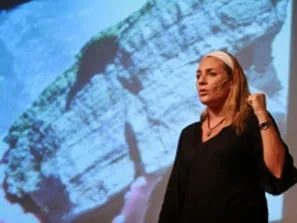
Lecture at the Planetarium: What do the Puna, the planet Mars and primitive Earth have in common?, by Dr. María Eugenia Farías LIMLA-PROIMI-CONICET*
Due to conditions of high UV, low O2 tension, wide thermal variation, volcanic influence and desert environment, the Puna is postulated as the environment most similar to the archaic environments of primitive Earth or what extraterrestrial environments could be like. For this reason, these systems are being proposed as emblematic environmental laboratories for studies of Astrobiology and the origin of life. In 2009, living stromatolites were discovered in the Argentine Puna. These ecosystems are formed by microorganisms that precipitate minerals and form a kind of "living rock." They are the oldest fossil records on the planet (3,400 ma) and were responsible for the formation of the ozone layer and the release of O2 into the atmosphere. The story of this discovery and its scientific, environmental and social implications will be presented in this lecture.
Friday, October 24 at 19 h.
Planetarium Show Hall/ Avda. Sarmiento and Figueroa Alcorta
Planetario de la Ciudad de Buenos Aires “Galileo Galilei”
(Free activity/Admission in order of arrival, no prior reservation)
*María Eugenia Farias was born in Córdoba on 04/22/1968. She moved to Tucumán at the age of 3 and has lived in this province ever since. Her specialty is microbiology in extreme environments of the Puna. She graduated with honors from the Facultad de Cs Naturales e Instituto Miguel Lillo (UNT. 1987-1991). She earned her doctorate in Microbiology (UNT-CONICET-1992-1996). She completed her postdoctoral work in Spain at CIB-CSIC-Madrid (1998-2001). She returned to the country in 2001, being one of the first scientists repatriated under the program for repatriating Argentine scientists abroad. She entered the CONICET career at PROIMI (2003) and created the Laboratorio de Investigaciones Microbiológicas de Lagunas Andinas (LIMLA) dedicated to the study of the microbiological biodiversity of the lagoons, salt flats and volcanoes of the Puna). In the last 10 years, she has dedicated herself to surveying, studying and valuing extreme microbiological ecosystems of the Andean Puna, which include lagoons, salt flats and volcanic fumaroles. She conducts research in extreme environments above 6000 masl. In 2009, she discovered microbial ecosystems (microbialites) of great scientific and biotechnological heritage value never before described at those altitudes. Since then, through intense scientific and outreach activity, she has worked to value and promote their protection in the face of the advance of mining activity in the country. She promoted the creation of a provincial protected area in Socompa (2010). She has created the first collection of extremophile microorganisms and metagenomes in the country, registered in the Sistema Nacional de Datos Biológicos (SNDB) (algae, archaea, bacteria and fungi and metagenomes of extremophile communities). She has supervised numerous doctoral theses. She is the author of 60 scientific papers published in top international journals. She has given lectures at numerous national and international conferences. She has participated in scientific outreach documentaries. She received an honorable mention in the L'Oréal Women in Science award (2011), and the Konex award in Science and Technology - Biology and Ecology (2013).
Sources and related links
About the images
- Photo of Dr. Farías. Planetarium website.