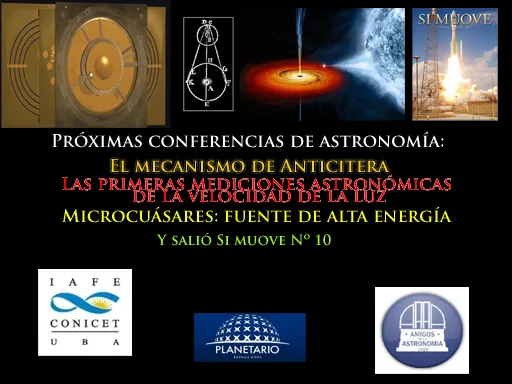
Upcoming astronomy lectures in Buenos Aires on various topics. Also, issue number 10 of the magazine Si Muove is out.
"International Year of Light"
Institute of Astronomy and Space Physics
CONICET-UBA
"The first astronomical measurements of the speed of light"
Dr. Rafael Ferraro
Institute of Astronomy and Space Physics (CONICET-UBA)
Classroom of the IAFE Building
Ciudad Universitaria de Núñez
Thursday, June 18, 2015, 19 h.
Until well into the 17th century, it was still not known whether the speed of light was finite or infinite. The progress of astronomy in that century, due to the introduction of the telescope, allowed the dilemma to be resolved. In this talk we will see how certain unexpected results in observations made by Olaus Roemer (1676) and James Bradley (1729) demonstrated that light propagates with a finite speed.
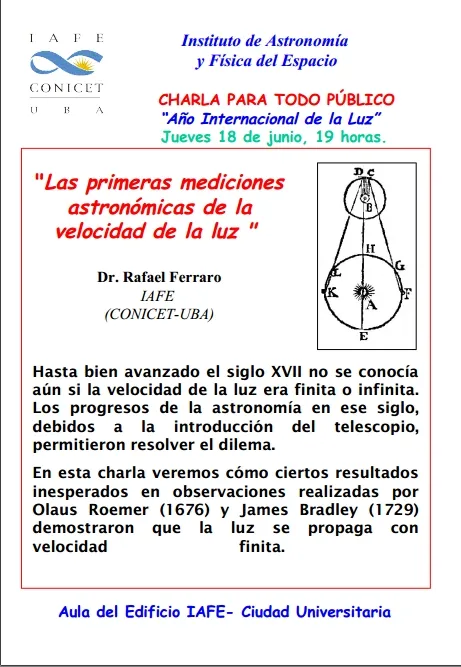
see PDF used for the lecture on the same topic at the 4th Latin American Workshop on Science Teaching. Buenos Aires, September 28, 2009
LECTURES AT AMIGOS DE LA ASTRONOMÍA
The cosmos in 30 gears: The Antikythera mechanism.
Saturday, June 27, 2015, at 19:00 h, at the social hall at Av. Patricias Argentinas 550 - CABA - Free admission.
In 1902, near the coast of Antikythera, at a depth of more than 40 meters, the remains of a complex mechanism were recovered, which was later dated as originating from the 2nd century BC. Although there were important studies in the 1970s, it was only at the beginning of this decade with the work of Michael Wright and the team led by Tony Freeth that the main functions of the mechanism have been clarified. It had more than 30 gears and, through different pointers, it showed the position of the Sun in the zodiac; the day of the year according to the Egyptian calendar; the day and month in a complicated lunisolar calendar and, even, served to predict eclipses, among many other things. In this presentation, we will briefly recount the history of the discovery and research, show its main functions, and state the challenges it poses to the history of astronomy.
Dr. Christián Carman (see profile on TEDxRiodelaPlata)
Microquasars: high-energy source
by Dr. Carolina Pepe (UBA), to be held on Saturday, July 04, 2015, at 19:00 h at the social hall at Av. Patricias Argentinas 550 - CABA - Admission is free.
Stars seem to be objects that do not change over time: every time we look at the sky they are there, beautifying the night. However, stars have their own life cycle: they are born, evolve, and then die. In some cases, this end can give rise to one of the most fascinating astrophysical objects: black holes. In this talk I will explain the formation process of these objects, describe some of their properties and, in particular, I will focus on those black holes that present collimated flows of matter, known as microquasars.
see article by the astrophysicist at IAR: Cygnus X-1 is still making headlines!
The three events were added to our Science Events Agenda.
Also, Si Muove No. 10 is out
Popular science magazine produced at the Buenos Aires Planetarium.
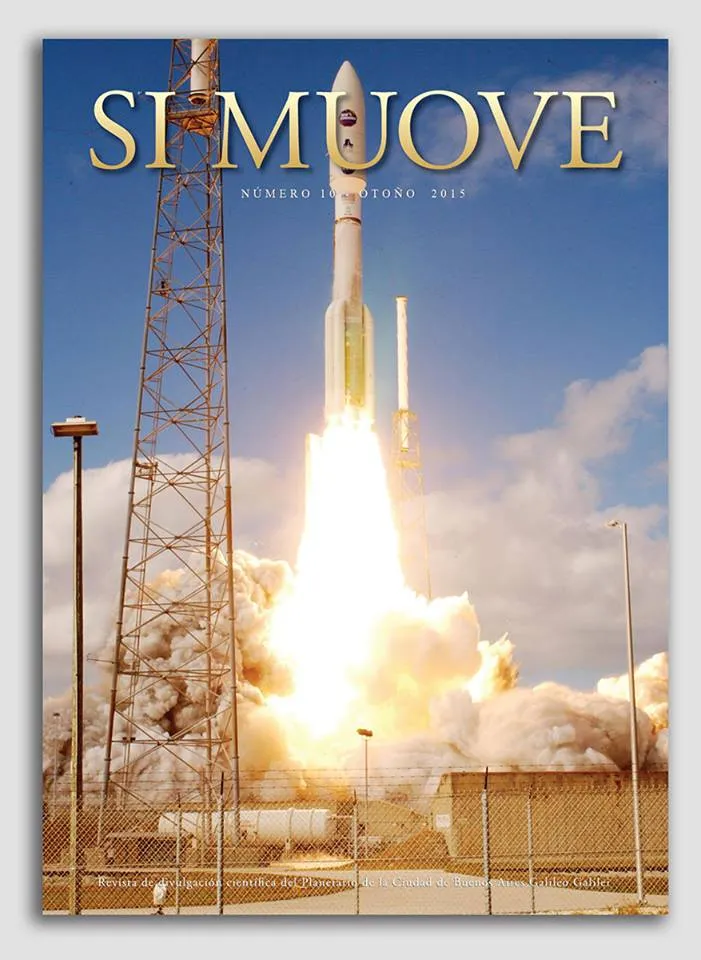
Info at Planetario Galileo Galilei
Sources and related links
- Asociación Argentina Amigos de la Astronomía: Lectures
- IAFE
About the images
- Initial image, microquasar composite (Chandra X-Ray Observatory, NASA); Antikythera mechanism (Youtube video screenshot); Ferraro PDF presentation screenshot (color inverted); Si Muove cover (Planetario CABA).