The Institute of Astronomy and Space Physics IAFE (CONICET - UBA) opens its doors to the public: Exhibition, talks and observations. Not to be missed.
-First meeting: Wednesday, May 6, 18 h.
"Our restless Sun: the different faces of a star"
Dr. Marcelo López Fuentes
It is often said that if it weren't for the magnetic field, the Sun would be as boring a star as most astronomers think it is.
Among the different types of stars available in the cosmos, our Sun is indeed a fairly common star. However, there are two things that make it special for us: it is close enough that we can see phenomena that are undetectable in other stars, and its behavior has, for obvious reasons, a much more direct impact on our lives. In this talk we propose to review our current knowledge about the Sun and look at it as a laboratory of physics under extreme conditions through impressive observations obtained with state-of-the-art instruments.
-Second meeting: Wednesday, May 13, 18 h.
"The fascinating life of Galaxies"
Dr. María Emilia De Rossi
The study of galaxies is one of the most fascinating branches of Astronomy and can contribute to unveiling secrets about the origin and evolution of our Universe. However, investigating galaxies is not an easy task since within them coexist the most varied astrophysical systems, ranging from planets like ours, millions of stars like our Sun, and even gigantic black holes. On the other hand, galaxies do not spend their lives in complete isolation but, on the contrary, interact with other galaxies and with the medium that surrounds them. Moreover, many galaxies collide with each other in violent collisions that dramatically alter their properties. These processes are so complex that to analyze them astronomers must resort to sophisticated telescopes and state-of-the-art computers. In this talk, we will analyze what galaxies are, how they formed, and what their life is like based on observations from telescopes and simulations generated by today's most powerful supercomputers.
-Third meeting: Thursday, May 21, 15:30 h.
Solar observations with telescope, at IAFE.
Dr. Marcelo Lopez Fuentes
-Fourth Meeting: Thursday, May 21, 17 h.
“From chemistry to biochemistry in the Galaxy”
Dr. Sergio Parón
In this Workshop we aim to study the interstellar medium of our Galaxy. We will highlight that stars are the fundamental building blocks that form and give rise to practically everything we see. We will study the chemistry related to stars and the interstellar medium, and follow the steps of a possible biochemistry that could occur in exotic places in space.
-Fifth meeting: Wednesday, May 27, 18 h.
"Galaxy Formation and Dark Matter"
Dr. Susana Pedrosa
What is the possible nature of dark matter? Its role in the formation of galaxies. The most recent models. How is the formation and evolution of galaxies studied through numerical simulations?
-Sixth meeting: Wednesday, June 3, 18 h.
“Radio wave interferometry applied to the study of stellar explosions”
Dr. Gabriela Castelletti
The death of stars with more than 10 solar masses is one of the most catastrophic events that occur in the Universe. During their short lives, of only 10 million years, in their constant struggle against gravitational attraction that tries to collapse them, these stars create elements such as carbon, oxygen, silicon and even iron. After the explosion that marks the end of the stellar cycle, the material that formed the star continues expanding at supersonic speeds into space for tens of thousands of years, irreversibly modifying the surrounding interstellar medium. On this occasion we will investigate the radiation coming from the relics of these giants, with special interest in the radio wave emission observed with world-class interferometers such as the Karl G. Jansky Very Large Array (USA) and the Giant Metrewave Radio Telescope (India).
-In all meetings starting at 17:15 h.
“Exhibition of the National Exhibition of Astronomical Images held at the 560th Meeting of the Argentine Astronomical Association”
Additional information at: http://www.iafe.uba.ar/docs/talleres.html
IMPORTANT NOTICE:
We inform you that according to the reforms being carried out within Ciudad Universitaria, those arriving by car must enter through the East Gate (POINT2) as seen in the following link:
http://www.iafe.uba.ar/docs/images/PLANO%20CIUDAD2.pdf
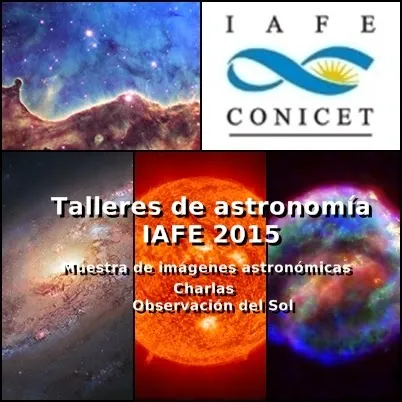
Initial image: Combination of Galaxy M106, Credits: NASA, ESA, the Hubble Heritage Team (STScI/AURA), and R. Gendler (for the Hubble Heritage Team); Solar prominence from SOHO NASA, 09-14-1999; Hubble image of NGC 3324 Credits: NASA, ESA, and the Hubble Heritage Team (STScI/AURA); Kepler supernova SN 1604 Credits: NASA, ESA, R. Sankrit and W. Blair (Johns Hopkins University).