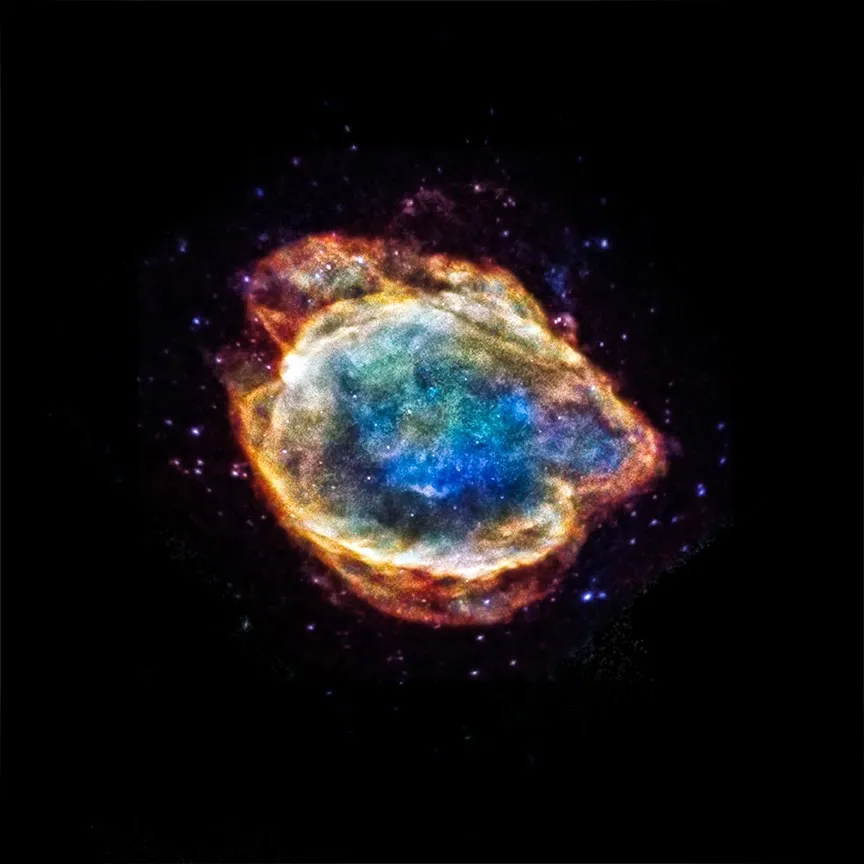
Since the debris of an exploded star, known as a supernova remnant, is very hot, energetic, and very bright in X-rays, NASA's Chandra Observatory is an ideal tool for studying them. The remnant G299.2-2.9 (or G299 for short) is located in our Milky Way, but the Chandra image recalls the beauty of a flower here on Earth.
G299 is the result of a particular class of supernova called Type Ia. Astronomers think this type of event is a thermonuclear explosion—involving the fusion of elements and the release of large amounts of energy—of a white dwarf in a compact orbit with another companion star. If the companion is a typical star like our Sun, the white dwarf can become unstable and explode by taking material from its companion. On the other hand, if the white dwarf is in orbit with another white dwarf, both can merge and trigger an explosion.
Beyond the trigger mechanism, Type Ia supernovae have been known to be uniform in their extreme brightness, usually outshining the entire galaxy in which they are found. This is important because scientists use these objects as cosmic measuring units, allowing them to measure distances to very distant galaxies and determine the expansion rate of the universe.
Traditional theoretical models of Type Ia supernovae generally predict that these explosions would be symmetric, creating an almost perfect sphere as they expand. These models have been supported by results showing that Type Ia supernova remnants are more symmetric than the remnants of supernovae involving the collapse of massive stars.
In this new false-color image, red, green, and blue represent low-, medium-, and high-energy X-rays, respectively, detected by the telescope. The resulting image is encoded with colors because humans cannot see X-rays. The images are taken with instruments designed for this purpose that detect X-rays of different wavelengths (and therefore different energies).
The medium-energy X-rays include emission from iron and the most energetic rays include emission from silicon and sulfur. These data were combined with infrared observations from the 2MASS survey showing the stars in the field of view.
From a detailed analysis of the X-rays, the researchers found several clear examples of asymmetry in G299. For example, the ratio of the amount of iron to silicon in the part of the remnant just above the center is higher than in the part below the center. This difference can be seen in the green color of the upper region compared to the blue color of the lower region. Also, there is a strong elongated portion of the remnant extending to the right. In that region, the relative amount of iron to silicon is similar to that found in the southernmost region of the object.
The patterns seen in the Chandra data suggest an unbalanced or skewed explosion. It could also be that the remnant has expanded into an environment where the medium was uneven. Regardless of the ultimate explanation, observations of this type of object are showing astronomers how varied these beautiful cosmic flowers can be.
A scientific paper describing these results was published in the September 1, 2014 issue of The Astrophysical Journal Letters by Seth Post and Sangwook Park of the University of Texas and other authors.
The Chandra Observatory made a video titled A Guide to G299.2-2.9, in English.
The relationship between stars and flowers is not new to poetry. I at least remember two examples: In one of Neruda's most beautiful poems, The Letter on the Road (Los versos del Capitán, 1952) the Chilean poet says:
"But neither can I
Forget my people.
I will fight in every street,
Behind every stone.
Your love also helps me:
It is a closed flower
That each time fills me with its aroma
And that suddenly opens
Within me like a great star."
And José Martí has a posthumous poem in Versos Libres (1913) called Flowers of the Sky.
What a strange name
G299.2-2.9 is a name that may sound as strange to a person unfamiliar with astronomy as a name like Las Piedras 156 2ºF would sound strange to an alien. To us, on the other hand, this last name will not seem "strange," if anything, more than a name we will consider it an "address." It's that the supernova remnant in question is located at galactic longitude 299.2 and galactic latitude -2.9. The designation of this object comes from the Galactic Supernova Remnant Catalogue by Dave Green (Cambridge) based on galactic coordinates.
In the catalog we will see that objects appear identified through two fields: the first named l, the second named b.
In galactic coordinates l designates galactic longitude (between 0º and 360º, sometimes also between -180º and +180º). The letter b indicates galactic latitude between -90º (Galactic South Pole) and 90º (Galactic North Pole).
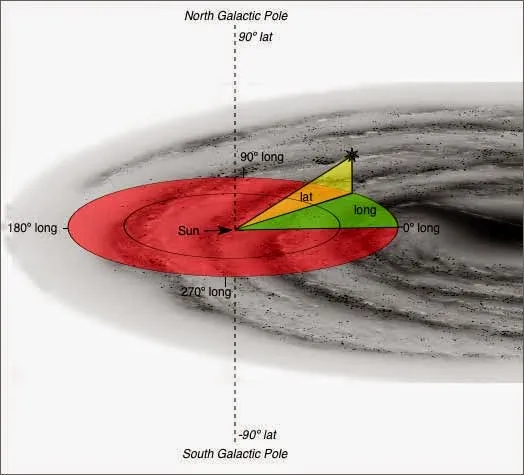
The galaxy's equator (galactic latitude 0º) coincides with the plane of the Milky Way and is shown in this image as the red circle. Galactic latitude is the angle above or below that plane (for example the yellow angle above). Thus, objects with a galactic latitude b close to 0º will be located within the spiral arms of the Milky Way. Objects with b>0º (that is, positive latitude) will be above the arms, in the galactic northern hemisphere.
Galactic longitude (l) is measured counterclockwise from the direction toward the galactic center, in Sagittarius.
Finally, consider that to locate an object in three-dimensional space some other value is needed.
G299.2-2.9 is located in the constellation Musca, about 16,000 light-years away. The image is 24 arcmin in diameter (about 114 light-years).
http://www.thinkastronomy.com/M13/Manual/common/galactic_coords.html http://es.wikipedia.org/wiki/Coordenadas_gal%C3%A1cticas
Sources and related links
- Chandra: G299.2-2.9: Exploded Star Blooms Like a Cosmic Flower
- Asymmetry in The Observed Metal-Rich Ejecta of Galactic Type Ia Supernova Remnant G299.2-2.9; Post, S. et al, 2014, ApJ, 792:L20; arXiv:1406.2190
DOI:10.1088/2041-8205/792/1/L20
About the images
- Credit: X-ray: NASA/CXC/U.Texas/S.Post et al, Infrared: 2MASS/UMass/IPAC-Caltech/NASA/NSF