Since its launch on July 23, 1999, the Chandra X-ray Observatory has been NASA's flagship for astronomy at those wavelengths among the fleet of "Great Observatories". Its latest observation is about gas falling toward a black hole.

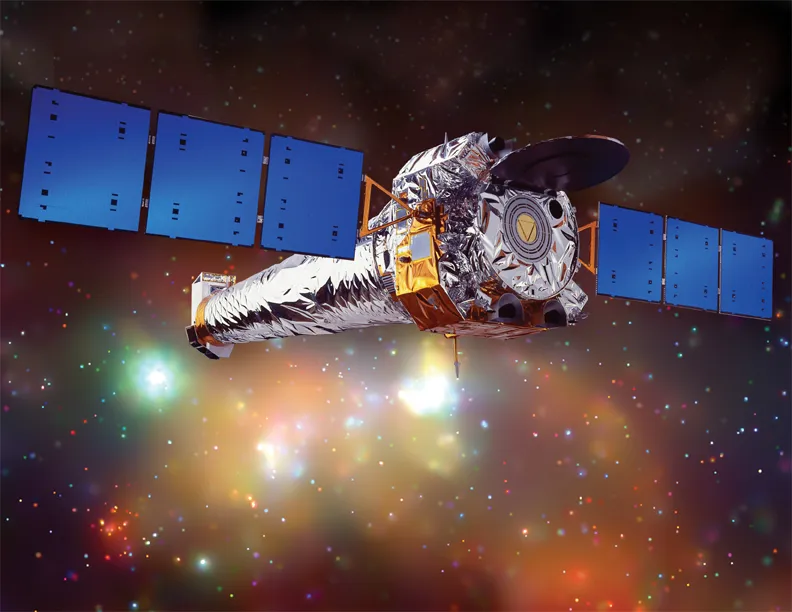
With the end of NASA's Space Shuttle program, it's worth remembering that just 12 years ago the Columbia was launched carrying Chandra to its orbit. At 1,370 centimeters long, it is the longest satellite ever transported by a shuttle. The STS-93, the mission that deployed the observatory in space, was commanded by Eileen Collins.
This incredible device requires 2,000 watts to operate, almost the same as a hair dryer.
The Columbia placed Chandra in a low orbit. Then, the Inertial Upper Stage took it to a higher altitude where an internal propulsion system placed it in its final orbit. This elliptical orbit takes the spacecraft to an altitude of 133,000 km (more than a third of the distance to the Moon) and then returns to its closest approach to Earth, at 16,000 km. It takes about 64 hours and 18 minutes to complete one orbit.
The spacecraft spends almost 85% of its orbit above the Van Allen belts, charged particles that surround Earth. This allows uninterrupted observations of up to 55 hours.
To know where it is now, we can track Chandra from n2yo.
Safe Mode
About two weeks ago Chandra entered safe mode of operations for the first time. The event occurred on July 6 and the cause is under investigation. The onboard computer reported that the predicted versus measured angular momentum was greater than allowed. However, telemetry from the gyroscopes showed no anomalies. Probably, they say, the cause was a set of corrupted data in the computer's memory.
This "shutdown" of the observatory surprised researchers. But since no major fault was found and all equipment is working well, the surprise was not huge. Instead, its observations always surprise.
Three days ago, the observatory surprised again.
Chandra detects gas falling toward a black hole
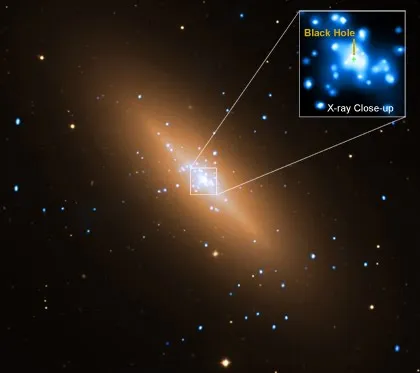
The flow of hot gas toward a black hole has been captured for the first time in X-rays, according to the observatory's announcement.
The black hole is located at the center of the galaxy NGC 3115, 32 light-years away from Earth. By detecting the hot gas at different distances from the supermassive black hole, astronomers have observed a critical threshold where the motion of the gas becomes dominated by the black hole's gravity and falls into it. That distance is known as the Bondi Radius, in honor of Hermann Bondi.
"It is exciting to find such clear evidence for gas in the grip of a massive black hole," said Ka-Wah Wong of the University of Alabama, who led the study that appears in the July 20 issue of The Astrophysical Journal Letters [Note #1].
As the gas flows toward the black hole, it becomes hotter and brighter, a signal now confirmed by the X-ray observations. The researchers found that the increase in the gas temperature began at 700 light-years from the black hole, giving the location of the Bondi Radius. This suggests that the black hole at the center of NGC 3115 has a mass of about two billion suns like ours, making it the black hole of that size closest to Earth.
The Chandra data also showed that the gas near the black hole is denser than the gas farther away, as had been predicted. Using the observed properties of the gas and theoretical assumptions, the team estimated that each year an amount of gas similar to 2% of the mass of our Sun is being pushed through the Bondi radius toward the black hole.
There are different models that describe the flow of material toward a black hole and each model has its predictions. A better determination of the increase in density will help researchers rule out some of those models in favor of the remaining ones.
The image above was created with data from Chandra and the VLT. The Chandra data are shown in blue and the optical data from the VLT in gold. The point sources in the X-ray image are probably binary stars containing gas that is being pulled from a star toward a black hole or neutron star. The inset shows the central region of the Chandra image, with the black hole in the middle.
Sources and related links
- A Birthday Card For Chandra
- NGC 3115: Chandra Images Gas Flowing Toward Black Hole
- Resolving the Bondi Accretion Flow toward the Supermassive Black Hole of NGC 3115 with Chandra
Ka-Wah Wong et al. 2011 ApJ 736 L23
DOI: 10.1088/2041-8205/736/1/L23
arXiv:1106.3069v2 [astro-ph.HE] - NASA celebrates 10 years of Chandra
- The universe in X-rays
About the images
- Image of NGC 3115: X-ray: NASA/CXC/Univ. of Alabama/K.Wong et al, Optical: ESO/VLT
- Initial image: Combination of launch photos and logos. Credits: NASA.
- Illustration of the Chandra Observatory: NASA/CXC/NGST