Researchers from the CIEMAT's ESTALLIDOS project, along with other collaborators, have concluded that supernovae with more metals are fainter than those with a low metal proportion.
ESTALLIDOS is a project involving CIEMAT, the Instituto de Astrofísica de Andalucía (coordinator), the Instituto de Astrofísica de Canarias, and the Universidad Autónoma de Madrid. This project studies in detail galaxies with recent bursts (estallidos) of star formation, which implies massive stars capable of ionizing the interstellar medium. This photoionization phenomenon produces emission lines in the spectra, and from their analysis the metal abundance of these galaxies can be deduced.
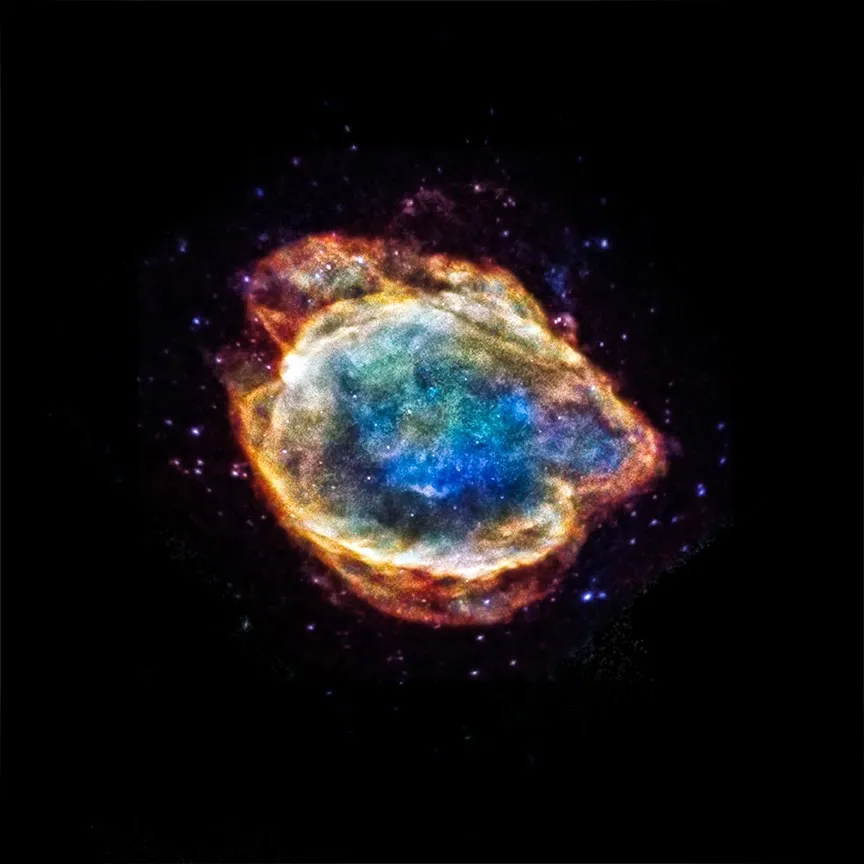
Type Ia supernovae are incredibly useful tools for determining very distant distances in the Universe [1]. Since they occur when the mass accreted by a white dwarf (in a binary system) reaches a set value, it is assumed that the peak luminosity must be very uniform among all Type Ia supernovae. This uniformity is what allows transforming the apparent brightness into distances to their host galaxies.
But what would happen if that peak luminosity is affected by a factor that has not been taken into account? Theorists have proposed that the luminosities of Type Ia supernovae could depend on the metallicity of the exploding system, so that if the metallicity is high, the luminosity would be lower. If this is the case, then we could be systematically mis-measuring the cosmological distances obtained using these supernovae.
The group led by Dr. Mercedes Mollá has analyzed this topic as part of the doctoral thesis of Manuel Emilio Moreno-Raya, within the framework of the ESTALLIDOS 5.0 project (funded by the Ministerio de Economía y Competitividad, AYA2013-4772-C4-4-P), of which Dr. Mollá is the principal investigator.
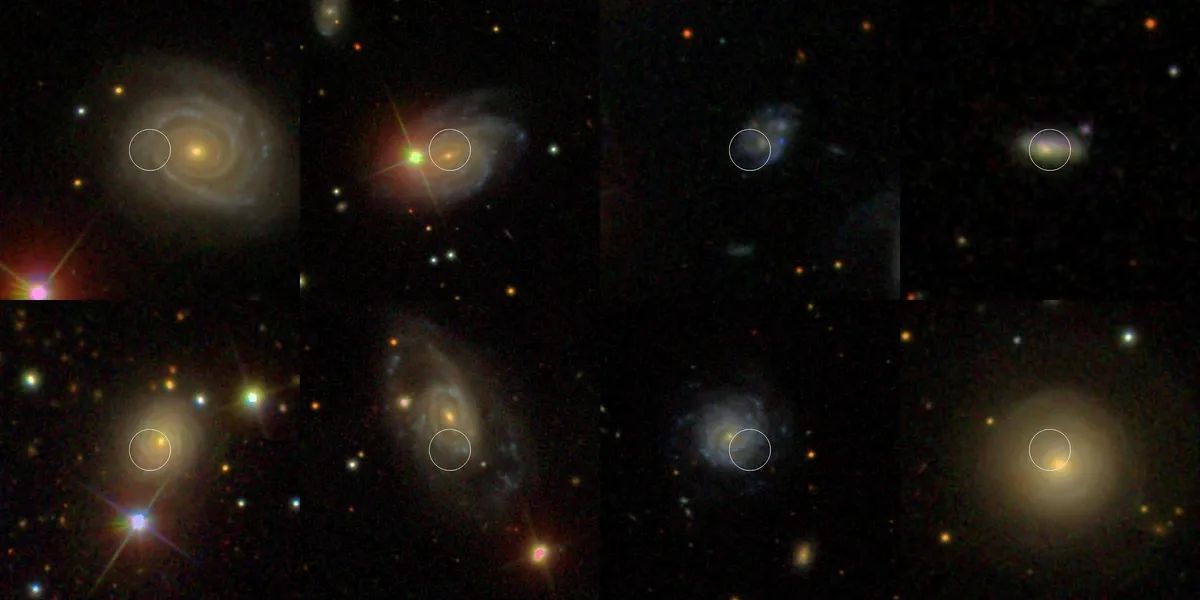
To do this, they observed 28 Type Ia supernovae located in galaxies in the local universe for which there are independent distance measurements not based on the supernova itself (Cepheids or the Tully-Fisher relation). Using spectra obtained with the 4.2m William Herschel Telescope, they estimated the oxygen abundances of the regions where the supernovae exploded and then used these measurements to determine whether or not their luminosity is affected by metallicity.
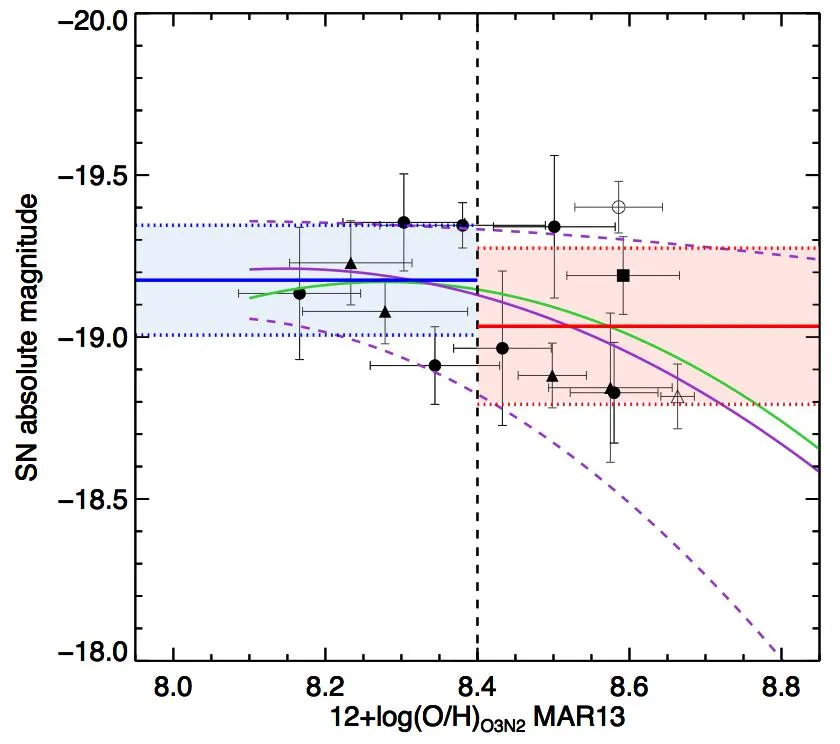
The researchers have concluded that supernovae with more metals were fainter than those with a low metal proportion. They believe this relationship of higher metallicity/less luminosity, which has an 80% probability of not being due to a random fluctuation, comes from the development of the supernova outburst. On average, low-metallicity and high-metallicity supernovae show an average difference of ~0.14 dex.[2]
Other participating researchers in the investigation: Manuel Emilio Moreno-Raya, both from CIEMAT, as well as other researchers, Dr. Ángel R. López Sánchez (AAO, Australia), Dr. Lluís Galbany (Universidad de Chile, Chile), Dr. José Manuel Vílchez (IAA, Granada), Dr. Aurelio Carnero (Observatório Nacional, & LIneA Laboratório Interinstitucional de e-Astronomia, Brazil), and Dr. Inmaculada Domínguez (Universidad de Granada).
Sources and related links
- ESTALLIDOS Group
http://wwwae.ciemat.es/estallidos/index_spanish.html - CIEMAT: The luminosity of Type Ia supernovae is affected by the metal content of their host galaxies
http://www.ciemat.es/cargarAplicacionNoticias.do?idArea=-1&identificador=1032# - ON THE DEPENDENCE OF TYPE Ia SNe LUMINOSITIES ON THE METALLICITY OF THEIR HOST GALAXIES
Manuel E. Moreno-Raya, Mercedes Mollá et al. (2016)
The Astrophysical Journal Letters, Volume 818, Number 1
DOI: 10.3847/2041-8205/818/1/L19 - arXiv:1511.05348 [astro-ph.GA]
http://arxiv.org/abs/1511.05348 - [1] A ladder to measure the cosmos
http://www.noticiasdelcosmos.com/2010/06/una-escalera-para-medir-el-cosmos.html - [2] The term "dex" is used to account for orders of magnitude. A difference of x dex is a change by a factor of 10x. It is often used specifically in astronomical jargon about metallicity, which is measured logarithmically relative to the abundance of metals in the Sun. The word was coined by C. W. Allen.
See also:
http://joe-antognini.github.io/toolkit/what-is-a-dex/
http://www.nature.com/nature/journal/v187/n4740/abs/187879a0.html
About the images
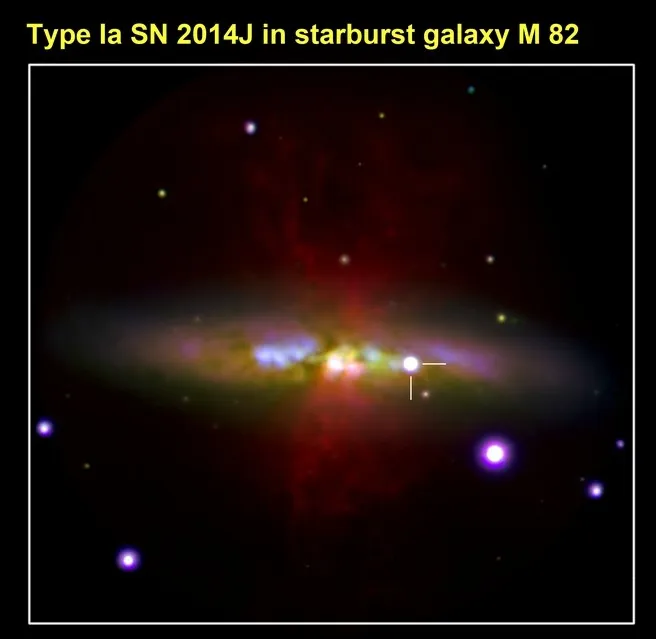
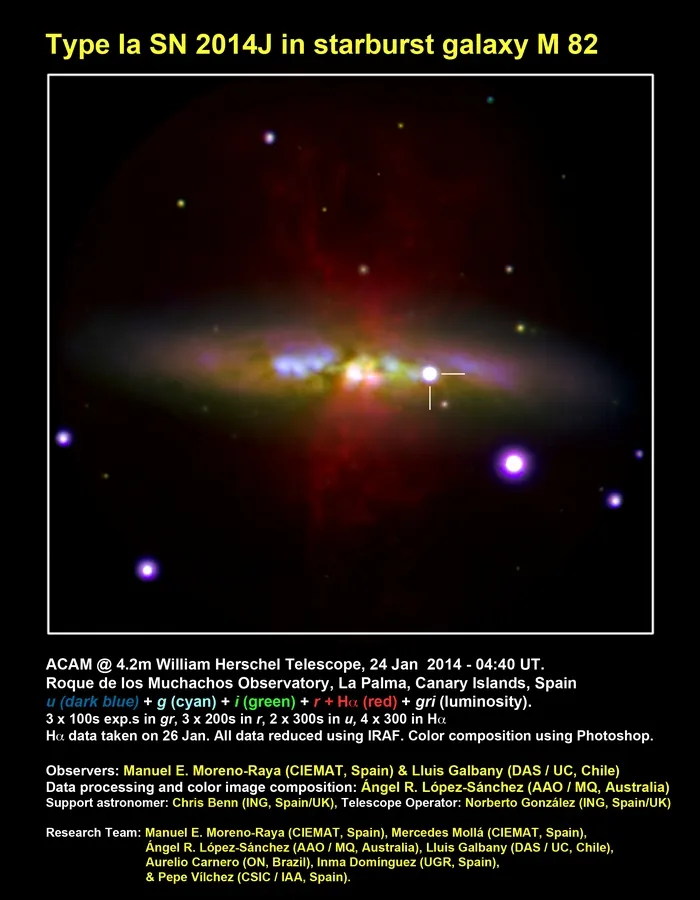
Figure 1: Image of galaxy M 82 (located 12 million light-years away in the northern constellation of Ursa Major) with supernova SN 2014J. The Type Ia supernova is indicated with two lines. The data to make this image were obtained with the ACAM camera of the William Herschel Telescope (ING, Observatorio del Roque de los Muchachos, island of La Palma, Spain), which has a 4.2-meter primary mirror. The filters used were u (colored dark blue, two 300-second exposures), g (in cyan, 3 exposures of 100 seconds), i (in green, three exposures of 100 seconds), and r (in red, 3 exposures of 100 seconds). The data were obtained on January 24, 2014 around 04:40 UT, except for the data in the r and u filters (January 25 around 06:00 UT). Additionally, an extra exposure in the Hα filter, also coded in red, was included, obtained by combining 4 images of 300 seconds. The Hα data were obtained on January 26 at 06:30, finishing already during twilight.
Credits, observers: Manuel E. Moreno-Raya (CIEMAT, Spain) and Lluís Galbany (DAS / UC, Chile), Data processing and color composition: Ángel R. López-Sánchez (AAO / MQ, Australia), Support Astronomer: Chris Benn (ING, United Kingdom), Telescope Operator: José Norberto González (ING, United Kingdom). Research team: Manuel E. Moreno-Raya (CIEMAT, Spain), Mercedes Mollá (CIEMAT, Spain), Ángel R. López-Sánchez (AAO /MQ, Australia), Lluís Galbany (DAS / UC, Chile), Aurelio Carnero (ON, Brazil), Inma Domínguez (UGR, Spain) and Pepe Vílchez (CSIC / IAA, Spain).
Figure 2: Brightness of Type Ia supernovae as a function of the metallicity of their environment measured as oxygen abundance 12+log(O/H). Low-metallicity supernovae (blue zone) and high-metallicity ones (red zone) show an average difference of ~0.14 dex (taken from Moreno-Raya et al. 2014).