The surprising absence of a theoretically predicted brown dwarf, whose existence researchers were so convinced of, means the conventional explanation for the strange behavior of V471 Tauri is wrong. A non-discovery is news.
Some star pairs consist of two normal stars with slightly different masses. When the slightly more massive star ages and expands to become a red giant, material is transferred to the other star and ends up surrounding both, creating a huge gaseous envelope. When this cloud disperses, the two stars move closer together and form a very tight pair consisting of a white dwarf and a more normal star (post-common-envelope binaries).
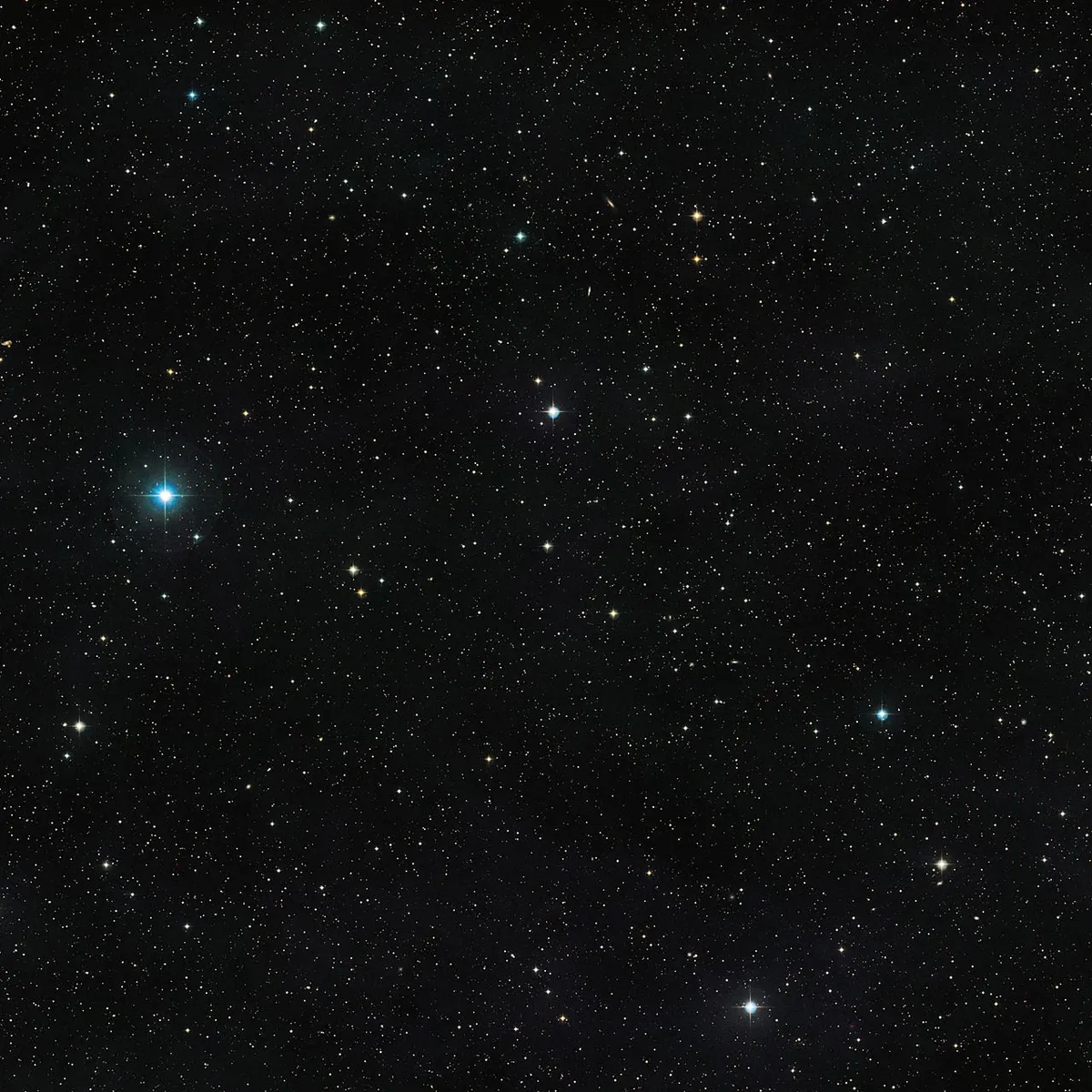
One of these pairs is V471 Tauri, a member of the Hyades star cluster in the constellation Taurus, and is estimated to be about 600 million years old and located about 163 light-years from Earth. The two stars are very close and orbit each other every 12 hours. Twice per orbit, one star passes in front of the other, causing regular changes in the brightness of this pair as seen from Earth, as they eclipse each other. The system consists of a 0.84 M (solar masses) white dwarf and a 0.93 M secondary star.
A team of astronomers led by Adam Hardy (Universidad Valparaíso, Chile) first used the ULTRACAM system, installed on ESO's New Technology Telescope, to measure these brightness changes very precisely. The eclipse timings (known as ETV, eclipse timing variations) were measured with an accuracy better than two seconds (a great improvement over previous measurements).
The eclipse timings were not regular, but could be explained by assuming there was a brown dwarf orbiting them: its gravitational pull would alter the stars' orbits. They also found signs that there might be a second small companion object. Other researchers (Guinan & Ribas 2001) had pointed out that there could be a brown dwarf in the system.
However, until now it had been impossible to image a faint brown dwarf so close to much brighter stars. But the power of the SPHERE instrument, recently installed on ESO's Very Large Telescope, has allowed the team to search, for the first time, exactly where the brown dwarf companion was supposed to be. But they saw nothing, even though SPHERE's very high-quality images should have easily located it.
"There are many scientific papers suggesting the existence of such circumbinary objects, but these results provide us with the painful evidence that contradicts this hypothesis", comments Adam Hardy.
If there is no object, then what is causing the strange changes in the orbit of this binary star? Several theories have been proposed, and although some have already been ruled out, it is possible that the origin of these effects lies in variations of the magnetic field in the larger of the two stars, something we could compare to the (smaller) changes observed in the Sun.
This effect is called the "Applegate Mechanism" (#1) and results in regular changes in the star's shape, which can lead to changes in the apparent brightness of the double star as seen from Earth.
"For many years we have been waiting for a study like this, but we had to wait for new and powerful instruments like SPHERE. This is how science works: observations carried out with new technology can confirm or refute, as in this case, previous ideas. For this incredible instrument, this has been an excellent way to inaugurate its observing life", concludes Adam Hardy.

SPHERE (Spectro-Polarimetric High-contrast Exoplanet REsearch instrument) is basically a coronagraph, meaning it serves to block the central light of a star in order to detect much fainter signals, such as from planets orbiting the luminous object. Put that way, we might think it's a "plug" or a cap to block light. No, it's more sophisticated. It happens that light naturally emitted by stars is unpolarized, meaning the electromagnetic waves oscillate randomly in different directions. But when light is reflected by a surface (like a planet or a dust disk), the reflected waves become partially polarized, meaning they oscillate in a well-defined plane. Polarized sunglasses exploit that property. The difference is that the lenses try to block that polarized light from the sun reflected off surfaces, but SPHERE is designed to detect those signals, using filters.
In science, predictions are not always confirmed. This is a clear example of how the predicted brown dwarf was, presumably, nothing more than a black hole in theory.
The translations of ESO press releases are carried out by members of the ESO Science Outreach Network (ESON), which includes science outreach experts and communicators from all ESO member countries and other nations.
The Spanish node of the ESON network is represented by J. Miguel Mas Hesse and Natalia Ruiz Zelmanovitch.
Sources and related links
- “The First Science Results from SPHERE: Disproving the Predicted Brown Dwarf around V471 Tau”, by A. Hardy et al., Astrophysical Journal Letters, February 18, 2015.
- ESO: The Strange Case of the Missing Brown Dwarf
- Chandra - V471 Tauri: Star Shows It Has the Right Stuff
- #1:Applegate Mechanism: A mechanism for orbital period modulation in close binaries; Applegate,JH.,1992ApJ...385..621A
About the images
- Initial image: Credit: ESO/Digitized Sky Survey 2
- SPHERE: Credit: ESO/J. Girard