Robotic telescopes will be installed in Salta.
Scientists from the Astronomical Observatory of Córdoba and the University of Texas at Brownsville will do it at Cerro Macón, in the Salta Puna, at 4,650 meters above sea level. It is expected to begin operation in September and can be operated remotely via an internet connection. It will work in coordination with teams from the United States and Europe.
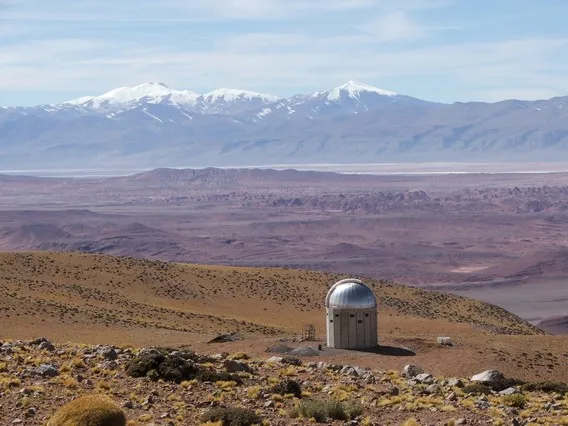
In September, the first telescope of the TOROS project, an acronym for "Transient Robotic Observatory of the South," is expected to begin operation in Salta. Its mission will be to detect powerful stellar collisions in distant galaxies up to 600 million light-years away. The goal? To discover luminous signals that serve as proof of the existence of gravitational waves predicted by the theory of general relativity formulated by physicist Albert Einstein.
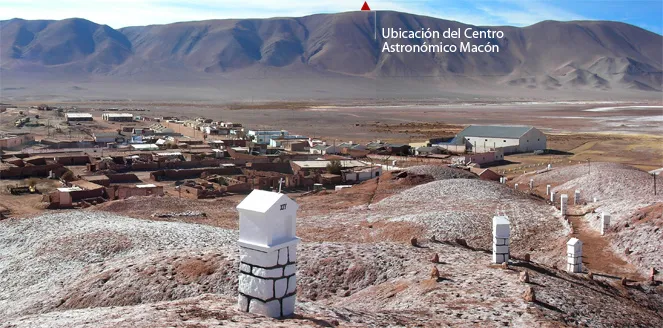
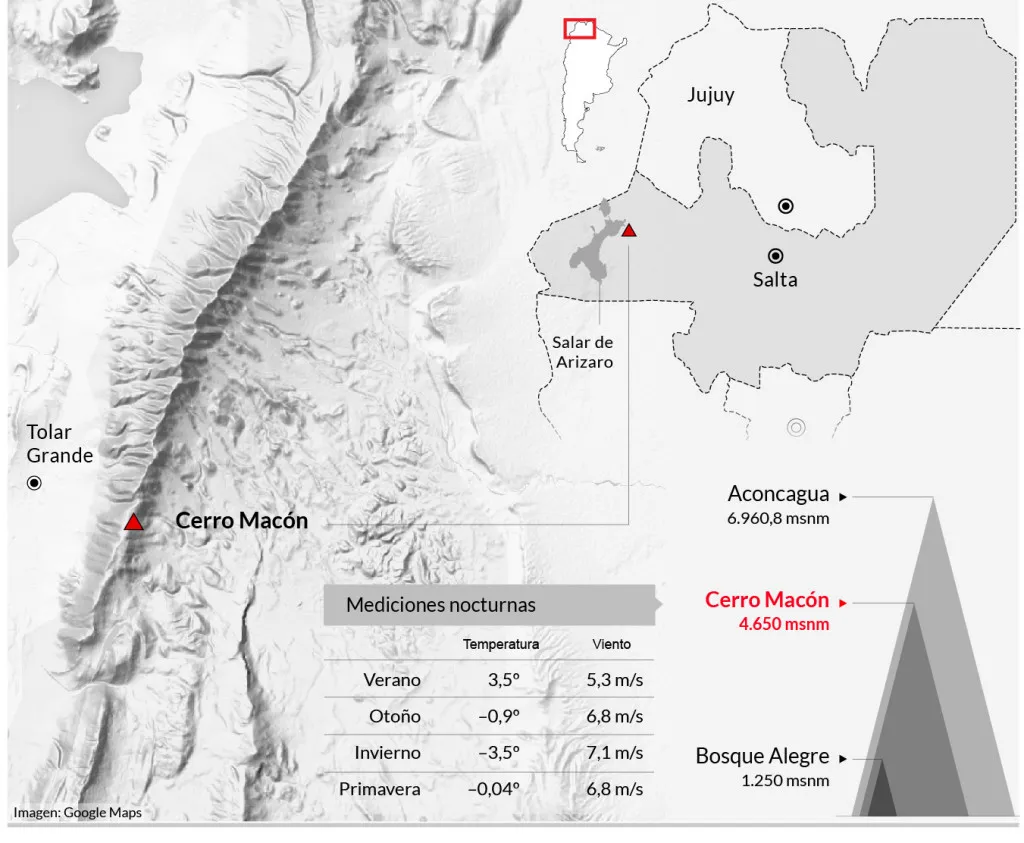
The instrument will be installed at Cerro Macón, in the Salta Puna, at 4,650 meters above sea level. There, scientists from the Institute of Theoretical and Experimental Astronomy (IATE), and the Astronomical Observatory of Córdoba (OAC), studied the conditions and sky quality between 2003 and 2009.
They did so in collaboration with the European Southern Observatory, as the site was one of the candidates to host the European Extremely Large Telescope (E-ELT).
Due to the number of clear nights per year and the altitude of Cerro Macón, the IATE researchers decided to take advantage of the work done and promoted the creation of the "Macón Astronomical Center" there. Three projects are being developed in that space: TOROS (together with the University of Texas at Brownsville, USA); ABRAS (in cooperation with the Institute of Astronomy, Geodesy and Atmospheric Sciences – USP, Brazil); and ISON (together with the Keldysh Institute of Applied Mathematics of the Russian Academy of Sciences, CONAE and the government of Salta)
The first instrument of the TOROS project is a robotic telescope that can be commanded remotely via an internet connection. It is a pilot device with a 16-inch diameter mirror, a CCD camera for taking photographs, and a filter system. It is smaller than the final one, whose installation is planned for 2016. Currently, construction of the enclosure that will house it is being finalized. This infrastructure is the size of an average room and has a roof that moves to allow observation work.
Its task will be to detect a certain type of luminous signals. One of the great predictions of the theory of general relativity indicates that large collisions between massive compact objects – such as neutron stars or black holes – generate gravitational waves. Basically, these are perturbations in the geometry of space-time, which translate into temporary variations in distances or lengths.
Although they would become increasingly faint with distance, these vibrations would initially produce a type of flash that can be captured using astronomical observation techniques.
A neutron star is the end of the life of a type of star. In general, they are not isolated: most have a companion, and in those cases, it is called a "binary star." Although both orbit around a common center, they can eventually collide and merge into a single object. Before merging, they generate gravitational waves, whose optical effect TOROS will try to capture.
In any case, its detection will be carried out jointly with the large interferometers – telescopes that measure light when it interferes with itself – located in the United States and Europe. They would identify the gravitational wave, and its optical counterpart could be observed with the telescope located at Cordón Macón.
The truth is that there is great uncertainty about where this could occur. For this reason, the TOROS telescope will have to explore the sky permanently. In case of an alert, it will have to focus on a specific region of the sky, albeit significant in size, in search of these variable effects.
Macón Astronomical Center
The site where the "Macón Astronomical Center" will operate has the best conditions for observational astronomy. The sky is clear more than 93% of the nights of the year, has little seismic activity, and lacks light pollution due to the distance from large cities. There, the OAC is developing three projects, all in agreement with other institutions. They are TOROS, ABRAS, and ISON.
ABRAS Project
ABRAS (Argentina-Brazil Astronomical Center) is the result of a cooperation agreement between IATE and the Institute of Astronomy, Geodesy and Atmospheric Sciences (USP, Sao Paulo, Brazil). It consists of the implementation of a telescope with a one-meter diameter mirror and an infrared detector (in the near-infrared). It will enable research tasks in different areas, from planetary astronomy to extragalactic astronomy. It will be the highest-altitude ground-based telescope of its kind in the world.
The building and the dome where it will be located have already been built. Twenty prestressed concrete slabs of two tons each were used to form the structure on which the dome rests. The windows will have a robotic opening system to regulate the internal temperature of the enclosure
The company Astrosysteme Austria is in charge of its construction. It expects to deliver it by the end of 2015, so it could enter into operation at the beginning of next year. This project has so far required an investment of approximately one million dollars. Currently, there is no telescope in Argentina with an infrared detector.
ISON International Scientific Optical Network Project
The initiative is expected to start in October. It aims to detect and track the trajectory of asteroids or man-made objects that are close to Earth's atmosphere. To identify that space debris, several small domes will be installed in areas adjacent to the ABRAS building. Inside them, telescopes specially designed for this task will be placed, as they must be fast enough to follow their path.
Ñawi Puna community interpretation and observation center
Finally, in Tolar Grande, a town located 30 kilometers from the site where the telescopes will be, the Astronomical and Geological Interpretation Center, Viewpoint and Astronomical Observatory is currently under construction.
It will be open to the general public and the works are expected to be completed by the end of 2015. Its realization is the result of an agreement between IATE, UNC, the Municipality of Tolar Grande, the government of the province of Salta and Conicet.
Sources and related links
- OAC: OAC to Install a Robotic Telescope in Salta
- TOROS Project University of Texas at Brownsville
- IAG/USP: LABCOSMOS-ABRAS
About the images
- Infographic: Andrés Fernández. Photos: Horacio Rodríguez (OAC)-Diego Julio Ludueña (Unciencia).